Show your support for DORA with one of our spiffing badges 📛: https://sfdora.org/resource/dora-badges/
Now includes a 🆕 badge for those of you who have contributed to our Resource Library!

| Homepage | https://sfdora.org/ |
Show your support for DORA with one of our spiffing badges 📛: https://sfdora.org/resource/dora-badges/
Now includes a 🆕 badge for those of you who have contributed to our Resource Library!
Interested in how research assessment can support better diversity, equity, and inclusion?
We have a specific tag for "Equity and inclusion" in #Reformscape, our tool compiling responsible research assessment policies and practices: https://sfdora.org/reformscape/source-materials/?_tara_assessment_topic=equity-and-inclusion

We have made our biggest update to #Reformscape yet!
We recently added fifteen 1️⃣5️⃣ new institutions and thirty-five 3️⃣5️⃣ new examples of responsible research assessment practices and polices.
(And we fixed a bug 🐜.)
DORA’s guidance on responsible use of quantitative indicators suggests 5 principles, like:
Be specific: How well does the indicator refer to the qualities of the person or the piece of work being assessed? Be mindful of aggregate metrics.
You can hover your mouse cursor over a country to see the raw number of signers and the number per million people. https://sfdora.org/signers/
Enjoy this new look into interest in research assessment reforms! 4/4 🏁
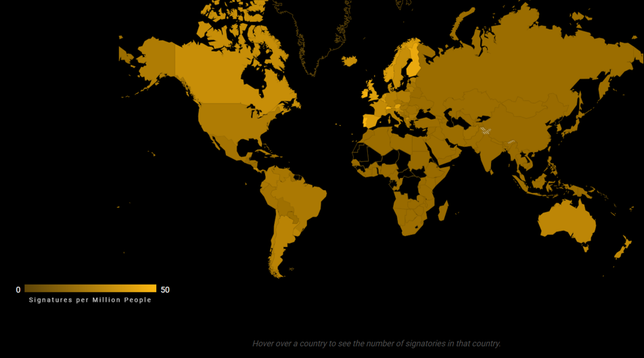
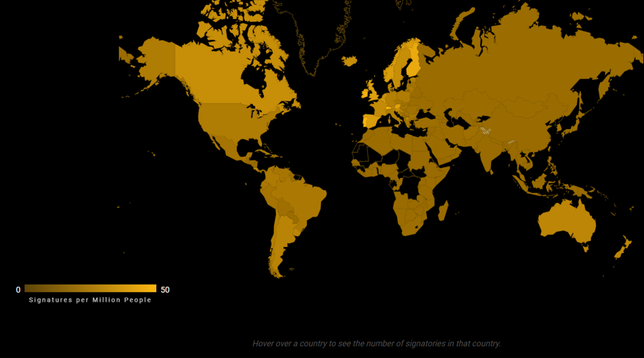
We wanted a map that would give the viewer a better idea 🤔 of where there was more DORA activity.
We scaled it to population so that larger, more populous countries wouldn't dominate the map.
Not as brightly colored but much more informative. 3/4
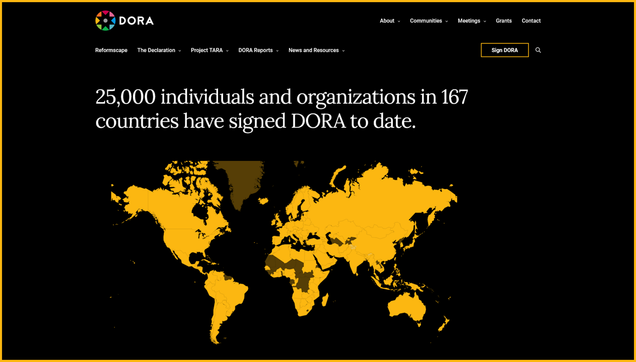
DORA had a map for a long time showing that supporters came from around the world. 🌍
But we reached a point where almost every country had at least one 1️⃣ person sign. It almost looked like DORA conquered the world.
But we knew there was more work to do. 2/4
We made a little improvement to our map 🗺 of DORA signatories on https://sfdora.org/signers/.
Here's why. 🧵 1/4

Duncan E. Wright argues that problems of getting peer reviewers, research fraud, paper mills, predatory journals, and trivial papers are all symptoms of research culture emphasizing quantity over quality.
"Open science arose in response to scientists churning out junk, but junk seems to be what the 'market' that interests scientists still demands."
– Opinion from Nicholas JL Brown on academic "gaming" (quote lightly edited)
The last decade has seen a substantial acceleration in the open science movement, yet it seems that the process of improving the practice of science is moving at a glacial pace. This Perspective explores the misaligned incentives that are hindering progress to more open, reproducible research.

