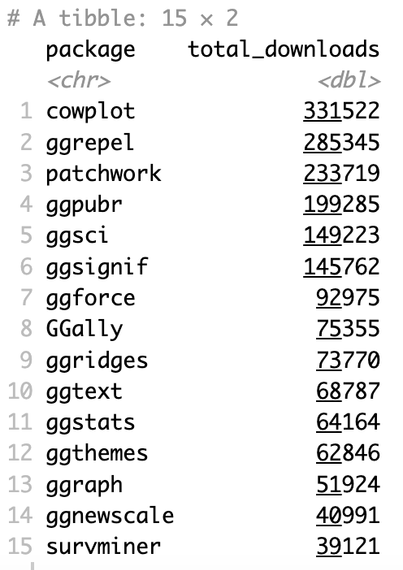
Top 15 ggplot2 extensions, by downloads during the last month.
Some surprises here, at least for me.
Code: https://gist.github.com/carlislerainey/1f7d1da41b7f9715b1e01ebf79d21b9d
Political scientist at FSU. I work on political methodology, mostly Bayesian and computational methods and experimental design.
#poliscitwitter, #econtwitter, #academictwitter, #rstats, #causalinference
| Website | http://www.carlislerainey.com |
| GitHub | https://github.com/carlislerainey |
| https://twitter.com/carlislerainey |
Top 15 ggplot2 extensions, by downloads during the last month.
Some surprises here, at least for me.
Code: https://gist.github.com/carlislerainey/1f7d1da41b7f9715b1e01ebf79d21b9d
“Does Threat Cause Increases in Conservatism? Evidence from Three Large Experiments in the United States Says No”
From Abigail Cassario, Mark Brandt, and Aymin Triki
PsyArXiv Preprint: https://doi.org/10.31234/osf.io/eqznx_v1

"Improving the Teaching of Applied Statistics: Putting the Data Back into Data Analysis"
from Singer and Willet
👇good👍
1️⃣real data
2️⃣context info
3️⃣interesting
4️⃣teaches something real
5️⃣allows many methods
6️⃣raw
7️⃣case ID

"What Good is a Regression? Inference to the Best Explanation and the Practice of Political Science Research"
from Spirling and Stewart
journal: https://doi.org/10.1086/734280

"The value of preregistration for psychological science: A conceptual analysis"
from Lakens
paper: https://www.jstage.jst.go.jp/article/sjpr/62/3/62_221/_pdf/-char/ja

"Preregistration does not improve the transparent evaluation of severity in Popper’s philosophy of science or when deviations are allowed"

"Social media consensus paper causes social media uproar"
link: https://www.science.org/content/article/social-media-consensus-paper-causes-social-media-uproar
original paper: https://osf.io/preprints/psyarxiv/b94dy_v1

new preprint
"On the Foundations of the Design-Based Approach"
from Aronow, Jang, and Offer-Westort

From Weingast's essay "Caltech Rules":
"Papers must focus on one main point. Do not attempt to enrich your paper with many
asides... It is far better to have a narrow, focused, and useful paper than a rich one that is ignored."
Link to essay: https://weingast.people.stanford.edu/caltech-rules-writing
From Weingast's essay "Caltech Rules":
"With rare exceptions, papers do not write themselves. Transforming a good idea into a good paper is a difficult process. A clear understanding of what each part of your paper must accomplish is essential to this process."
Link to essay: https://weingast.people.stanford.edu/caltech-rules-writing