
- 0 Followers
- 0 Following
- 2 Posts
Putting aside the sneering and philosophy to nerd for a minute, before getting back to it.
For a long time people were very into the split-consciousness notion of what happened to split-brain people, but a couple things have come around and now some people really think that the better way of thinking of it is still-unitary consciousness with a very difficult time moving around information between different sensory/expression modalities.
First, you get people who are born without a corpus callosum who are behaviorally normal (www.tandfonline.com/doi/…/13554794.2013.826690). They get a bit of extra connectivity sidways through their deep brain structure as some kind of homeostatic compensation, but the total amount is definitely low. What this says is there’s a difference between a brain that grew under a very unusual set of structural constraints, and one that grew normally that gets shredded. Similar with those people you find now and then with a brain that’s 90% fluid (though with the actual cortex pushed up against the skull around a big bubble of CSF) and the only neurological findings are things like weakness in one leg and an IQ of 80 (worth noting that this is still very very different from hydranencephaly) (www.thelancet.com/journals/lancet/…/fulltext).
Second, when you do a wider range of experiments with the split brain people you find that while they cannot verbally say what is in their left visual field (which goes to the right side, while language is usually a left-side phenomenon) they can reliably state that something is there with speech, or either hand, and approximately where in the visual field it is. The low bandwidth awareness of presence is there, but they cannot get their speech capacity to access the details. It’s like their sight is now multiple separate sensory modalities, some of which is very difficult to talk about and some of which are very difficult to draw with particular hands.
uva.nl/…/split-brain-does-not-lead-to-split-consc…
academic.oup.com/brain/article/140/5/…/2951052
People argue a lot about what this means
www.sciencedirect.com/…/S0028393221002402
You can also apparently reorganize around very small amounts of remaining fibers to have no deficits like that, with no issues talking about anything in either part of the visual field
news.ucsb.edu/…/new-findings-split-brain-science-…
Now, getting out of the nerd mode, there’s a LOT of weird literature from the 60s to 80s about people with very strange brain anatomy who nonetheless developed normally or better than expected
…wiley.com/…/j.1469-8749.1965.tb07839.x
“Two cases of hydranencephaly are described in infants. In both these there was evidence of excessive intracranial pressure-as is often the case-and both were operated on to relieve this. The progress of the older child, now 21 months of age, was throughout excellent physically and mentally, and he is considered to be normal. The progress of the second infant was remarkably good for three months, but thereafter mental retardation and spasticity followed; he was also blind. There is no good explanation for the unexpectedly good progress of the first patient.”
www.science.org/doi/10.1126/science.7434023
…the most severe group, in which ventricle expansion fills 95 percent of the cranium. Many of the individuals in this last group, which forms just less than 10 percent of the total sample, are severely disabled, but half of them have IQ’s greater than 100. This group provides some of the most dramatic examples of apparent ly normal function against all odds. Commenting on Lorber’s work, Kenneth Till, a former neurosurgeon at the Great Ormond Street Hospital for Sick Children, London, has this to say: “Interpreting brain scans can be very tricky. There can be a great deal more brain tissue in the cranium than is immediately apparent.” Till echoes the cautions of many practitioners when he says, "Lorber may be being rather overdramatic when he says that someone has ‘virtually no brain.’ "
Anybody ever read the short story “Cutie” by Greg Egan? Very apropos…
technologyreview.com/…/r3-bio-brainless-human-clo…
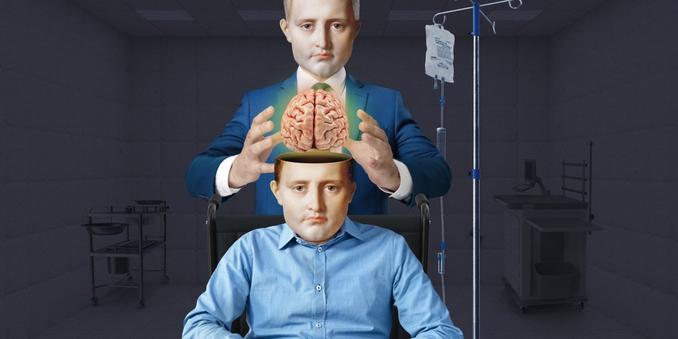
Imagine it like this: a baby version of yourself with only enough of a brain structure to be alive in case you ever need a new kidney or liver.
Or, alternatively, he has speculated, you might one day get your brain placed into a younger clone. That could be a way to gain a second lifespan through a still hypothetical procedure known as a body transplant.
The fuller context of R3’s proposals, as well as activities of another stealth startup with related goals, have not previously been reported. They’ve been kept secret by a circle of extreme life-extension proponents who fear that their plans for immortality could be derailed by clickbait headlines and public backlash.
And that’s because the idea can sound like something straight from a creepy science fiction film. One person who heard R3’s clone presentation, and spoke on the condition of anonymity, was left reeling by its implications and shaken by Schloendorn’s enthusiastic delivery. The briefing, this person said, was like a “close encounter of the third kind” with “Dr. Strangelove.”
A key inspiration for Schloendorn is a birth defect in which children are born missing most of their cortical hemispheres; he’s shown people medical scans of these kids’ nearly empty skulls as evidence that a body can live without much of a brain.
And he’s talked about how to grow a clone. Since artificial wombs don’t exist yet, brainless bodies can’t be grown in a lab. So he’s said the first batch of brainless clones would have to be carried by women paid to do the job. In the future, though, one brainless clone could give birth to another.
Last Monday, the same day it announced itself to the world in Wired, R3 sent us a sweeping disavowal of our findings. It said Schloendorn “never made any statement regarding hypothetical ‘non-sentient human clones’ [that] would be carried by surrogates.” The most overarching of these challenges was its insistence that “any allegations of intent or conspiracy to create human clones or humans with brain damage are categorically false.”
My ‘no conspiracy to create humans with brain damage’ shirt is making people ask a lot of questions
But if space was a place that replicators could exist, there would already be an ecology of some sort there. Or to put it in words (that I hate) related to the so-called Fermi paradox (which I hate and isn’t a paradox) ‘If they could be here they already would be here’. (The ‘solution’ incidentally is obviously ‘interstellar travel is not actually a thing that can happen for replicating systems’ and it flabbergasts me that nobody can admit that.)
But space is The Future, The Grand Destiny of Humanity, Literal Heaven.
The mythologization of space as somehow transcendant, that going there somehow changes everything rather than it just being another environment which happens to be utterly inimical to life such that everything that makes anything possible has to come from your point of origin, is so utterly ingrained into the culture at large and the cult of progress/tech/humanity-as-master-of-the-universe. Once you see it you cannot unsee it. And it’s incredible how much space SUCKS, such that the people on the ISS are just living off a constant hose of material from Earth. They’re not living in space, they’re glamping.
I just ran a test and after a few google-gemini-assisted searches about satellite launch rates and a few back and forth questions about orbital debris and relative masses of different spacecraft, I was able to evoke from gemini a massive unhinged rant about orbital goblins and their culture and effects on the global climate with a single instance of the word “Goblins!” at the end of a prompt.
This would actually be an interesting question for the more rigorous end of the mechanistic interpretability people to study. They decompose the system to find ‘features’ within different layers that are associated with different behaviors or concepts in the inputs and outputs, that activate or deactivate each other. Famous example being the time they identified a linear combination of activations in a layer that corresponded to ‘the golden gate bridge’ and when they reached in and kept their numbers high during the running of the model it would not stop talking about it regardless of the topic, even while acknowledging that its answers were incorrect for the questions at hand.
I actually would love to see what mechanistically happens to that feature when you put in the input ‘do not talk about the golden gate bridge’.
Checks out. Political science, biological science, physics… we got them all. Might have to go to ancient egypt to get hydrology religion though.
So we are inferring that in the vector space of all possible sentences, QNTM is sitting at one of the attractors?