
destroy gender, create memes
I rant about anarchism a lot

destroy gender, create memes
I rant about anarchism a lot
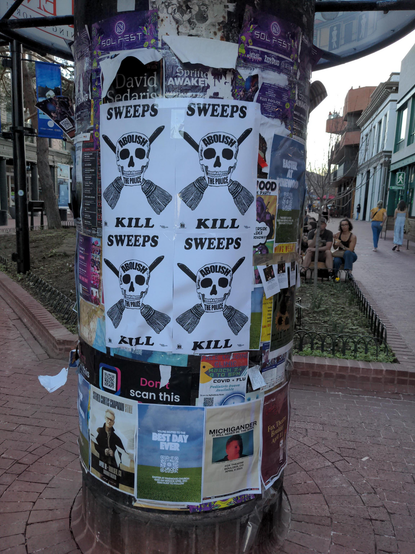
Our street team put up 56 more posters on the Pearl Street Mall printed on reclaimed paper.
Graphics by Western Regional Advocacy Project
WRAP works with artists to put ideas into visual form and carry our message directly to the viewer. This artwork is created as part of our ongoing housing and civil rights campaigns. You are free to use them too. We just ask that you credit WRAP and share your work with us. Creative Commons License
So what was the point of this massive rant beyond proving that I have way too much free time at my job and that I have an autistic hyperfixation on anarchist theory?
I think this is an interesting example of how ideas spread and proliferate in radical spaces, especially in a time period where the internet was just beginning to better connect people and ideas. I used the word "plagiarize" in my rant somewhat tongue in cheek, as I'm sure that the pseudonymous authors of these various zines wouldn't actually mind that much that their ideas are getting out there more. It's interesting seeing how the same ideas and passages get reworded and repurposed for different zines over the span of over 20 years, and are still being handed out by people that are probably unaware of this convoluted history.
It also shows the importance of preservation, and of the internet archive especially. This weird rabbit hole I went down on would have been pretty much impossible, or at least much more difficult, without the internet archive, and while charting out the origins of a few random anarchist zines isn't of monumental importance, being able to research how ideas proliferate and originate is extremely important, and far easier with the use of archives like the Internet Archive. The fact that it may be sued out of existence is seriously such a loss for our ability to access knowledge freely and accessibly
I'm currently going crazy from the rabbithole of insurrectionary anarchist zines copying from each other. I'm reading Organizing For Attack! insurrectionary anarchy, which best I can tell is taken from the British eco anarchist journal Do or Die. While reading it, I noticed that some of it is copied from Some Notes on Insurrectionary Anarchism by Sasha K, which was originally published by Killing King Abacus. Weirdly enough, the same zine(and I'm pretty sure some of the same exact passage) is copied in Insurrectionary Mutual Aid by the Curious George Brigade(which is a wonderful zine that I highly recommend). I'm also pretty positive that the beginning of organizing for attack copies, or was copied by, some other insurrectionary anarchist zine I've read, but I'm not sure which and I'm too lazy to go through my stack of zines to find out which(assuming that it's even a zine I have a physical copy of). Weirdly enough, I also have a zine in my collection(that I think came from Filler Distro) that's a compilation of both Some Notes on Insurrectionary Anarchism and Without a Trace, the latter of which is originally published with Organizing For Attack. The tangled web of zines that have influenced or were plagiarized by other zines is so convoluted here.
It's taken a bit of sleuthing to figure out whether Some Notes on Insurrectionary Anarchism or Organizing For Attack was the original. It's pretty hard to find too much online info about either publication online, most of the info online is saved on the internet archive or various other articles on places like Libcom or the anarchist library. As a side note, I'm pretty sure whoever put together the specific copy of Organizing For Attack just copied the text from the internet archive, cux there's some weird formatting issues that make more sense in that context. Killing King Abacus and Do or Die existed more or less in the same time period, although the former is American and the latter British. Internet Archive clames Organizing For Attack came from issue 10 of Do or Die, which according to libcom.org, was published in 2003. IA also claims that some notes on insurrectionary anarchism was first published in 2001, which libcom also backs up.
I honestly wonder if this rabbithole goes any deeper, and kind of get the sense that English language insurrectionary anarchist theory is just 3 zines in a trenchcoat endlessly repackaged and reworded from obscure 2000s era journals.
I humbly suggest that everyone who fed-jacketed Hridindu Sankar Roychowdhury because of their alleged graffiti hand-style—from the blowhards at Chapo Trap House, to the dozens of Twitter hot take machines, even to friends in my local anarchist milieu— owes a contribution to a legal support fund that supports them, and vocal support at least as loud as the conspiracy theorizing they engaged in.
In two stories about law enforcement infiltration during the George Floyd uprising, @theintercept has referenced our work without attribution.
In their story about Mickey Windecker, we are simply referred to as "an antifascist activist group in Colorado Springs," despite playing a significant role in this story by blowing Mickey's cover and being on the receiving end of his copjacketing.
https://theintercept.com/2023/02/07/fbi-denver-racial-justice-protests-informant/
In the recent story about CSPD undercover April Rogers, we broke the news about her trying to entrap leftists with illegal firearms sales a year ago, but that is never mentioned.
https://theintercept.com/2023/03/21/fbi-colorado-springs-surveillance/
Journalists and editors love to benefit from antifascist work but are often too afraid to credit us when it comes time to publish.
Fashion Tips for the Brave
https://crimethinc.com/2008/10/11/fashion-tips-for-the-brave
Blocs, Black and Otherwise
https://crimethinc.com/2003/11/20/blocs-black-and-otherwise
How to Form an Affinity Group
https://crimethinc.com/2017/02/06/how-to-form-an-affinity-group-the-essential-building-block-of-anarchist-organization
Staying Safe in the Streets
https://crimethinc.com/2014/08/14/staying-safe-in-the-streets
The Femme's Guide to Riot Fashion
https://crimethinc.com/2017/10/16/the-femmes-guide-to-riot-fashion-this-seasons-hottest-looks-for-the-discerning-anarchist-femme
A Demonstrator’s Guide to Understanding Police Batons
https://crimethinc.com/2020/12/15/a-demonstrators-guide-to-understanding-police-batons-and-how-to-protect-against-them
A Demonstrator’s Guide to Understanding Riot Munitions
https://crimethinc.com/2021/01/04/a-demonstrators-guide-to-understanding-riot-munitions-and-how-to-defend-against-them
A Demonstrator’s Guide to Body Armor
https://crimethinc.com/2020/12/15/a-demonstrators-guide-to-body-armor-protecting-yourself-against-blows-batons-bullets-and-more
A Demonstrator’s Guide to Responding to Gunshot Wounds
https://crimethinc.com/2020/09/24/a-demonstrators-guide-to-responding-to-gunshot-wounds-what-everyone-should-know
A Demonstrator’s Guide to Gas Masks and Goggles
https://crimethinc.com/2020/09/02/a-demonstrators-guide-to-gas-masks-and-goggles-everything-you-need-to-know-to-protect-your-eyes-and-lungs-from-gas-and-projectiles
A Demonstrator’s Guide to Helmets
https://crimethinc.com/2020/09/01/a-demonstrators-guide-to-helmets-everything-you-need-to-know
Tools and Tactics in the Portland Protests
https://crimethinc.com/2020/08/03/tools-and-tactics-in-the-portland-protests-from-leaf-blowers-and-umbrellas-to-lasers-bubbles-and-balloons
Protocols for Common Injuries from Police Weapons
https://crimethinc.com/2020/06/08/protocols-for-common-injuries-from-police-weapons-for-street-medics-and-medical-professionals-treating-demonstrators
Over on Twitter people are speculating as to why Americans don't fight back the way the French do.
They're all forgetting that in 2020, tens of thousands of people did fight back, many of whom are doing prison time.
Don't forget those people, supporting them plants the seeds of future revolts.
I've been thinking quite a bit lately about how the refusal or inability to engage with problematic texts/figures from the past potentially contributes to an over-optimistic/rosy view of queer history -- one which aligns with a liberal vision of linear progress (i.e., yeah, LGBT people in the past were oppressed, but things got better over time and now we have general equality, even if some things are still bad).
And it's like... 1.) That's not how history works. It's not a linear progression from total oppression to total liberation, but is way more uneven and fractured. Queer people in the past weren't totally repressed or dominated, and Queer people today aren't entirely equal and liberated;
2.) Any "progress" made for queer people over the last 60 years has been the result of the concerted effort of queer people and activists, and long protracted struggles -- a fact which the linear/progressive view of history covers over;
and 3.) The long, protracted struggles and battles that queer people engaged in to get to the point we're at now also involved conflicts and contestation between queer people themselves. Like, not all queer people were in favour of Gay Liberation after Stonewall. And the lesbian feminist movement of the 70s and 80s involved a TON of conflict and disagreement over literally EVERYTHING. But if we just engage with the ideas that won out in the end, or that are palatable to us today, we ignore all of that contestation and just fall back into the same pattern of viewing history as a smooth, linear trajectory of progress. We also risk thinking of queer and LGBT people (of both the past and present) as a kind of monolith of shared interests and ideas, which again ignores the very real difference between like radical queer activists and mainstream gay assimilationists.
I dunno. I just think people need to be more willing to engage with past thinkers and ideas, even if they are problematic or unpalatable.
Have been doing community organizing work for almost a decade and I am always floored by the people who bring praxis that spans generations of deep knowledge and experience.
Those rad add ass comrades who put together events with childcare, food, focus on accessibility, flexibility, relationship-building, community care, non-hierarchical information sharing... this shit is sacred.
Many blessings to the people looking to generations past and future to drive the essence of your work. Absolutely here to learn from, and collaborate with, that kind of intentionality