 Allison Parrish
I have a vague goal of doing daily or at least regular typography experiments here in 2018, here's day one: applying perlin noise to positions of points along the path of the text #typography https://mastodon.social/media/P-VAKr6F5x5QeQitrTE
in the same vein more or less, hmm. probably not that much more of interest can be done with just having a list of x, y coordinates https://mastodon.social/media/Y24AHCBl_AfnIPBiOy4
each point in one word moves to the nearest point in the next word https://mastodon.social/media/b-32WNDAFvd9XDXbM0A
adding a bit of randomness into the distance function... https://mastodon.social/media/-frlr0-lViTLcsO6EAY
based on yesterday's code, here's the entire alphabet (uppercase and lowercase) with each letter's points a little more than halfway lerped to the next https://mastodon.social/media/WsrdYvLeDyuV7MXCTWM
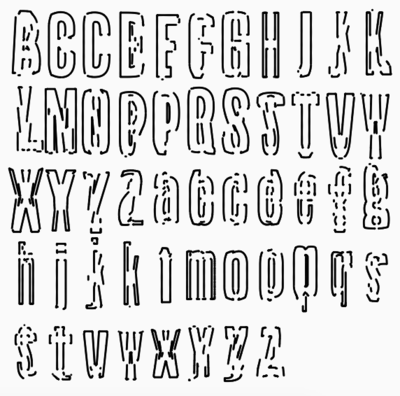
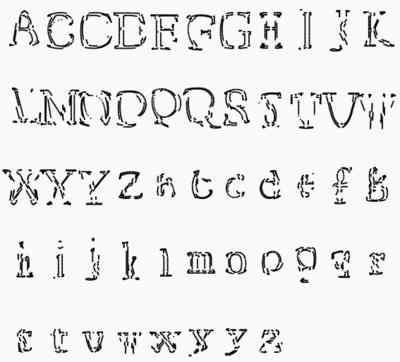
perhaps not surprisingly, a little less successful with a delicate serif font https://mastodon.social/media/sh4XjS9VxO7UmLWFgME
again building off the same code, a matrix showing all possible halfway-interpolations between points in the letters (i.e., top row is (A+A)/2, (A+B)/2, (A+C)/2, etc.) (matrix is not symmetric because letters have different numbers of points)
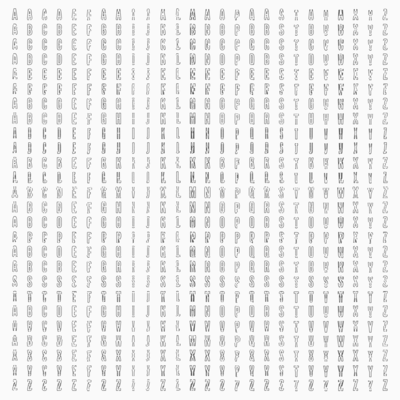
hi-res here since mastodon downsampled it http://static.decontextualize.com/alphabet-lerp-matrix-2018-01-07.png
today: speculative letterforms made from stitching together top/bottom halves of randomly rotated letters (I have more ambitious ideas for this, just trying to do some foundation work today) https://mastodon.social/media/IqrbvTrThNYXQkt8jrs
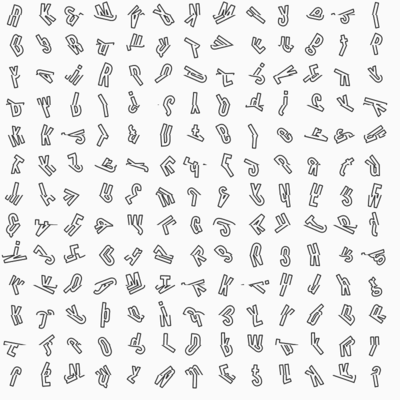
continuing this experiment: trying to match top halves to bottom halves based on how similar the points are through their horizontal center line (also fixed the rotation here to increments of π/8 radians) https://mastodon.social/media/JTU2hQbVTvoqYYC1Szc
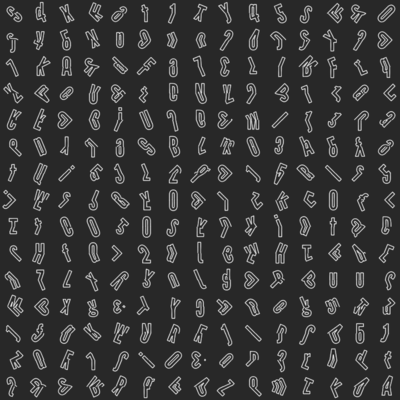
stringing together middle segments of letterforms based on similarity at the top and bottom of the segments https://mastodon.social/media/gvRrkTRdANymacTOuFI
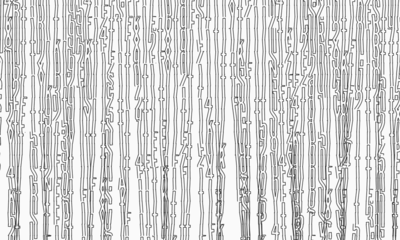
(has some random rotation on the points of the letterforms themselves and on where each segment is drawn beneath the previous)
little experiment with animating this (reeeeally need to start doing all of this in webgl so I can get decent framerates) https://mastodon.social/media/u8A3eQR29dlibPKx0EA
back to perlin noise experiments, setting offsets and line thickness with thresholds https://mastodon.social/media/VZ8iUyK3ysVjh2xk63s
trying to figure out three.js. I am really not used to working with scene graphs https://mastodon.social/media/GquowEs33Gj5qrNuKaY
I keep on posting examples that look the same, but this one was made with a completely different set of tools: opentype.js -> svg-mesh-3d -> p5.js (kind of a hassle to get working tbh but will hopefully be wayyy more versatile for these experiments moving forward) https://mastodon.social/media/Mwq4ZesNa2DTzAv2_Qo
much smoother with the webgl renderer in p5.js but I need to figure out why it's drawing these extraneous lines. tomorrow i guess https://mastodon.social/media/-eQ4kYNUiHtKXISv7Vc
 Luis
Luis@aparrish is p5.js your preferred framework/library? I've tried a few of the Ruby versions of processing (JrubyArt, propane) but never quite got them working right. I have tried p5.js, processing and even paperscript.js. I'm simply not too fond of working in JS.
@luisroca oh I hate working in javascript, it's a truly lousy language with lousy toolchains. I do like p5js, though, for certain applications (interactive sketches where you don't want or need a scene graph). p5js is also the framework that my department uses for the intro programming classes (which I teach), so another benefit of using p5js for my own experiments is that I can easily incorporate them into tutorials for my students