Just in case you missed it: The Shadow Brokers has published a rant and the password for their tool dump.

https://medium.com/@shadowbrokerss/dont-forget-your-base-867d304a94b1

Password for c&p is:

CrDj"(;Va.*NdlnzB9M?@K2)#>deB7mN

Files, for those needing them, at:

https://pastebin.com/hur8kVYM

(thanks to @kript3ia for reminding me)

For someone definitely active in the 90s this Equation Group dump is exactly as described by @osxreverser: a trip down memory lane.

There's exploits for Apache running on Linux for DEC Alpha, Netscape Enterprise Server, RedHat 5.x and stuff that you probably haven't heard except in "greybeard's storytime".

If you wander over to the birdsite @osxreverser is posting headers of all the interesting exploits he finds.

There is also an OpenSSH one (KWIKEMART): https://twitter.com/osxreverser/status/850678952138067969

# KWIKEMART
###################################3
# SSH-1.5-1.2.27
# SSH-1.5-OpenSSH-1.2.3
# SSH-1.99-OpenSSH_2.1.1
# SSH-1.99-OpenSSH_2.2.0

So, KWIKEMART, in /bin/km (not found source yet) has pearls such as the following in its strings:

echo CHRIS CHRIS
No Crash, might have worked
Reply from remote: %s
CHRIS
No Chris not found and since we can't live without her .. searching on
error on read, continuing

It looks suspiciously like we might have to RE them all to find out if the holes are all patched...

Oh, this is interesting (but expected):

#######################################
### ELITEHAMMER
#######################################
### Runs against RedFlag Webmail 4 (software install)
### Gives you user nobody, not root;
### Need a local to get root (EVENTSTART or ELASTICBANJO?)
### Webmail port is usually 80 or 443

For ref: Red Flag Linux is a, now defunct, Chinese distribution (see https://en.wikipedia.org/wiki/Red_Flag_Linux)

Another adorable "from the past" entry, interesting choice of name (CICADA, see https://en.wikipedia.org/wiki/Cicada_3301 and engage your conspiracy theories):

#########################################################
# ELVISCICADA
#########################################################
### only up to ealry Sol2.9; Sol2.10 not vulnerable

### snmpXdmid (/usr/lib/dmi/dmispd) daemon program (RPC program 300598 version 1)

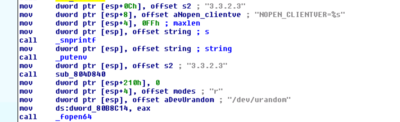
A little bit of "obvious" is that they have a remote backdoor called NOPEN... I have not seen it mentioned yet but basically almost every tool's aim is to drop NOPEN.

Unsurprisingly "NOCLIENT" seems to be the C2 side of "NOPEN"

@cynicalsecurity https://mastodon.social/media/Ey30sAT5BM0u8uP7YaU

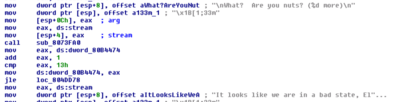
Some of these strings. Can't say NSA folks lack a sense of humour.

"It looks like we are in a bad state, Elvis has left the building"

@cynicalsecurity https://mastodon.social/media/wQbYgZv8mNsuWa9pqQw

Anyone has any clue about what INCISION mode might be?
@cynicalsecurity
@kwanre @cynicalsecurity From the references in the dump it looks like that is another implant, doing things like file hiding "HP-INCISION provides process and file hiding". That one seems targeted at HPUX (more dinosaurs...).
@orionwl @kwanre @cynicalsecurity there are a lot of other references to INCISION - e.g. in Linux/doc/old/etc/user.mission.sicklestar.COMMON, references to INCISION 'trigger' and 'callback' ports on both Windows and Linux
@puellavulnerata @orionwl @kwanre yes, that is true but this looks like a very specific telco-oriented staging server, at least to my eyes. Lots of references to CDRs and Oracle on HP-UX was a telco classic.
@cynicalsecurity @orionwl @kwanre yeah, agreed on that interpretation - the references to finding IMEIs with multiple IMSIs seem like a pretty clear pointer to what they were up to with this
@puellavulnerata @orionwl @kwanre I am focusing on trying to locate GRX-specific or GSM/UMTS-specific (we are pre-LTE...) information.