Capitalism is a system in which some people, called capitalists, own the power to permit or deny other people permission to labor productively.

You’ve probably encountered a version of this definition that goes something like “private ownership of the means of production.” And that version isn’t bad, but it makes it seem like the thing that really matters is “the means of production,” the stuff we use to make more stuff. But what really matters in capitalism is that power to grant or withhold permission to others to labor productively.

Capitalism is, at its heart, not about stuff. It’s about social relationships and it’s about *sabotage*.

1/
Capitalism is unique among exploitive economic systems in that its exploitation is purely economic.

In most other exploitive systems, exploitation is extra-economic. This means that exploiters possess some legal rights to take directly from their subordinates through the direct threat of violence. Enslavers might possess the legal right to torture of murder enslaved people to force them to labor; feudal lords might possess the right to demand rents, labor service, and fees directly from their tenants.

But capitalists possess no formal, legal right to directly threaten their subordinates in order to exploit them. Instead, capitalists use purely a economic means, and that is *sabotage*.

2/

We have economist Thorstein Veblen to thank for his insight into the social relationship at the heart of capitalism.

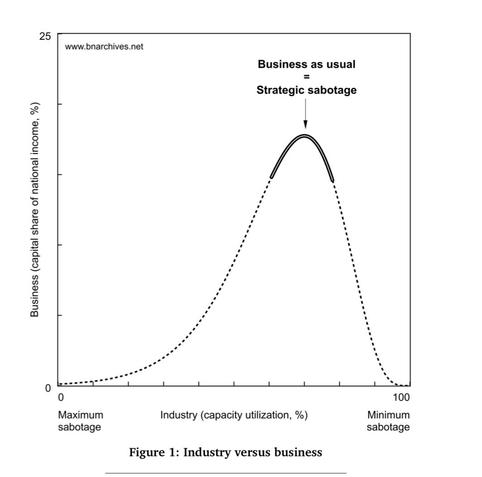
Veblen understood that there were two sides to capitalist economic production, which he named “industry” and “business.” The goal of industry, the workers actually making things, is to quickly and efficiently meet the needs of the public. The goal of business, the capitalists who own industry, is to generate profits. Business generates profits, Veblen realized, by interfering with industry—a process he labeled “industrial sabotage.”

People who have their needs quickly and efficiently met don’t have much of a reason to keep buying things, or to pay high prices for the things they want. So business—capitalists—need to make sure people do not have their needs quickly and efficiently met.

3/

This plays out in all sorts of ways that you’ve probably encountered in your daily life. Sometimes, capitalists sell products that are deliberately intended to wear out quickly and require frequent replacement, a tactic known as “planned obsolescence.” Sometimes, a product is deliberately made worse in order to sell the same product at multiple price points, a tactic known as “product crippling.” Sometimes, capitalists deliberately destroy useable products they failed to sell at their desired price rather than allowing them to be sold at a cheaper price.

I just came across this Bloomberg article today about capitalists attempting to offload their investments in solar power production in Spain because they accidentally made solar power too abundant. They did too good a job; there’s simply too much cheap, clean electricity. People’s needs are being met. They can’t turn a profit.

https://archive.is/uzAwG

4/

The most pervasive and important form of sabotage, though, is unemployment.

Human beings need to eat. When left to our own devices, we tend to feed ourselves through our own labor, usually in voluntary cooperation with other people. We hunt, gather, fish, farm, or, more likely these days, labor to meet the needs of people who do produce food in return for the food they produce.

But we can only feed ourselves when we either have unimpeded access to the means of laboring productively, or when we have *permission* from people who own access to those means.

When we don’t have either unimpeded access or permission from owners, we die—not because we lack the capability to labor productively, but because we’re prevented from doing so.

5/

Most of us do not have unimpeded access to the means of laboring productively. This is because virtually everything in the world that could be used productively is already owned by someone else—a capitalist. Farmland, forests, mines, factories, and all the classical industrial “means of production,” but also everything from the schools in which we might learn how to labor to the very ideas about how to labor in particular ways, hidden being intellectual property claims.

And, of course, the production of money and credit, the process by which we might pool our resources together if we were free to do so.

So instead of laboring freely, we must gain permission from owners. Without that permission, we die—from hunger, or disease, or starvation. Or we live miserable lives of enforced precarity on the margins of society. In short, we are *sabotaged,* prevented from laboring and living as we might choose.

6/

Medieval peasants might labor all year to produce a harvest and then turn over a share of it, each autumn, to their feudal lord as “rent.”

Workers under capitalism do much the same, working to generate incomes from customers. But instead of keeping that income and paying a share as rent—which would make the process obvious—those workers don’t collect any of that income. Instead, the capitalist owner collects all of it and then doles some back out as wages, making it appear as if the workers’ income comes from the capitalist.

But the end result is the same: workers labor productively, generate something of value, and pay a share of it to an owner in return for permission to remain alive a bit longer. Capitalism just relies on a titanic bait-and-switch to hide these rent payments.

7/

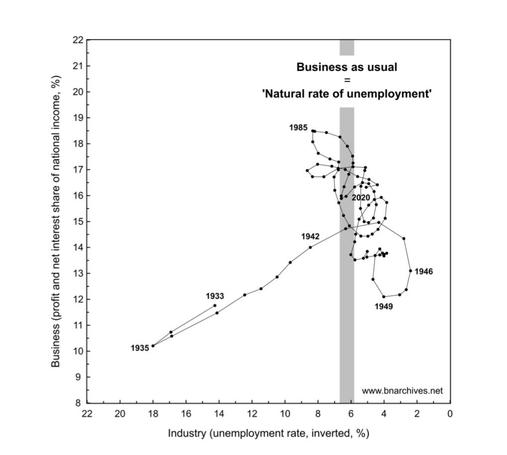
Building on Veblen’s work, economists Shimshon Bichler and Jonathan Nitzan set out to discover whether there is an optimal rate of sabotage in capitalism that maximizes capitalist profits.

If capitalists gave every worker permission to labor, then workers would have little incentive to turn over their revenues in return for a fraction back as wages. But if capitalists gave no worker permission to labor, then there would be no economic activity to extract rents from. So, capitalists must aim for an ideal unemployment rate that puts some fear into workers while still maximizing productive output.

And that’s just what Bichler and Nitzan found! In the US, at least, an unemployment rate of around 6-7% corresponds to capitalists capturing their highest share of national income:

https://bnarchives.net/id/eprint/760/

8/

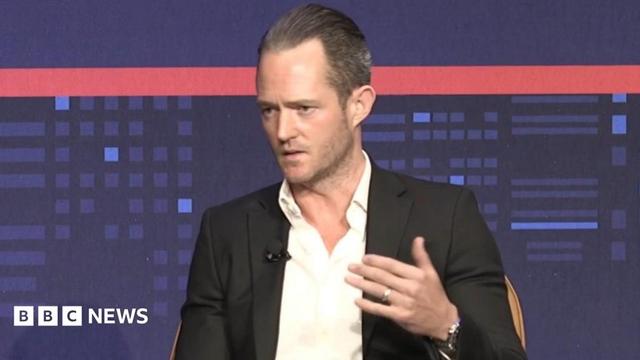
Sometimes, capitalists just tell us this explicitly and verbatim. Back in 2023, an Australian capitalist advocated for a higher unemployment rate—he wanted it to grow from 3.7% to something closer to 6%—to humble workers whom he believed had grown too arrogant and demanding in their relationships with capitalists.

https://www.bbc.co.uk/news/business-66803279

We don’t even need those fancy graphs by Bichler and Nitzan! Sometimes capitalists just come right out and say it! The point of unemployment is to discipline workers. It is to *sabotage* their ability to labor productively so that other workers can see how unpleasant it is to be denied permission to labor productively. In this way, those workers will be more obedient and more willing to pay their rents.

9/

Tim Gurner apologises over call for more unemployment to fix worker attitudes

Tim Gurner backtracks over his call for "pain in the economy" to remind people they are lucky to have jobs.

BBC News
@HeavenlyPossum Which is why the share market usually reacts positively to an increase in unemployment. The more desperate drones out there, the less the owners can pay them and the more profit they can make as a result.