Capitalism is a system in which some people, called capitalists, own the power to permit or deny other people permission to labor productively.

You’ve probably encountered a version of this definition that goes something like “private ownership of the means of production.” And that version isn’t bad, but it makes it seem like the thing that really matters is “the means of production,” the stuff we use to make more stuff. But what really matters in capitalism is that power to grant or withhold permission to others to labor productively.

Capitalism is, at its heart, not about stuff. It’s about social relationships and it’s about *sabotage*.

1/

Capitalism is unique among exploitive economic systems in that its exploitation is purely economic.

In most other exploitive systems, exploitation is extra-economic. This means that exploiters possess some legal rights to take directly from their subordinates through the direct threat of violence. Enslavers might possess the legal right to torture of murder enslaved people to force them to labor; feudal lords might possess the right to demand rents, labor service, and fees directly from their tenants.

But capitalists possess no formal, legal right to directly threaten their subordinates in order to exploit them. Instead, capitalists use purely a economic means, and that is *sabotage*.

2/

We have economist Thorstein Veblen to thank for his insight into the social relationship at the heart of capitalism.

Veblen understood that there were two sides to capitalist economic production, which he named “industry” and “business.” The goal of industry, the workers actually making things, is to quickly and efficiently meet the needs of the public. The goal of business, the capitalists who own industry, is to generate profits. Business generates profits, Veblen realized, by interfering with industry—a process he labeled “industrial sabotage.”

People who have their needs quickly and efficiently met don’t have much of a reason to keep buying things, or to pay high prices for the things they want. So business—capitalists—need to make sure people do not have their needs quickly and efficiently met.

3/

This plays out in all sorts of ways that you’ve probably encountered in your daily life. Sometimes, capitalists sell products that are deliberately intended to wear out quickly and require frequent replacement, a tactic known as “planned obsolescence.” Sometimes, a product is deliberately made worse in order to sell the same product at multiple price points, a tactic known as “product crippling.” Sometimes, capitalists deliberately destroy useable products they failed to sell at their desired price rather than allowing them to be sold at a cheaper price.

I just came across this Bloomberg article today about capitalists attempting to offload their investments in solar power production in Spain because they accidentally made solar power too abundant. They did too good a job; there’s simply too much cheap, clean electricity. People’s needs are being met. They can’t turn a profit.

https://archive.is/uzAwG

4/

The most pervasive and important form of sabotage, though, is unemployment.

Human beings need to eat. When left to our own devices, we tend to feed ourselves through our own labor, usually in voluntary cooperation with other people. We hunt, gather, fish, farm, or, more likely these days, labor to meet the needs of people who do produce food in return for the food they produce.

But we can only feed ourselves when we either have unimpeded access to the means of laboring productively, or when we have *permission* from people who own access to those means.

When we don’t have either unimpeded access or permission from owners, we die—not because we lack the capability to labor productively, but because we’re prevented from doing so.

5/

Most of us do not have unimpeded access to the means of laboring productively. This is because virtually everything in the world that could be used productively is already owned by someone else—a capitalist. Farmland, forests, mines, factories, and all the classical industrial “means of production,” but also everything from the schools in which we might learn how to labor to the very ideas about how to labor in particular ways, hidden being intellectual property claims.

And, of course, the production of money and credit, the process by which we might pool our resources together if we were free to do so.

So instead of laboring freely, we must gain permission from owners. Without that permission, we die—from hunger, or disease, or starvation. Or we live miserable lives of enforced precarity on the margins of society. In short, we are *sabotaged,* prevented from laboring and living as we might choose.

6/

Medieval peasants might labor all year to produce a harvest and then turn over a share of it, each autumn, to their feudal lord as “rent.”

Workers under capitalism do much the same, working to generate incomes from customers. But instead of keeping that income and paying a share as rent—which would make the process obvious—those workers don’t collect any of that income. Instead, the capitalist owner collects all of it and then doles some back out as wages, making it appear as if the workers’ income comes from the capitalist.

But the end result is the same: workers labor productively, generate something of value, and pay a share of it to an owner in return for permission to remain alive a bit longer. Capitalism just relies on a titanic bait-and-switch to hide these rent payments.

7/

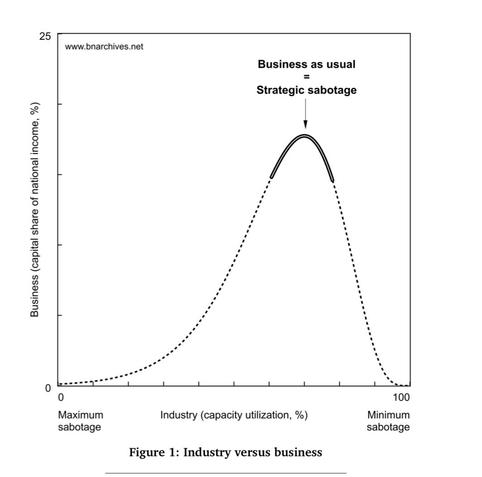
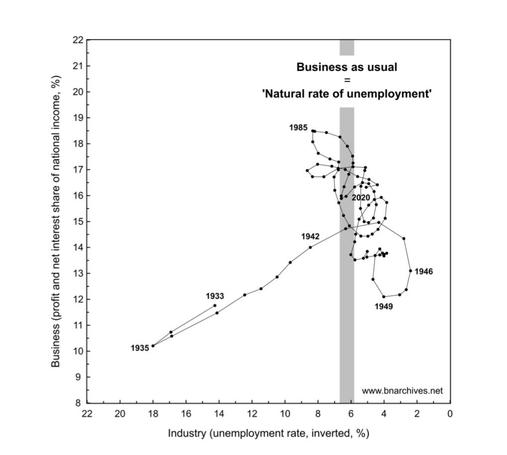
Building on Veblen’s work, economists Shimshon Bichler and Jonathan Nitzan set out to discover whether there is an optimal rate of sabotage in capitalism that maximizes capitalist profits.

If capitalists gave every worker permission to labor, then workers would have little incentive to turn over their revenues in return for a fraction back as wages. But if capitalists gave no worker permission to labor, then there would be no economic activity to extract rents from. So, capitalists must aim for an ideal unemployment rate that puts some fear into workers while still maximizing productive output.

And that’s just what Bichler and Nitzan found! In the US, at least, an unemployment rate of around 6-7% corresponds to capitalists capturing their highest share of national income:

https://bnarchives.net/id/eprint/760/

8/

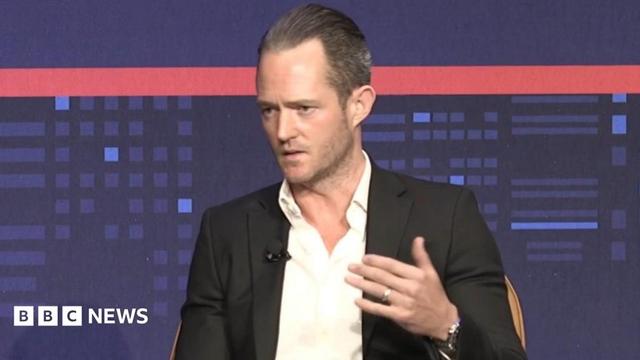
Sometimes, capitalists just tell us this explicitly and verbatim. Back in 2023, an Australian capitalist advocated for a higher unemployment rate—he wanted it to grow from 3.7% to something closer to 6%—to humble workers whom he believed had grown too arrogant and demanding in their relationships with capitalists.

https://www.bbc.co.uk/news/business-66803279

We don’t even need those fancy graphs by Bichler and Nitzan! Sometimes capitalists just come right out and say it! The point of unemployment is to discipline workers. It is to *sabotage* their ability to labor productively so that other workers can see how unpleasant it is to be denied permission to labor productively. In this way, those workers will be more obedient and more willing to pay their rents.

9/

Tim Gurner apologises over call for more unemployment to fix worker attitudes

Tim Gurner backtracks over his call for "pain in the economy" to remind people they are lucky to have jobs.

BBC News

This is what I mean when I say that capitalism is a system in which some people own the power to permit or deny others to labor productively.

Individual capitalists are often abusive, but they rarely own the formal right to directly extract wealth from subordinates, the way feudal lords did. Instead, they must exploit through purely economic means alone—their ownership of property (physical, financial, intellectual, and whatever) that allows them to allow or deny others to labor productively.

While any one capitalist might not have that much power over you, they do, as a class, effectively own your life.

I’ll close with this passage from Friedrich Engels, who was problematic for all sorts of reasons I won’t get into here but did summarize this particular dynamic really well:

“The only difference as compared with the old, outspoken slavery is this, that the worker of today seems to be free because he is not sold once for all, but piecemeal by the day, the week, the year, and because no one owner sells him to another, but he is forced to sell himself in this way instead, being the slave of no particular person, but of the whole property-holding class. For him the matter is unchanged at bottom, and if this semblance of liberty necessarily gives him some real freedom on the one hand, it entails on the other the disadvantage that no one guarantees him a subsistence, he is in danger of being repudiated at any moment by his master, the bourgeoisie, and left to die of starvation, if the bourgeoisie ceases to have an interest in his employment, his existence.”

10/end

@HeavenlyPossum

The other con is the idea that anybody could start a business and become a capitalist.

If only it was that easy when you aren't rich already.

@ta11dave

Exactly.

If you don’t already own capital, then you still have to pay rents to capitalists until you can (hopefully) save up enough to buy ownership of someone else’s labor.

@HeavenlyPossum

As much as capitalism requires exploitative capitalists, it also requires meek, compliant workers.

To get humble compliance, bosses can either pay us a fair wage for our time and labor, or they can try to humble me and abuse me.

All too often, stupid, or greedy, or pathologic bosses choose the latter instead of the former. And no one kicks their ass and/or quits on the spot. It makes me sad.

We need UBI because we need dignity.

@grumble209

There’s no such thing as a “fair wage” under capitalism. Workers pay rents to capitalists compliantly because capitalists will starve them if those workers do not submit.

@HeavenlyPossum

"fair" is a subjective word. I guess I meant, "a wage that's enough to keep me from walking away". Pay is to compensate for your time and labor, which are finite, and to compensate you for submitting to the authority of someone else.

Workers could repay their bosses with lumps and bruises if they wanted to. That doesn't pay the rent, but thrashing your boss once a month might make the other 29 days of low pay more tolerable.

Given how workers are sometimes treated, assaults seem rather usual, IMHO.

My point is not that capitalists are not assholes - they mostly are. My point is that workers often seem pretty damn meek about standing up for themselves.

@grumble209

What would happen to a worker who beat their boss (who is likely just another worker)?

@HeavenlyPossum

Oh, the chain of command utterly forbids and cannot tolerate workers being violent in the workplace. If anyone gets violent, they are fired and a mark is applied to their PERMANENT RECORD.

I do not advocate actual violence. I advocate sabre rattling violence so that the wise capitalists stop being such assholes.

I notice that few politicians talk about North Korea and regime change there much anymore. I think that's likely because North Korea has nukes and delivery vehicles.

No one is actually nuking cites, though. But the threat is clear, and so North Korea is not fucked with as much as, say, Iran.

Strikes, sabotage, and violence are all potential actions that modern capitalists seem to think are impossible today. I'd like them to rethink that position and act accordingly.

@grumble209 @HeavenlyPossum
Heh, they also don't want to direct attention to North Korea, because it, like other communist states, is advancing so rapidly that it's embarrassing the capitaiist class and they don't dare attack it because, as you pointed out, they have nukes. :)
@HeavenlyPossum Great thread, thank you. My thoughts on this stuff are much fuzzier than yours, but I will try to articulate something I notice - capitalism only wants us working *for it.* All the "dignity of work" and "nobody wants to work anymore" rhetoric only applies to the work people do for/within the system. Work that happens outside of that - e.g. things like cooking a meal from scratch, growing some of your own food, or even walking/cycling to get somewhere instead of driving - is presented as a bad kind of work, and the antidote for it, helpfully provided for you by the system, is "convenience." Capitalism effectively tells people "Give all your labor and time to us, and we will sell you "labor-saving devices" and "convenience foods" in compensation."

@MelissaBenyon

Oh, absolutely. Productive work that capitalism hasn’t figured out how to exploit directly is largely invisible to capitalism, and most of that is caring work performed domestically—and much of that is performed by women around the world.

I dunno, since capitalism started being a thing, productivity has never been higher. We're producing more products and extracting more resources faster than any point in history, and it shows no sign of slowing down. So it feels a little... "off" to say that capitalists are stopping workers from being productive. You're undeniably correct; I just think there might be a better way of framing it that doesn't give labor implicit value.

Capitalists do, after all, unemploy the "workers" (people) who are not productive.
@cy @HeavenlyPossum
Productivity is *much* higher in communist states. "High" for capitalists is a lot lower. So is development. That's why they blow so much money on trying to suppress them.
Productivity isn't a good thing, is what I'm saying. Sometimes it's good to relax, and be unproductive. No reason to convert the entire planet into paperclips.

@zapradon @cy @HeavenlyPossum

There's productivity, and then there's productivity.

Trouble is this system has gotten very, very good at obscuring the difference between things that have real value, and SHITTY JUNK.

I keep thinking about the mimics, like the parasitic beetles that imitate the pheromones of a beehive so they can creep in and be fed as if they're a member of the community.

We're buried in mountains of boxes that LOOK like they contain something worthwhile, all superficial promises, all full of nothing but shit. Websites that look like they contain information, boxes that look like they contain food, foods that look like they contain nourishment, clothes that look like they should be comfortable, boots that look like they should wear, vehicles that look rugged, towers that look like they should contain nobility, egos that look like they should contain strength, gadgets that look like they should chop your vegetables, on and on.

And NOTHING does what it says on the fucking tin anymore.

@cy

As Bichler and Nitzan observe, it’s a double-edged sword. Workers are compelled, under threat of not being able to produce at all, to over-produce at the direction of and for the benefit of capitalists.