The rise of larger vehicles like SUVs and pickup trucks, with their taller hoods and larger blind zones, has contributed to a 75% increase in pedestrian and cyclist deaths since 2009.

Until we design better streets and ban these vehicles, people outside these vehicles will keep dying.

https://www.nytimes.com/interactive/2026/06/21/us/trucks-suv-pedestrian-crashes.html?unlocked_article_code=1.sFA.I27_.RXJpxEQcJXSI&smid=nytcore-ios-share

The Deadly Rise of Giant Trucks and S.U.V.s

The vehicles on American roads have grown larger — and they are killing thousands more pedestrians, a Times investigation found.

The New York Times

@davidho “These should be banned.” Look I hate involuntarily being in a monster truck rally as much as the next guy, BUT. The truck on the right exists because its smaller, more efficient precursor on the left effectively *was* banned.

David, thank you for sharing this article. I think its authors do its readers some disservice however by not asking people inside the industry, or just some automotive journalist WHY light-duty trucks have become so much larger since 2011. And far from saying ‘We’re only focusing on the safety implications here,’ they go out of their way to imply that the size increase is a market response to consumer demand.

An EIA story from 2012: https://www.eia.gov/todayinenergy/detail.php?id=7390
“In 2006, the formula used to establish CAFE standards for light-duty trucks was changed. Manufacturers were given the opportunity to comply with fleet-based standards or standards based on their sales-weighted "footprint" (wheelbase times track width). For Model Year (MY) 2011, a new footprint-based standard was enacted for both passenger cars and light-duty trucks. This new footprint standard required that all vehicle manufacturers improve their fuel economy at a similar rate, regardless of the types and sizes of vehicles sold.”
Fuel economy standards have affected vehicle efficiency - U.S. Energy Information Administration (EIA)

Energy Information Administration - EIA - Official Energy Statistics from the U.S. Government

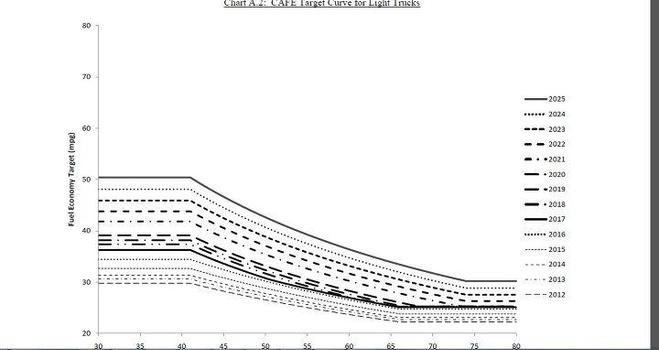
Truck makers were faced with the choice: We face a penalty if we keep doing what we’re doing. Do we invest heavily in research and development that (we hope) results in fractionally more efficient engines for our trucks, or do we find another way to comply with the new standard? Well as it turns out, if your current engine isn’t fuel efficient enough at its current footprint, all you have to do is move your finger along the curve a bit to the efficiency level you can achieve, and then increase the vehicle footprint to the corresponding value. As CAFE standards gradually increased, so did the truck footprint.
And things are not looking good if the trend continues on into the future. Honestly, can you imagine getting 40–50 miles per gallon in a pickup truck? That’s the kind of efficiency required to keep trucks from pushing beyond their current oversize footprints over the next few years. At a certain point, industry leaders will have to make the case to the EPA why exactly their customers are not interested in running and jumping to get into dumptruck-sized vehicles.
Source: https://www.federalregister.gov/documents/2023/08/17/2023-16515/corporate-average-fuel-economy-standards-for-passenger-cars-and-light-trucks-for-model-years

@davidsudweeks This might possibly influence the manufacturer preference for a larger length and width of a vehicle. Not the height.

Seems like increased size is driven mostly by testosterone based marketing. And then its "But honey, we need a tank to keep our kids safe"

@andyw350 Agree—we could do with some shorter trucks on the road. Disagree with size increase “driven mostly by” marketing of any kind. My main point is still very strong. My neighbor has a Fourth Generation Dodge Ram he uses for his landscaping business. It’s plenty big, and gets about 20mpg. A model year 2032 pickup of the same size (those go into production in 5 years) will need to get better than 50mpg or pay a penalty. (This is on the chart attached to the post you responded to: Find 60 ft² on the X axis and trace it up to where it intersects the top dashed line.)
Auto makers don’t know how to achieve this level of efficiency—not at a price their customers are willing to pay, and likely not at any price.
It would surprise me very much if the authors of the New York Times article referenced don’t know this. But concluding with CAFE Standards are the greatest contributing factor to the recent rise in auto fatalities, and getting rid of them would result in a return to pre-2011 stats and smaller cars and trucks that more closely reflect consumer preference—well, true or not, we can’t talk like that, can we?