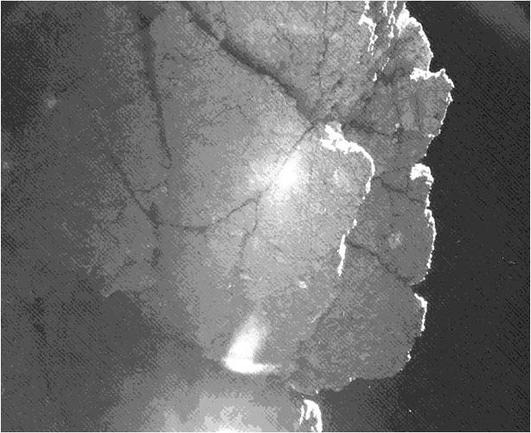
Philae Lander View of Perihelion Cliff on Comet Surface

From the location where it came to rest after bounces, the Philae lander of the European Space Agency Rosetta mission captured this view of a cliff on the nucleus of comet 67P/Churyumov-Gerasimenko. The feature is called Perihelion Cliff.

More: https://images.nasa.gov/details/PIA19095
Credit: Copyright: ESA/Rosetta/Philae/CIVA

#comet #rosetta #astrodon #astronomy #astrophotography #astrophysics
@astropic

When the Philae lander detached from the Rosetta spacecraft in 2014 to perform the first-ever soft landing on a comet, its harpoons failed to fire. Instead of sticking to the surface, Philae bounced wildly across the comet's low-gravity landscape before finally wedging itself sideways into a dark, rocky crack.

#astrophotography
#comets
#Rosetta
#Philae

@astropic

When the lander turned its cameras on and beamed its first panoramic images back to Earth, it found itself staring directly at a massive, towering wall of dark, icy crags. Astronomers officially named this specific rock face the Perihelion Cliff.

#PerihelionCliff

@astropic

The word perihelion refers to the exact point in an object's orbit where it is closest to the Sun.

Comets spend most of their lives frozen and dormant in the dark outer edges of the solar system. But as they approach perihelion, the Sun's intense thermal heat causes the subsurface ice inside the comet to violently vaporize (sublimation), blasting out massive jets of gas and dust into space.

#comets
#perihelion

@astropic

Because Comet 67P's cliffs are weak—scientists estimate the composition is structurally weaker than freshly packed winter snow—the intense thermal stress around perihelion causes massive parts of these cliff walls to fracture, crumble, and completely collapse.

By naming that towering wall the Perihelion Cliff, scientists paid homage to the incredibly volatile, ever-changing environment where the lander accidentally ended its journey.

#comets
#PerihelionCliff