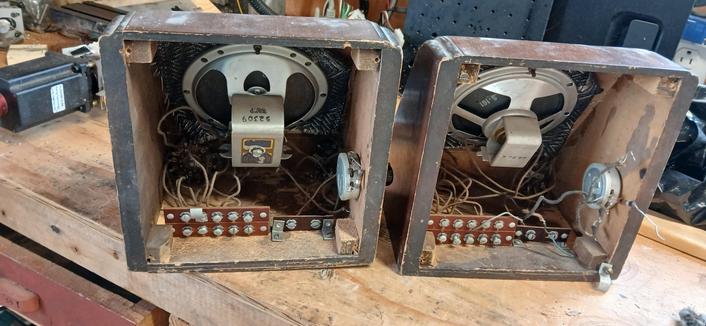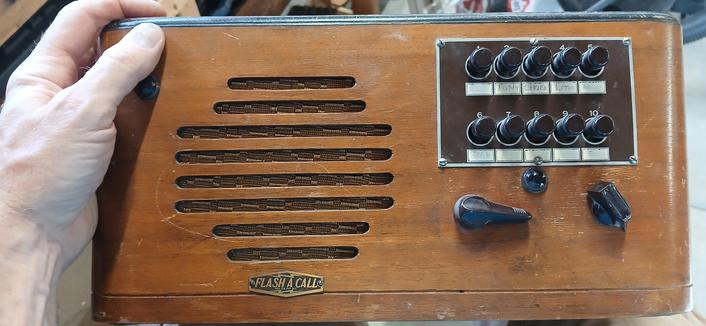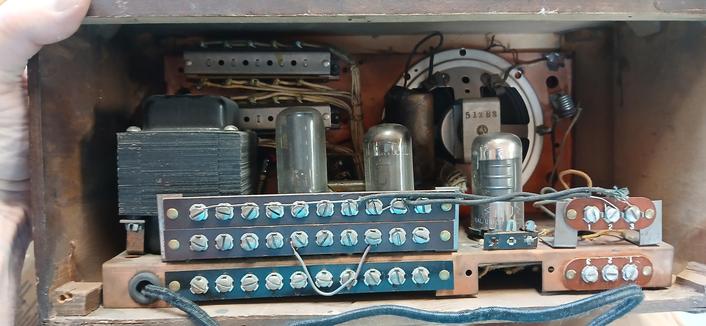
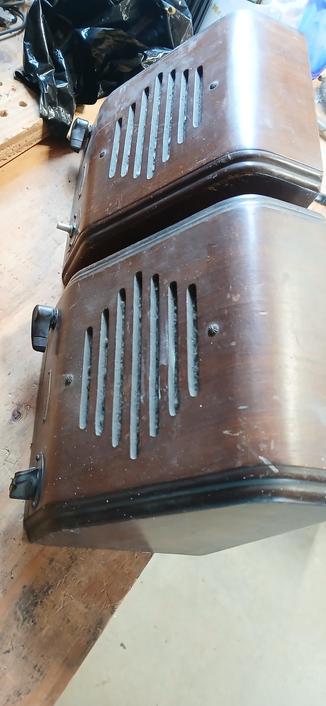
This is a project for @mediaarchaeologylab consisting of a Webster model 2501 intercom system made in 1946. The remotes are just a speaker, that serves as a microphone if you close a PTT switch. The main system has a rectifier tube, a cooked ripple capacitor, and some amp tubes. I've figured out how to rewire the remotes so they match and hopefully work, and blown and picked massive wads of fluff out of them. One remote needs a new backplate fabricated.
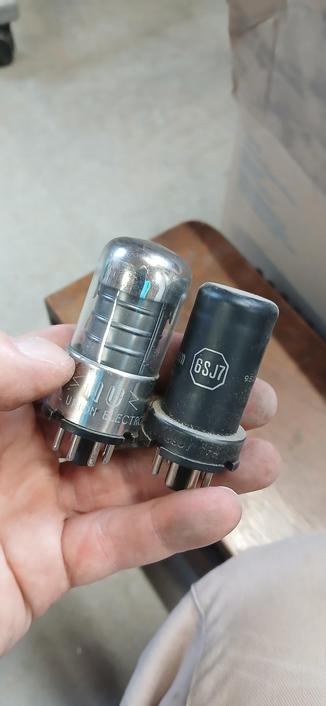
These two are the same tube in different manufacturer cases. It's an amp and it's still readily available

@smellsofbikes
In Richard Feynman's biography, he tells how as a kid he made some spare change during the depression by repairing tube radios.

One of them had a weird symptom: it would make an awful racket when you turned it on before settling to play radio normally.

He figured out that the tube for the amplifier was coming online before the tube for the tuner was ready to provide a clean signal.

Since both circuits used the same type of tube, he just swapped them and now the tuner warmed up before the amp and everything was fine.

@DenOfEarth I like this! I know enough about tubes to prefer silicon.
@smellsofbikes @DenOfEarth as the youngest tech in the tv repair shop I got to work on the old tube sets while the old techs got sent to solid-state training. Tubes are beautiful, elegant, and so, so, power hungry! In college I would just turn down the volume on my 25" color tube set as it's nearly 400 watts would bump the temp up just enough to keep it comfy!
@vonslatt @DenOfEarth our only tv when I was young was a Heathkit tube tv my dad had built and I vividly remember the smell of miller moths being attracted to the glow of the tubes and then being incinerated by the heat.
@vonslatt @smellsofbikes @DenOfEarth The tech in my undergraduate EE "Superlab" would touch exposed wires to sense line voltages instead of using a voltmeter. He claimed this was safe because his fingertips were so callused from pulling hot tubes
@rrmutt @vonslatt @smellsofbikes
Our electronics teacher would lick his finger and flick it off the end of the soldering iron to see if it had reached temperature. He would say: "Ça sent l'cochon brûlé!"
To make this more fun, there are two different Webster companies active in 1946 that made intercoms, one based in Chicago, IL, and the other in Racine, WI. This is probably the former as they were much larger.

@smellsofbikes

How on earth did you figure that out?

@NilaJones I've been looking everywhere I can think of to try to find any info on the base station wiring. One base station has something weird off to the far right, where the other one just has a blank space. The only photo I've found online of another similar model has something entirely different in that location. So I guess I have to take it apart and look inside. It's not a vacuum tube. Maybe a ballast resistor?

@smellsofbikes

Well you know I'm not going to have any idea! 😂

@NilaJones it's all guesswork on 80 year old undocumented stuff. I hope I'm a good guesser.

@smellsofbikes

It's too bad the RV forum died and everyone went to Facebook. Because I would definitely send you over there, to find somebody who had worked on these things before they retired

@NilaJones the places I have found things are old radio repair fora. I pulled one tube and said to myself wait this has GOT to be a rectifier (four pins, no central pin at all) and sure enough I found another model from the same company that has the same tube, identified as a rectifier (purely for safety, because this was before plugs were polarized and they needed to make sure the whole thing didn't vaporize if it was plugged in backwards.)

@smellsofbikes

I love that you are working with the media museum people, though!

@smellsofbikes the Radio Museum does peg these to the Chicago Webster, yes
@tankgrrl It's so pretty, and it'll work, too, and we can wire it up through the @mediaarchaeologylab complex. I think I'll have to build a couple more receivers, though, because MAL is COMPLICATED.

@smellsofbikes @mediaarchaeologylab

Intercoms like these featured so heavily in old movies and TV shows when people worked in offices

@NilaJones @mediaarchaeologylab There was apparently a naming hierarchy for competitor models that denoted how much clout the person who had the central station carried.
These models don't have any identification at all past the flashy plate, just a model number hand written on the bottom. Not even a manufacturer label.
@smellsofbikes @mediaarchaeologylab
Very cool! What's the voltage like on the speaker lines?
@sb I don't know yet because I haven't gotten the base unit running, and there are as far as I can tell zero references to this specific model anywhere online. Other similar models ran 100VDC in the main station. I hope they didn't run that out to the speakers.
@smellsofbikes
It looks like a fairly standard 70v setup. I still maintain one at work that's "halfway between your system and now" years old.
@sb ooooooh that's neat! It's cool you have a working one. Do you know what the speaker voltage is on yours? I have no wiring for that so I have to figure out what to use.
@smellsofbikes @mediaarchaeologylab no soldering? no turret board? I would have dated this way before than 1946. Thanks for sharing. It is an awesome piece of equipment.
@FrancoisPrague design probably earlier but all four units I have were inspected prior to shipment in mid-1946.
@smellsofbikes it makes sense. Thanks for taking the time answering. Much appreciated.