I don't actually know any sign language well, but I've been learning #ASL for fun from the Lingvano app for the last four months, and making little edits related to sign languages in @wikipedia in English, Russian, Ukrainian, Hebrew, and occasionally other languages. And I've discovered a curious thing: in all the languages, people aren't very diligent about specifying the sign language that they are writing about.

Like very often, they'd just say "sign language", instead of "American Sign Language", "French Sign Language", etc.

A common example is film: if a sign language is used in a film, it's usually a specific one that is used in the culture in which the film is set. And sometimes, it's something invented specifically for the film. Sometimes it's documented in reliable sources and sometimes it isn't.

I kind of thought that Wikipedians, at least in the English Wikipedia, would be thorough about specifying it, but quite often they aren't.

Sometimes it's genuinely hard because the language isn't known, but in some other cases, the language can be easily found, but the Wikipedia editor didn't specify it anyway.

My ability to fix this is limited: I'm very curious about the topic, but at least for now, I barely know ASL and I don't know any other sign language at all. I try to find articles that aren't specific about this and add specific information when I can find it.

Ideally, this could be solved with good old representation and diversity: more people who know a lot of sign languages should become Wikipedia editors, find fuzzy or incorrect information, and improve it.

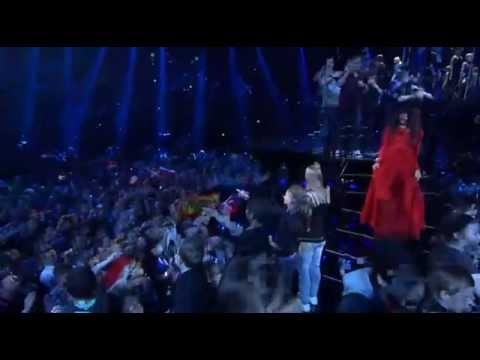
I've been doing it for a few weeks, and I've learned a lot, of course. I had one moment of particular joy this morning: I've been changing the words "язык жестов", the imprecise Russian term for "sign language" in many Russian Wikipedia articles to "жестовый язык", which is the preferred term. One of those articles is about #Eurovision Song Contest 2013, which featured a performance of the 2012 winner in English and in "sign language".

But which one?

The event took place in Sweden, the main performer Loreen is Swedish, and the children choir who joined her are from a school in Sweden. So it's supposed to be the Swedish Sign Language, right? Maybe, but it's an international event, and its main presentation languages are English and French in addition to the languages of the host country, so maybe it's French, British, or International Sign language? Or just something that the choreographer invented? Or something else?

https://www.youtube.com/watch?v=ZhJNbUTE3Po

Eurovision 2013: Loreen - Euphoria - Opening Act (1st Semi-Final)

YouTube

I couldn't find a clear answer in search engines or conversation simulators, so I tried something else: https://www.spreadthesign.com , a video dictionary of multiple sign languages. In it, I found words from the lyrics: forever, euphoria, up, heart. Some were similar in BSL, but only Swedish Sign Language had all the signs that looked the closest to what I see in the video.

So I decided to be bold and changed the Russian Wikipedia to say specifically "Swedish Sign Language".

Sign language dictionary | SpreadTheSign

Sign language dictionary that works great as a reference and as a tool for learning.

If all goes well, next month I'm going to Wikimania, and I'll ask Wikipedians from Sweden to verify it a bit more, because otherwise, you know, it's a bit too close to original research, which is prohibited in Wikipedia.

But hey, when I saw how the signs on the spreadthesign.com website match the signs in the video, I experienced euphoria, which by complete coincidence happens to be the title of the song.

So anyway... you could think that it's a niche topic, but it's actually a good demonstration of why "AI" cannot replace humans and why there should be more diversity and representation of all kinds of people among Wikipedia editors. I'm NOT a good representative of deaf people, of course; I'm at most an ambassador, and not even a very good one. Only real signers and sign language linguists can do an actually good job with improving sign language content on Wikipedia.
And it's also a good demonstration that sign languages are languages. It would be absurd to say that DiCaprio learned lines in "foreign" or "Indian" for "Killers of the Flower Moon"; he learned lines in Osage. And it's the same with sign languages: there are quite a lot of movies that feature sign languages, and Wikipedia articles about them should specify which sign languages they are.
And it's the same not just for Deaf people's sign languages. It's the same for all disabilities, all countries, all cultures. All kinds of people are needed in Wikipedia in all languages.

There are a couple of much more fundamental things related to Wikimedia projects and sign languages that I'd love to address someday:

1. Figure out how can signs be looked up in Wiktionary. There is some system in place in the English Wiktionary, but I haven't totally figured it out yet, and I suspect that the system itself is not perfect.

2. There should probably be Wikipedias in sign languages. There are serious technical challenges for achieving this, but they are worth working on.

@aharoni I watch most of my TV with subtitles, and there's A LOT of subtitles that read "[speaks in foreign language]". drives me nuts every time.