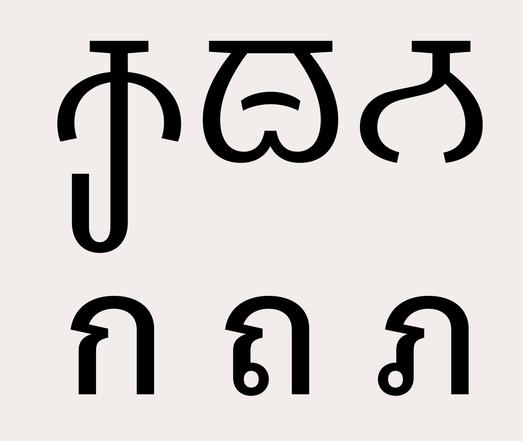
One of these things is not like the others.

The way in which Bangla re-uses the same shape for entirely unrelated letters in conjuncts is disconcerting.

@TiroTypeworks I can't speak for Bangla, but it fascinates me that in many scripts we see this convergent evolution of letterforms that descend from different ancestors. Thai has ก ถ ภ or ล ส; Burmese has ဩ and သြ, or ဦ ဉီ, all etymologically unrelated. A subconscious drive for consistency and uniformity among scribes over the centuries? The mechanics of writing makes some shapes naturally evolve into shapes that are easier to write?
@ohbendy @TiroTypeworks serious question, although it might sound like trolling: how are we defining "unrelated" ?
@n8 @TiroTypeworks So here's Late Southern Brahmi (aka Pallava) the ancestor of many SEAsian scripts, in the top row. Those forms are typical of the 6–7th centuries and I wouldn't consider those three letterforms related, the ductus differs so much. Below are the modern Thai counterparts, which have settled into the familiar beaked architecture. (I don't unfortunately have fonts showing the fascinating intermediary steps in the evolution)
@ohbendy @TiroTypeworks well, one thing I wondered and I can't tell as a non-reader is where there are relationships between letters outside of the visual realm. Like phonetically related letters, or historical ones. E.g., (and admittedly this is a blend of several), Latin "i" and "j" are not related sounds, but the visual connection is because one is an offshoot of the other. Or phonetics nerds might argue that "b" and "p" should clearly have related forms because the sounds are related.
@n8 Thai has some letters that are related in that way, like ค/ฅ, ช/ซ, ฎ/ฏ, ด/ต, where a pair letters diverged from the same source, but in the letters I showed before, there's no phonetic or historical reason they should look similar.

@n8 @ohbendy In the Bangla writing system, the same letter is used for /b/ and /v/ phonemes, while these sounds are graphically distinguished in the same script as used for Assamese, and in some orthographies for Sanskrit.

A related form is used for /r/ phoneme. Note that the distinctive behaviour of /r/ in Brahmi derived scripts means that the graphically identical Assamese /ro/ and Sanskrit /va/ need to be separately encoded.

https://www.unicode.org/L2/L2022/22268-bengali-alternate-ba.pdf

[Image corrected.]