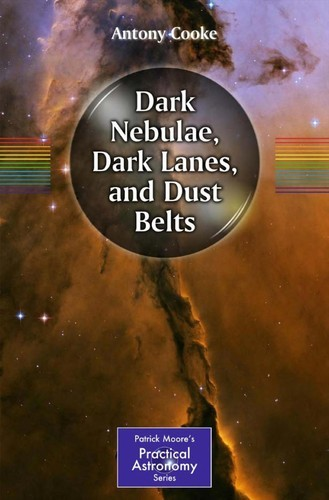
Dark Nebulae, Dark Lanes, and Dust Belts by Anthony Cooke, 2012

Dark Nebulae, Dark Lanes, and Dust Lanes looks out into the deep sky to see "the spaces between the words..." While not usually considered independently, many of the apparent dark ‘voids’ in space are among the most compelling telescopic destinations.

#books
#nonfiction
#astronomy
#DarkNebulae
#DarkLanes
#DustLanes
1/
"Before time began we assume there was nothing that we would describe as dark
or light. It is thought that the ‘Big Bang,’ that term used to describe the beginning
of everything, occurred about 13.7 billion years ago. Most elements did not exist,
yet to be created by the nuclear processes of stars; of the state of matter at the time, the majority was hydrogen, along with much lesser quantities of helium-4; little else existed...

#astronomy
#astrophysics
#BigBang

2/
probably consisting only of tiny amounts of lithium, beryllium and deuterium, with any other possible trace elements still mired in controversy. There was no observable light for hundreds of millions of years, and thus the early universe was dark. Stars were yet to come into being. Thus the light and dark in the universe is only the result of cosmic evolution, central to this writing.

#astronomy
#astrophysics
#cosmology
#BigBang

3/
The moment of creation – the ‘Big Bang’ – was certainly nothing like many a
layman’s faulty notion of a huge explosion radiating and expanding outwards from a single point into a spherical universe all around us. Although superficially the Big Bang could be seen as such, creation was not the product of just one point expanding like the stretching of a rubber sheet.

#astronomy
#astrophysics
#cosmology
#BigBang

4/
It was actually caused by all points
together in the universe, (although perhaps seeming to be an apparent single point), expanding equally in all directions, with everything rushing apart at the same rate relative to the next. This is, of course, a totally different reality, if you can get your mind around it.

Thus, all galaxies are rushing away from each other at equal speeds, but the
combined and compounded effect is that the more distant the galaxy, the faster it

#BigBang

5/
appears to be receding relative to us (their distances measured by ‘redshift,’ or the shifting of absorption lines in the red part of the spectrum, which allows us to calculate distances in space). Therefore we can observe no center to the universe at all and have no idea what lies beyond what we are able to observe; we may only be aware of a tiny corner of the totality, for all anyone knows.

#astronomy
#astrophysics
#cosmology
#BigBang

6/
It turns out that the edge of the universe, at least as we might imagine it – that mythical place that might be thought to harbor secrets from the beginning of time –
apparently does not exist, or perhaps cannot exist even in theory."

Anthony Cooke

#astronomy
#astrophysics
#cosmology