 Mark Prince
Option-O Lagom Casa Grinder
Share
Article
Casa Grinder and Box
Female Burr
Side Profile
Warning about Grinds
Branded Boxes
Lagom Casa Box Opened
Option-O Lagom Casa
Removing the Hopper
Front Profile
Hopper and Knocker
Anti Popcorn
Male Burr
Branded Boxes
Lagom Casa Box
Lago Casa Operating Instructions
Grinder Removed
Angled Position
Manual and Stickers
Single Dose Area
Just Pure Quality
Option_O_Lagom_Casa_CG-29
Option-0 Casa and Mini
Inside the Burr Assembly
Dosing Cup
Remove Top Burr
Smaller Box
Main Grinder
Lagom Casa Box
Top Polystyrene Removed
Lagom Casa Front View
Showing Slide 1 of 30
Whereto Buy
Manufacturer Website
Buy from Supplier
Buy from Cafune
Buy here to support CoffeeGeek!
Out of the Box
When the Lagom Casa arrived, the packaging immediately felt premium: subtle branding on the box, an integrated carry handle, and everything secure and professional. Inside, the familiar polystyrene made an appearance, big chunks holding the grinder firmly in place. It does the job, but I can’t help thinking that companies like Rancilio manage to ship 35kg espresso machines and 8kg grinders using fully sustainable packaging.
I’ll keep saying it: companies need to do better here. Sustainability should be non-negotiable, and it would be great to see Option-O take this on as a positive goal for future releases.
The box, complete with handle, that the Lagom Casa comes in.
Box opened, you’re greeted by polystyrene. Not the best look. And the manual.
The Casa ships with a full printed manual, old school.
Top polystyrene removed, you see more polystyrene cut out to the grinder shape. This is where I think they could have made real changes.
Inside, there’s two boxes, this one most likely holds the dosing cup.
This box is most likely for the power cord.
Inside, the grinder and its parts are wrapped in what looks like biodegradable plastics, which is a good thing. The magnetic catch cup, power cord, everything is wrapped nicely and securely. The Lagom Casa weighs around 3.5 kg (≈ 7.7 lb) when fully assembled. Its width is slim, roughly 9 cm, with enough depth and height to sit comfortably beside most espresso machines without feeling oversized or intrusive.
Running a hand over the CNC-machined aluminium body, you can’t find a single seam or rough edge. Our matte black review unit feels like it was milled from a solid block. There are no panel gaps or rattles, just a dense, solid object that conveys precision before you even turn it on.
There’s also a surprising heft and density to the grinder that belies its compact footprint. The whole impression is so complete, you feel like you’ve bought something Jony Ive would design if he had his own ultra-secret, super-exclusive coffee gear lab.
The smaller box does hold the dosing cup as well as Option-O’s dots, which you can apply to the grinder grind selection dial as reminders.
The larger box does hold the beefy three pronged power cord.
The grinder removed from the box. It is wrapped in a material that feels like compostable bags, but I cannot confirm.
Option-O hand tests every single grinder before they ship, and warn that you may find stray grinds.
Option-O includes a complete manual and bonus stickers if you’re into that kind of thing.
Even while unwrapping, you see the pure quality of build and materials the company uses in their products. Hence the Ive comparison.
The top houses a compact but deep bean hopper, which holds a respectable 30–40g. Just know that for doses above 25g, some beans will be chilling on top of the anti-popcorning device for a moment before they drop in. Beneath that, the stepless adjustment dial encircles the burr housing, featuring clear, numbered markings for reference. Option-O also includes their signature dot stickers, a nice touch for users who want to mark their own specific, in-between settings with even greater precision.
Dead centre on the front of the grinder is a round, protruding button that looks suspiciously like a power switch. It is not. This is the integrated grinds knocker. Solid, firm and well machined, a press down activates the chute’s knocker with a satisfying clack sound.
The Bean hopper is single dose, features a anti-popcorn lid design and you rotate it for your stepless grind adjustment.
The hopper and knocker, very simple controls, very effective to use.
The Lagom Casa grinder and its box. Only real assembly is sliding the dosing cup into place and plugging in the cord.
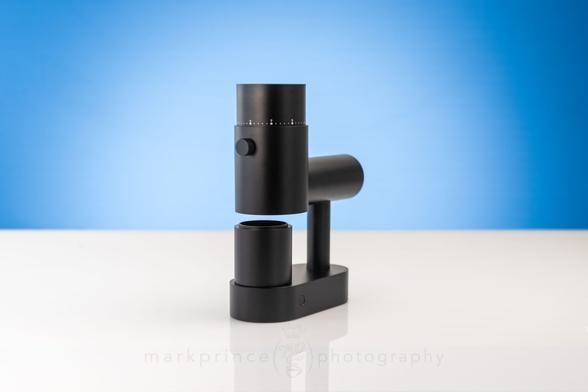
The side profile shows how the dosing cup sits forward a bit, so it is perfectly centred under the dosing chute. Some don’t like this. We don’t mind.
Then we come down to the grounds cup and bottom platform. The magnetic grounds cup doesn’t sit flush with the central body of the grinder above it; it’s intentionally offset to align perfectly under the grinder’s exit chute. Some may find the look a bit quirky, but frankly, I thought it looked fine. The cup aligns itself every time magnetically with a very satisfying “snap” into position.
The catch cup is designed to fit a standard 58mm portafilter well, for a clean transfer. However, it can be slightly messy when used with smaller 54mm portafilters, like those common on many Breville espresso machines, so a funnel is recommended in those cases. The cup itself is robust and easy to handle, and seems completely devoid of static when grinds are inside.
The power button is mounted on the right side of the grinder base and has a pro-spec tactile feel, not flimsy or cheap, and the integrated power supply keeps the setup clean with a standard cord, avoiding a clunky external brick (one of the big complaints about the original Lagom Mini). The grinder also includes an auto-off feature that shuts the motor down a few seconds after the last grind, which makes the workflow safer and less stressful during a busy session, and ensures you never leave the motor running unintentionally.
A close look at the dosing cup shows exceptional finishing and quality of build. Note the lip, for 58mm filter baskets.
The Casa on an angle; nb the thin perch arm that houses the motor and grind assembly; early units had some issues with it remaining secure.
The side profile shows how much longer the grinder is compared to the Lagom Mini grinders.
The front view of the Casa and Mini grinders; note that the Casa is a very small footprint when seen in this position.
You get an immediate sense of longevity from the Casa; it feels designed by people who actually grind coffee every morning. Every touchpoint, from the collar’s smooth rotation to the self-aligning cup, feels considered, intentional, and pro-spec. After seasoning the burrs with nearly 3kg of old coffee, our first test shots with a light-roast Ethiopian confirmed this. The clarity was immediately evident, and the minimal static cling right out of the box was impressive for a new grinder.
The only real quirks at this stage are minor workflow considerations: turning the dial for big adjustments still requires multiple rotations, and transferring grounds into a 54mm portafilter can lead to minor spills without a funnel.
Beyond those minor quirks, the workflow feels incredibly polished thanks to the combination of low retention, the magnetic cup, a solid knocker, and the auto-off feature. That polish extends to the stubbornly professional build quality, projecting a confidence that genuinely exceeds its price point.
The side profile shows how the dosing cup sits forward a bit, so it is perfectly centred under the dosing chute. Some don’t like this. We don’t mind.
Using The
Using the Option-O Lagom Casa becomes routine quickly. Set your grind setting via the stepless dial, weigh or measure your beans, dump them into the bean hopper, place the grinds cup, flip on power, grind, knock the chute, and wait for the grinding to be done. The auto-off feature takes care of shutting off the motor after the beans are chewed through. The magnetized cup makes alignment easy; I found myself appreciating that more than I expected.
Once you get the rhythm, the workflow feels seamless. At the heart of the Casa are two key design choices: its burrs and motor speed. It now comes standard with Option-O’s refined 65mm Mizen Omni conical burrs, a set they honed to excel at both espresso and filter. This is paired with a slow 140 RPM motor to prioritize flavour clarity. This design philosophy also underscores the Casa’s identity: despite its commercial-grade build, this is unapologetically a home grinder. The official 1:1 duty cycle confirms this; for a typical morning routine it’s a non-issue, but it rules out any kind of commercial volume.
Removing the hopper is just a matter of unscrewing it and lifting it out.
Once the hopper is removed you can see the massive 65mm Mizen burr assembly.
Removing the top burr is just a matter of pulling it out. Be wary of the three tension springs underneath – don’t lose those!
The maie conical burr remains attached but can be removed by lossening the lock nuts on top.
The 65mm female Mizen burr, a serious piece of engineered metal.
This is the underside of the removed hopper – you can see the anti popcorn cap in place.
The Casa’s leisurely 140 RPM pace is a worthwhile trade-off for flavour fidelity. Surprisingly, it’s even slower than the unhurried Lagom Mini (~180 RPM), though it drives a much larger 65mm burr set versus the Mini’s 48mm. This isn’t a design flaw but a fanatical devotion to the low-speed philosophy; it’s how Option-O achieves such a clean grind from conical burrs.
The small footprint and compact bean hopper further reinforce the Casa’s home-friendly design: it doesn’t dominate a countertop, and you can grind espresso and filter without reorganizing your kitchen setup.
The stepless adjustment dial is smooth and almost clinically precise. The crisp, easy-to-read numbers provide excellent reference points, making it straightforward to remember your settings and switch between espresso and filter grinds. The included sticky dots let you set more “way points” for the types of grind you are dialing in. This simple and effective feature makes the grinder easier to use day-to-day.
The grind adjustment is made by physically turning the hopper. Note the numbers on the face. Little dot stickers are also included for setting additional grind settings, though the black stickers on this black model are impossible to see.
Grinds collection and transfer is straightforward thanks to the magnetic catch cup. It aligns well under the chute, and removal or replacement is instantaneous. The cup’s lip is designed for a standard 58mm portafilter, and while I’ve seen some reviewers – most notably Tom at Tom’s Grinder Lab, who I have immense respect for – complain about the dosing cup’s design, my own experience over dozens of shot pulls has been flawless and clean.
The only inconvenience is with the ubiquitous 54mm Breville portafilters, where the size difference can cause some spillage. A simple dosing funnel remedies this. Either way, static is so impressively low it’s a virtual non-issue, which keeps the entire process tidy.
The integrated chute knocker is another well-engineered feature. You press it straight down, and it responds with a satisfyingly sharp “clack,” clearing residual grounds. The action feels purposeful and the tactile feedback from both the knocker and the side-mounted power button reinforces a sense of quality engineering. The internal construction and CNC-machined aluminium body also help to dampen down vibration, contributing to consistent grinds with minimal noise.
Cleaning and maintenance are intuitive. Lift the hopper, unscrew the burr chamber, and you can brush or vacuum residual coffee with minimal effort. The combination of low retention design, magnetic cup, and chute knocker reduces the need for frequent deep cleaning while keeping workflow efficient. Because the grinder is compact yet solidly built, handling these components never feels precarious.
Cleaning this machine is very easy: unscrew the hopper, remove the top burr and springs, and just brush and air-blow everything. Make sure the hopper threads are completely clean.
Overall, I got a completely “professional” vibe from using the Casa in its single-dosing workflow. The machine balances speed, precision, and ease of use without resorting to gimmicks or overcomplicated mechanisms. Light and medium roasts, whether for espresso or filter, are where it shines, giving clarity and flavour separation that make each shot or brew satisfying.
For home enthusiasts who enjoy fine-tuning their grind and prioritise flavour over brute speed, the Casa offers a polished, considered experience that feels more expensive than its mid-range price suggests.
The Lagom Casa, in black. Also available in brushed aluminum.
The Lagom Casa lives in a lively mid-range space where home baristas are spoiled for choice, yet the online conversation is often dominated by a few key players. This is the realm of users who have graduated from entry-level gear and are now searching for precision and a more premium workflow without the flagship price tag.
This puts the Casa in direct conversation with some heavy hitters. It is often measured against the three best known single-dosers in this space: the iconic Niche Zero, the workhorse DF64 Gen 2, and the influencer-obsessed (but rather limited) Fellow Ode Gen 2. The discussion also needs to include ambitious specialists that fly under the radar, like the Ceado Life X. Each brings its own philosophy to the coffee bench.
Niche Zero
Without a doubt, the Niche Zero is the OG single-dosing champion and the Casa’s most direct philosophical competitor. Built around a large 63mm Mazzer conical burr set, its claim to fame is a workflow that feels intentional and clean, with a promise of near-zero retention (which it failed to reach). For years, its quiet operation and reputation for producing rich, textured espresso shots made it the go-to recommendation.
The conversation between the Niche and the Casa is one of refinement. Both grinders cater to the same ritualistic coffee lover, but the Casa feels like a significant evolution of the concept. It incorporates modern enhancements like a magnetic grounds cup, an integrated chute knocker, and a true auto-off function. These are meaningful quality-of-life features that streamline the daily process and deliver, at least in our early testing, noticeably lower retention.
NB, we have never formally reviewed the Niche Zero, as the company has not responded to review requests, but have used three different units for about 15 total hours of informal testing and hands on work, in order to develop a working opinion of the grinder.
DF64 Gen 2
The DF64 Gen II grinder was a big refinement in flat burr, single dosing grinders when it was introduced.
If the Niche is about refined simplicity, the DF64 Gen 2 is about open-ended potential, making it a favourite of tinkerers. It’s a versatile single-doser with 64mm flat burrs and a huge ecosystem of aftermarket burrs to explore. The Gen 2 (or Gen II) model is a welcome update, fixing the original’s flaws with a plasma generator for static and a 45-second safety auto-stop.
But the fundamental choice here comes down to the burrs: the DF64’s flat set versus the Casa’s conical. The DF64’s flat burrs excel at creating a uniform grind, which means brewed coffee with fantastic clarity and clean flavour separation. For espresso, this translates to modern, bright shots, sometimes at the expense of body (though you can buy aftermarket burrs to change this).
The Casa’s conical burrs, prized for creating textured espresso, are paired with a slow-spinning motor. This is the Casa’s secret weapon, minimizing fines to deliver remarkably clean pour-overs. The decision is about the character of your coffee: the high-clarity, endlessly tweakable profile of the DF64, or the rich texture and versatile performance from the Casa’s smart conical design.
Fellow Ode Gen 2
The Fellow Ode Gen 2 is a specialist, and a well regarded one at that, with some arguing it is the best-in-class grinder for filter coffee at its price point (that’s not our take at CoffeeGeek though). Fellow has said that every engineering choice, from its custom 64mm flat burrs to its quiet motor, is optimized for pour-over clarity. Fellow is transparent that the motor isn’t built for the high-torque stress of espresso; they say this isn’t a flaw, but a deliberate trade-off made to perfect its performance for one purpose.
This is where the Lagom Casa presents a compelling challenge. Thanks to its slow-spinning conical burrs, the Casa produces filter coffee with remarkable clarity that can genuinely rival the Ode Gen 2. The crucial difference, however, is that the Casa’s talents don’t stop there. It is also a fantastic espresso grinder, capable of producing the rich, textured shots that conical burrs are famous for.
This makes the Casa a true multipurpose machine, excelling in a realm where the Ode simply cannot compete. For the barista who enjoys the full spectrum of coffee, the choice becomes clear. While the Ode has mastered one trade, the Casa’s ability to excel at both makes it the more versatile and, ultimately, the better overall choice.
NB, we have not formally tested the Fellow Ode Gen 2 grinder, as Fellow does not want CoffeeGeek to formally review their products (though we have independently reviewed a few anyway, including the Fellow Opus). That said, we have had a local coffee enthusiast’s Ode 2 in our lab on several occasions for informal testing.
Ceado Life X
The Ceado Life X is an often overlooked grinder that really offers a lot.
The Ceado Life X brings a touch of Italian commercial expertise to the home market, offering 50mm flat burrs and a stepless adjustment system in a compact and stylish package.
Ceado’s goal was to distill the features of its more expensive grinders – low noise, near-zero retention, excellent grind quality – into an accessible form. It cleverly bridges the gap between single-dosing and hopper use by including both options in the box.
The Life X and the Casa occupy a similar premium-but-accessible space, but they offer two distinct paths. True to its design, the Life X’s 50mm flat burrs are engineered for espresso with high clarity and flavour separation. This stands in contrast to the rich body and blended texture from the Casa’s conical burrs. Their philosophies also diverge in workflow; the Casa leans heavily into a dedicated single-dosing routine, while the Life X is for the user who wants a high-end feel plus the flexibility of using a hopper, though it also comes with an option to use it as a single dose grinder as well.
Conclusion
So, the Lagom Casa. It made a solid first impression in our Lab, which, in a world of coffee gear that promises to change your life but mostly just changes your bank balance, is a minor miracle. It’s a strikingly beautiful single-doser that aims to handle both espresso and filter without drama, and based on our initial testing, it pretty much pulls it off.
The build quality is borderline obsessive, and the workflow is noticeably clean. With its low static, clever magnetic cup, and a knocker that actually feels like it does something, you will spend more time drinking coffee and less time cleaning it up. The flavour rewards patience, particularly if you favour the lighter side of the roast spectrum. It has no interest in your morning rush, but it pays you back for your deliberation with clean, repeatable results.
It is not perfect. It is notably slow, so if speed is a priority, look elsewhere. The espresso it produces is more about clarity than a thick, syrupy punch, which won’t satisfy die-hard dark roast drinkers. And making big adjustments on the dial requires attuned effort, a full rotation of the big grind dial to move between espresso and filter, with a resistance that feels heavy (and deliberately so).
The pricing is where things get complicated. This is a niche product, and a niche, almost cottage-industry like availability. (though to call Option-O “cottage industry” really does no justice to them and the amount of work and perfection they put into their products). The direct-from-Asia price of around US$530 looks attractive, but Americans will get a pointed lesson in vengeful and hair trigger international trade policy at the door, pushing the landed cost closer to US$700.
Canadians have a more straightforward path at $849 CAD through Cafuné. (Cafune is a past CoffeeGeek sponsor). Depending on the exchange rate, buying locally in Canada may actually be the better deal once the tariff math is done. At either price, for the right user, the value holds.
A First Look is just that. The full scored review is coming, with quantified retention figures, particle distribution analysis, and long-term consistency testing across roast profiles and brew methods. The question isn’t whether the Casa made a strong first impression. It did. The question is whether it earns that impression under sustained scrutiny.
We intend to find out. In the meantime, if you have any questions about this grinder, feel free to ask in the comments section, below.
Where to Buy the
Manufacturer Website
Buy from Supplier (WORLD)
Buy from Cafune (CA)
Buy here to support CoffeeGeek!
We use affiliate links to a) Amazon, and b) manufacturers only. Any links to vendors (including CoffeeGeek Sponsors) are not income generating links. Further details about our commission and affiliate link policies can be found on our Terms and Conditions Page. The use of any affiliate links have no effect on our editorial policy or review objectivity.
#coffeeGrinder #conicalBurr #firstLook #lagomCasa #optionO #review