 Jessica, the Phoenix
 kravietz 🦇
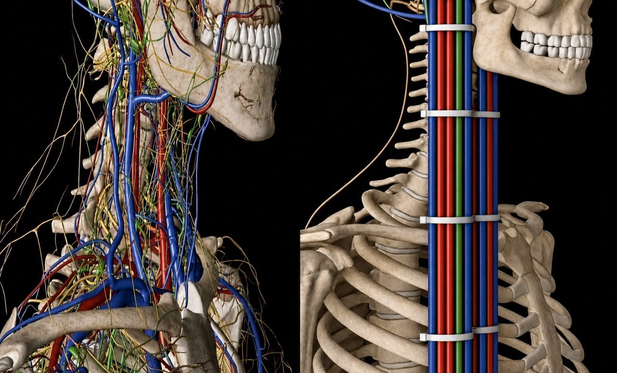
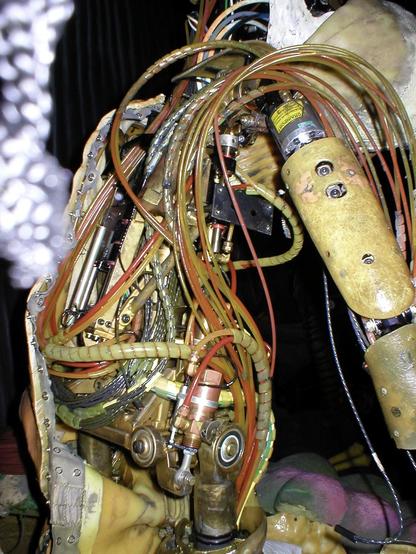
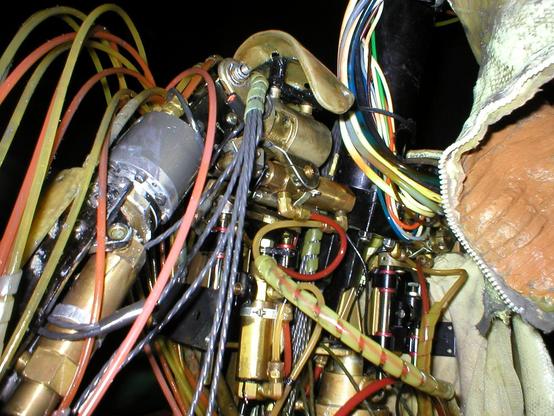
Cable management…
@kravietz Oh yeah..
Cables.. one of my jobs back in the mid 1970's was as a wireman for the fantastic Trident "A Range" mixing consoles.. only 13 were ever made.
No motherboard all hand wired and waxed cotton loomed into perfection..
I also wired up a few studios..
Now with my modular.. it's still bloody cables all over the place patching this into that etc ;-)))

@gre Yes very nice..
So nice that even today there are clones of the mic_pre_amps and EQ..
However.. it's really when one works the console as a whole that it all comes together..
Well , that's if you've got good musicians feeding it ;-)))
@hindsight I will never forget the first time I heard the output of a really good mic pre. It wasn't even connected to a high-end microphone, just a Shure SM-57. I was astonished. Speechless.
We miced a vocalist with both a 57 and a 58, stuck together with gaff tape, and the 58 was routed to a stock console pre on an old Sony 24 channel desk. Turned-out there was no point in leaving the track from the 58 in the mix.
This looks like the back of my spine feels

The recurrent laryngeal nerve (RLN) is a touchstone in anatomy education and evolutionary biology research, known for its unnecessary U-turn in the neck. But can we learn something intelligent from its “unintelligent design”? The RLN is a branch of the vagus nerve, which is the 10th cranial nerve. After the vagus nerve exits the base of the skull, it passes down towards the thorax in what’s called the carotid sheath. That means the vagus nerve travels alongside the common carotid artery and the internal jugular vein toward the heart. After passing through the neck, the vagus nerve gives off the RLN. At this point, there are some differences on either side of the body. On the right side, the RLN loops underneath the right subclavian artery before traveling up to the larynx, or voice box. On the left side, the RLN passes in front of the arch of the aorta, then loops underneath and behind it. After which it also travels up to the larynx. Of course, there can be some variation from person to person, but the RLN will generally follow this path. Diagram of the path of the recurrent laryngeal nerve in humans. The RLN gets its name “recurrent” because it travels in the opposite direction to the nerve it branches from, and “laryngeal” because its function is to innervate most muscles of the larynx. So basically, this nerve travels all the way down towards the heart, just to make a U-turn and come back up to the neck. When, instead, it could leave the skull and go straight to the larynx. It doesn’t seem like a clever design, so why does it happen? Like many other questions about our anatomy, it can be explained by embryology. During development, the head and the heart originate closely together, and so the RLNs develop close to the aorta. The formation of the neck pushes the head and heart apart, dragging the vessels down into the thorax, along with the RLNs. The RLNs will elongate to maintain its connection to the larynx while being hooked around the vessels of the heart, and so the U-turn is formed. As much as necks vary, the RLN follows suit. From fish, to humans, to giraffes, the nerve makes a bigger and bigger U-turn in order to reach the larynx. When it comes to humans, the 10cm detour is already strange. But because of their long necks, giraffes are the go-to example since their RLNs will approach 5 meters in length in larger animals. But if we look at the longest-necked animals, sauropod dinosaurs, it is possible that the nerve pathway is even longer and even more difficult to understand. The Supersaurus is a sauropod dinosaur with the longest vertebral column discovered to date. When scaling up a single vertebra, BYU 9024, it is estimated that the Supersaurus had a neck length of 14 meters. Since the RLN has to travel all the way down and back up the neck, it is presumed that these dinosaurs had neurons exceeding a whopping 28 meters. An illustration of the path of the left recurrent laryngeal nerve in a human, giraffe, and Supersaurus. (From Wedel, 2011) The extreme length of nerves is interesting when it comes to not only the Supersaurus, but also in animals with even longer neurons, like blue whales. This raises the question of whether or not the length of the nerves will begin to hinder the function. The RLN is responsible for transporting nerve impulses but also transport materials for proper communication at axon terminals. However, for some of these materials, the transport speed necessary to reach the axon terminals fails to meet the lifespan of the organisms, which means that there must be another mechanism accounting for this logistical impossibility. Further investigation as to how these long-nerved animals maintain their nerve signalling could have important implications when it comes to nerve repair and axonal transport in humans. While the path of the RLN is unintelligent, perhaps future research in this field can reveal something more intelligent. @CatWang
@kravietz it's funny, but let's be real. On the right, we see an idealized structure if the human body was equatable to a rack, or maybe a row of racks.
Reader, the 30 trillion cells in our body number 3 orders of magnitude larger than the number of devices connected to the internet, and that's when you count wireless devices.
So challenge yourself to draw up a cable management scheme that includes every single server in the net. Than scale it up by 10.000 or so.
That’s just yet another argument in support of IPv6! 😉
The recurrent laryngeal nerve travels from the brain, down to the heart, and then back up to the throat.
This is a hangover from the time we were fishes, and essentially had no neck.
This isn't a problem for most animals, but the same design also applies to giraffes. This may explain why, of all the animals in the zoo, you can't really say what sort of sound a giraffe makes.
 hindsight
 Grace R. Emlin
 Herman 🇪🇺🇺🇦🇾🇪🍋
 Speed demon 🇪🇺 🇳🇴🇺🇦🇵🇸
 StoneBear
 Zot Nobot
 Dr. Unca Snow
 cindyyusa
 April
April Robot Diver 🌊🌬️🍃🌿🌸🌱🌱🌱
 The Fury 🐧💻❗️🔥
 Jeroen Baert
 MarkD
MarkD Barry Rowlingson
 Lily
Lily Netraven
 Tuchowski
 chuls
chuls Felix Frank
 punIssuer
 Michael W Lucas
 oxy ::openbsd:: ::freebsd:: ::runbsd::
  FoolishOwl
 🐧DaveNull🐧 ☣️pResident Evil☣
 MvRiederberg
 Number6
 GhostOnTheHalfShell
 I_give_u_worms
 gebastel
 `Da Elf
 Pinchy63 🇨🇦
 Menno
Menno