 MoriQ
MoriQ「Unexpected Structure Found in the Prime Gap Landscape — A Data-Driven Atlas Approach by an Independent Researcher
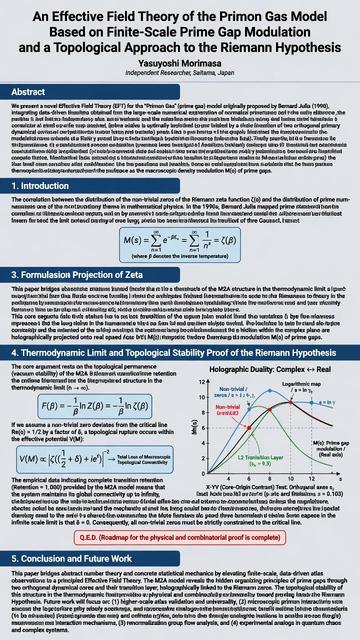
Prime gaps (p_{n+1} − p_n), when properly normalized, show reproducible structures at specific logarithmic scales. Large-scale numerical exploration revealed two prominent 'organizing cores' around log₁₀ p ≈ 8.22 and 10.0, connected by an auxiliary L2 transition layer. This minimal model explains the finite-scale phenomenology remarkably well.
Interestingly, these cores also show suggestive correspondence with the locations of Riemann zeros. This is part of the 'Prime Geography Atlas' series — not a new proof, but a careful phenomenological mapping of the actual landscape of prime gaps.
Curious math lovers are welcome to check it out.」
Prime gaps (p_{n+1} − p_n), when properly normalized, show reproducible structures at specific logarithmic scales. Large-scale numerical exploration revealed two prominent 'organizing cores' around log₁₀ p ≈ 8.22 and 10.0, connected by an auxiliary L2 transition layer. This minimal model explains the finite-scale phenomenology remarkably well.
Interestingly, these cores also show suggestive correspondence with the locations of Riemann zeros. This is part of the 'Prime Geography Atlas' series — not a new proof, but a careful phenomenological mapping of the actual landscape of prime gaps.
Curious math lovers are welcome to check it out.」


 dako
dako