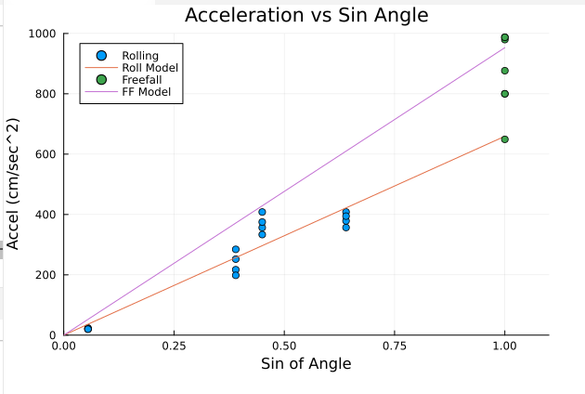
This morning, Alex and I extended our investigation of rolling by rolling a marble down a piece of crown molding at higher angles. We then dropped the same marble from various heights, limited by the ceiling height. Small heights lead to big errors in timing, so we added 4 data points from the full ceiling height. Rolling produces one estimate of acceleration and freefall produces an entirely different one.
@johncarlosbaez
#physics #julialang

@johncarlosbaez

When fitting these models by linear least squares, we specify an intercept of 0 because we know if we level the track, or drop the marble from contact with the floor, it doesn't move. That's an extremely precisely known behavior. However for the free fall, only sin(theta) = 1 is meaningful. We don't yet have evidence of sliding friction free on a track being more like freefall at an intermediate angle.

@johncarlosbaez

Next steps in the experiment. We pull out the springs. We put a bag of marbles or whatever on a scale... and we pull upwards with a spring, measuring the spring extension and the resulting weight on the scale. Then do the same thing without the scale, different weights hanging down... We calibrate the spring basically. Then... here's the magic

@johncarlosbaez

We get a fishing rod with adjustable drag, we attach our known mass to the spring, and then the spring to the end of the fishing line, and we set the drag to different amounts so that the bag of marbles falls to the floor while we can measure the spring extension (say falling in front of a meter stick on video).

@johncarlosbaez

Hopefully we could set this up so the drag is almost but not quite the weight of the mass. So it falls slowly like on the moon or whatever, if we could get a range of accelerations from say 0.1 m/s^2 to 2.0 m/s^2 we could get pretty nice data with just smartphone timers and video measurement of the spring extension. Someone would just hold the end of the fishing rod tip against the ceiling to avoid issues with flex of the rod.

@johncarlosbaez

I tried this out with our 200g lab masses with a hook. setting the drag just below the weight of the mass lets it lower to the ground over like 5 seconds, we can definitely get a range of say 3 to 10 seconds. I didn't include a spring, but it's clearly doable.

Whoops, the previous graph was cutting off data points above the plot... here's the full dataset for freefall