 Kit Peters
SWANSEA: University research helps power world-first hydrogen aero engine breakthrough
Researchers at Swansea University have helped achieve a world-first in aviation — an aero engine running at full take-off power on nothing but hydrogen.
The milestone caps a four-year international programme led by Rolls-Royce and easyJet to prove that hydrogen can work as a clean aviation fuel.
It is being hailed as a significant step towards zero-carbon flight, with hydrogen producing no carbon emissions when burned.
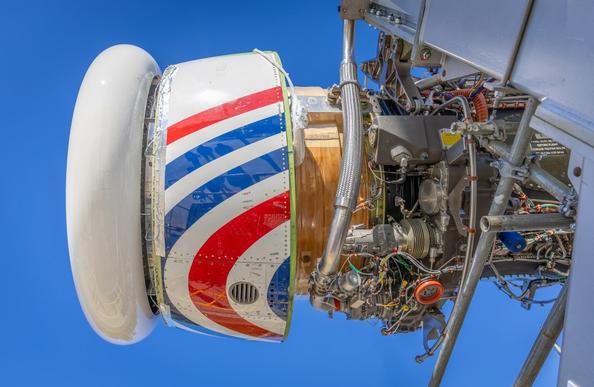
A close-up of the Rolls-Royce test engine used in the world-first hydrogen programme. Image: © Rolls-Royce plc 2026Swansea’s role was to crack one of the trickiest parts of the problem — how engine materials cope with the extreme conditions hydrogen demands.
The university’s Institute of Structural Materials built entirely new testing facilities to do it, working in two areas the research group had never explored before.
The first involved cryogenic temperatures — the intense cold at which hydrogen is stored as a liquid.
The second recreated high-pressure hydrogen environments, replicating the punishing conditions inside a working engine.
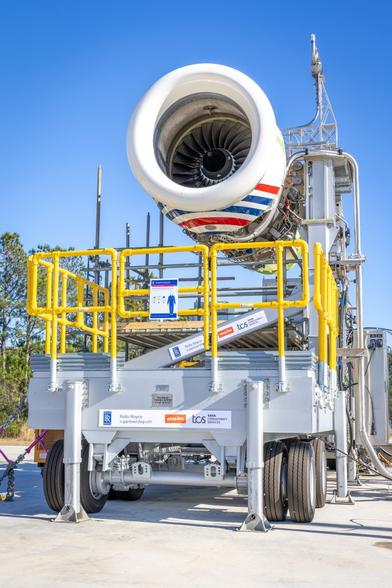
The Rolls-Royce engine on its test rig during the hydrogen programme run in partnership with easyJet. Image: © Rolls-Royce plc 2026The facilities were developed alongside the university’s Steel and Metals Institute, and generated the materials data needed to design the engines safely.
Professor Mark Whittaker, who directs the Institute of Structural Materials and the Rolls-Royce University Technology Centre at Swansea, said the work had drawn on the university’s particular expertise.
He said the institute was an internationally recognised centre for testing materials in high-temperature environments, while its sister institute brought experience of working with difficult industrial gases such as hydrogen.
Together, he said, they had created “truly unique facilities” that generated extensive data to support the development of hydrogen-based engines.
He said the close relationship with Rolls-Royce meant laboratory testing could directly inform how materials behave inside a real hydrogen-fuelled engine.
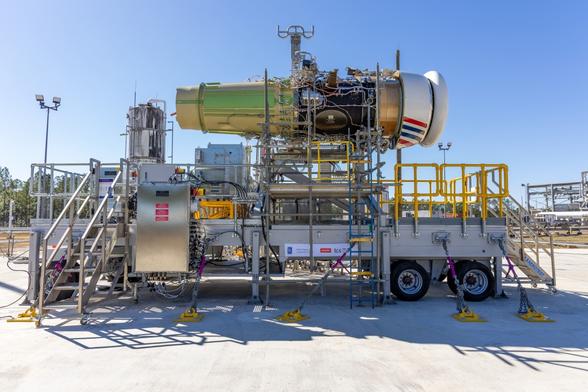
The test engine that ran at full take-off power on 100% hydrogen, mounted on its stand. Image: © Rolls-Royce plc 2026The engine itself was tested at NASA’s Stennis Space Center in the United States, the culmination of a programme designed to prove the technology step by step.
Louise Gale, a materials specialist at Rolls-Royce, said Swansea had been “a clear choice” as a partner, building on many previous collaborations.
She said developing hydrogen-fuelled engines required new ways of testing how materials behave, and that the capability built at Swansea had produced key data for component design and safety.
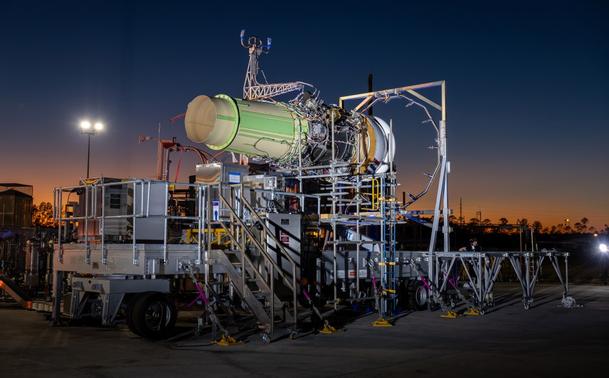
The Rolls-Royce test rig lit up at night during the hydrogen engine programme. Image: © Rolls-Royce plc 2026The work adds to a growing hydrogen sector across south-west Wales, where a £50m green hydrogen project at Milford Haven is among the schemes aiming to turn the region into a clean-energy hub.
The programme also forms part of a wider industry push towards cleaner aviation, with easyJet among the airlines aiming to reach net zero by 2050.
It builds, too, on Swansea’s standing in aerospace research, a field the university has invested in heavily in recent years.
A hydrogen-powered passenger flight remains some way off, but the test marks a significant milestone on the road to proving the technology can work.
Related stories from Swansea Bay News
More aviation news
CARDIFF AIRPORT: A million passengers in a year as Welsh airport becomes UK’s second fastest-growing
Record growth and new routes at the Welsh Government-owned airport.
CARDIFF AIRPORT: First direct WestJet flight from Toronto touches down
Wales’ first direct link to Canada in nearly 20 years.
CARDIFF AIRPORT: Bristol reported to be fighting on over £205m subsidy
The cross-border legal battle over Cardiff’s future.
More on hydrogen in Wales
MILFORD HAVEN: £50m hydrogen green energy ‘revolution’ to create 70 local jobs
How the region is positioning itself as a clean-energy powerhouse.