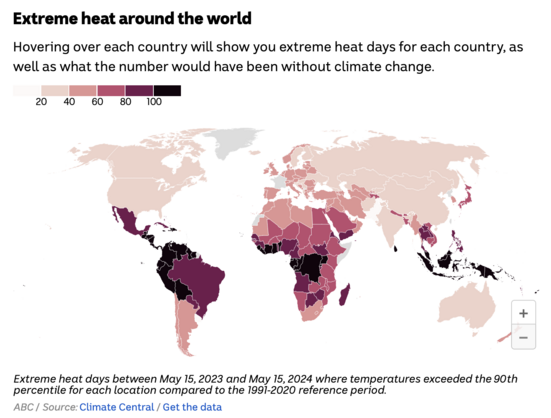
"To better understand what has played out on the ground during those record months, a team of researchers from analysed how many days of unusually hot weather each country experienced over the last year.

It found human-caused climate change added 26 more days of extreme heat, on average, across all places in the world, to what there would have been without a warmed planet."

https://www.abc.net.au/news/2024-06-05/world-the-hottest-on-record-12-months-in-a-row/103904150

Find the number of your country on the article's interactive map.
As 12 months of record heat stack up, scientists unpack the impacts around the globe

As the world hits an alarming climate milestone, a new report by a US research team shows the staggering amount of extreme heat days each country experienced last year, with the majority made more likely by human-induced climate change.
ABC News

"An extreme heat day is one that is warmer than 90 per cent of all observed temperatures at the site from 1991-2020."

https://www.abc.net.au/news/2024-06-05/world-the-hottest-on-record-12-months-in-a-row/103904150

The interactive map shows the largest number of extreme heat days around the equator where temperatures are already high even without climate change.

Extreme heat days with / without climate change:

127 / 27 DR Congo
135 / 12 Indonesia
180 / 10 Ecuador

39 / 20 United States
30 / 20 Russia

As 12 months of record heat stack up, scientists unpack the impacts around the globe

As the world hits an alarming climate milestone, a new report by a US research team shows the staggering amount of extreme heat days each country experienced last year, with the majority made more likely by human-induced climate change.
ABC News

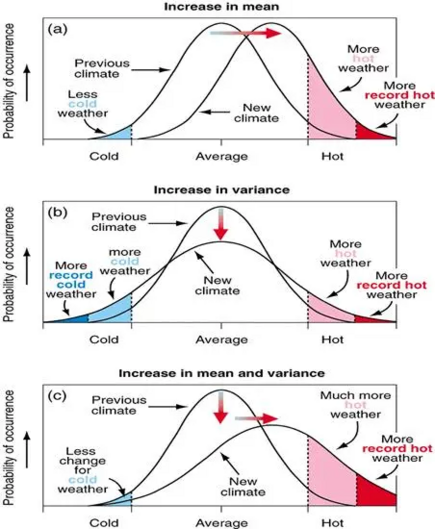
Why the huge increase in days with #ExtremeHeat?

Climate change does two things to air temperature:
1. The AVERAGE shifts to higher temperature. This one is obvious. But also:
2. The VARIANCE gets larger so the extremes become more prevalent

Both of these effects together give a LOT more VERY hot days.

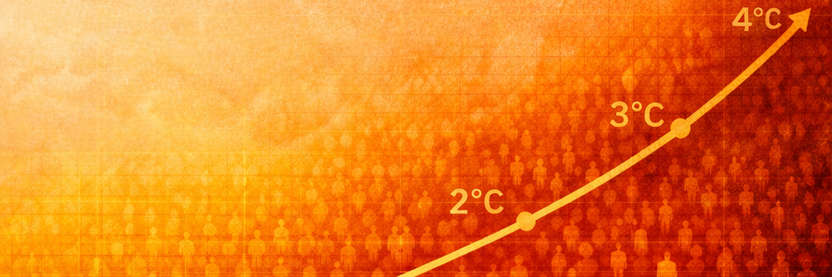
"The world is on track to add nearly two months of dangerous superhot days each year by the end of the century, with poorer small nations hit far more often than the biggest carbon-polluting countries.

But efforts to curb emissions of heat-trapping gases that started 10 years ago with the Paris climate agreement have had a significant effect.

Without them Earth would be heading to an additional 114 days a year of those deadly extra hot days, the same study found."

https://www.9news.com.au/world/weather-world-is-heading-to-add-57-superhot-days-a-year-but-study-indicates-it-could-have-been-worse/4410926b-de5e-4142-adb0-e849e8ac2ea9

The world is heading to add 57 superhot days a year, but study indicates it could have been worse

<p>Earth would be heading to an additional 114 days a year of those deadly extra hot days without current emissions targets in Paris agreement.</p>

9News

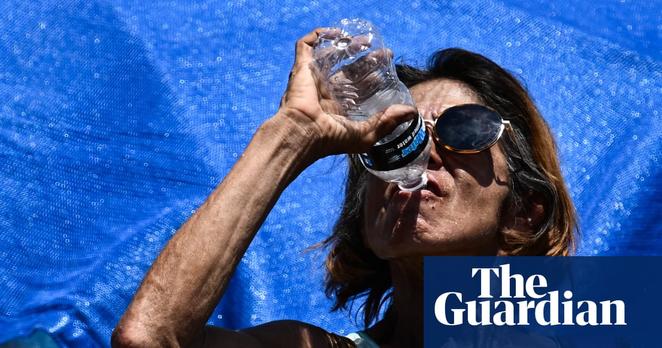
A sobering preview’: extreme heat now affects one in three people globally, study finds

"Rising temperatures making it hard even for young, healthy people to safely do normal physical tasks in many regions

Within countries there are huge variations according to geography, income group and types of work."

https://www.theguardian.com/environment/2026/mar/10/extreme-heat-study-global-warming-physical-activity

‘A sobering preview’: extreme heat now affects one in three people globally, study finds

Rising temperatures making it hard even for young, healthy people to safely do normal physical tasks in many regions

The Guardian

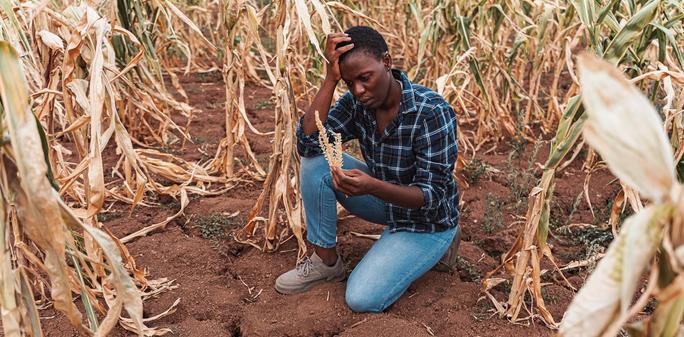
Extreme heat identified as "the most urgent and rapidly growing risk to health and livelihoods across the Southern African Development Community.

A key finding of the study is that extreme heat acts like an "integrator hazard" - a risk that multiplies multiple climate related challenges at once."

https://africasciencenews.org/extreme-heat-emerges-as-a-major-climate-and-health-threat-in-southern-africa/
#ExtremeHeat

Extreme Heat Emerges as a Major Climate and Health Threat in Southern Africa - Africa Science News

By Henry Neondo A new study by the Academy of Science of South Africa, funded by the Department of Science, Technology and Innovation, has identified extreme heat as one of the most urgent and rapidly growing risks to health and livelihoods across the Southern African Development Community. The report, Climate Change and Extreme Heat: Strengthening […]

Africa Science News

"All six heatwaves included periods that would not have been survivable for people aged over 65 remaining outside in full sun [for six hours].

The Larkana and Phoenix heatwaves included periods that were not survivable for older people even if they had found shade.

The Larkana heatwave included a non-survivable period that would have been deadly for people aged 18 to 35 in full sun."

https://www.theguardian.com/environment/2026/apr/08/extreme-weather-heatwaves-breaching-human-survival-limits-study-finds

‘Non-survivable’: heatwaves are already breaching human limits, with worse to come, study finds

Analysis of six extreme heatwaves found when temperature and humidity were accounted for, all were potentially deadly for older people

The Guardian

"Our study was unique because it brought together evidence from across health, labour, food systems and infrastructure to show how heat affects everyday life, analysing heat not just as a weather event, but as a system-wide risk.

In our report, we describe extreme heat as an “integrator hazard” (a multiplier). This means it is not only one risk but makes existing problems worse all at once."

https://theconversation.com/extreme-heat-is-a-growing-threat-to-health-jobs-and-food-security-in-southern-africa-study-looks-for-practical-solutions-280339

Extreme heat is a growing threat to health, jobs and food security in southern Africa – study looks for practical solutions

Extreme heat is a huge threat to health, work and food security across southern Africa.

The Conversation

"This report uses ‘lethal humidity’ as a focal concept.

The report’s main objective is to show that those impacts aren’t isolated: they cascade through societies, magnified by other climate hazards, such as storms and flooding."

https://www.aspi.org.au/report/lethal-humidity-and-the-systemic-risks-of-climate-change/

Lethal humidity and the systemic risks of climate change - ASPI

One of the great challenges in understanding the extraordinary consequences of global warming is our tendency to think in silos.

ASPI

"HEAT exposure could drive a dramatic rise in cardiovascular disease (CVD) burden across the USA over the next 25 years, with researchers warning that climate change and population ageing may combine to reverse decades of progress in heart health."

https://www.emjreviews.com/en-us/amj/cardiology/news/climate-change-could-triple-cardiovascular-disease-burden-by-2050/

Climate Change Could Triple Cardiovascular Disease Burden by 2050

Heat exposure could triple US cardiovascular disease burden by 2050, with older adults and vulnerable communities facing the greatest risks. Learn more.

European Medical Journal

"Researchers estimate that more than two billion people live in what they call “cooling poverty,” meaning they face dangerous heat without safe or affordable ways to stay cool.

So if the problem is not a missing [AC] machine, what is it? The study shows that heat rarely harms people on its own.

It does its damage by teaming up with poverty, bad housing, and weak public services."

https://www.earth.com/news/more-than-two-billion-people-face-dangerous-heat-without-access-to-cooling/

More than two billion people face dangerous heat without access to cooling

More than two billion people live with cooling poverty. Heat risks increase when poverty, poor housing, and outdoor work combine.

Earth.com