 War Fantasy
Mongol Invasion of Hungary 1241, Part 1 – The Invasion
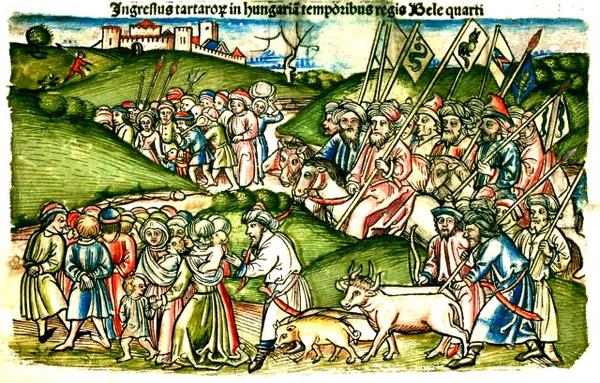
Mongols had invaded Hungary and Croatia in 1241 – 1242 period. Contemporaries described the invasion in the apocalyptic terms. While in the long run far less damaging than the later Ottoman wars, effects were much more immediately obvious and pronounced in the short term. Lowland areas, especially in Hungary, were basically depopulated and overall population losses were significant. Hungary was no a stranger to periodic nomadic invasions: Hungarian Alfod was after all an ideal area for nomads to establish a holding close to numerous settled states they could plunder. But these invasions were easily stopped by border defenses or elsehow contained, and never presented a major threat to the kingdom itself. In fact, Under Andrew II Hungary had been expanding its influence in the Cuman steppe, especially after Andrew’s son, prince Bela, got appointed to the newly created office of the Duke of Transylvania.
This effort proved especially successful following the Kalka battle (1224) which caused a major disarray in the Cuman world. Bortz/Burch’s Cuman tribe adopted Christianity in 1227, and consequently also Pontificial Siege’s political protectorate and Hungarian military protectorate. Cumans could not become Hungary’s political protectorate due to political conflict between Hungary and the Teutonic Order at the itme. During 1230s, Hungary and Russia clashed over the Kuman issue, but the Mongols were increasingly a presence in the area from 1229 onwards.
Hungarian involvement in the steppe naturally captured Mongol interest. While Mongols were always going to attack Europe and Hungary due to their ideology of world conquest (discussed later in the article / series), it is likely that Hungarian involvement with the Cumans turned Hungary into the primary target during the 1241/2 campaign. The great kuriltai of 1235 which had taken the decision to attack the Cuman steppe had explicitly concluded Hungary as one of potential opponents. Batu had in fact been trying to establish diplomatic relations with Hungary from the very beginnings of the military operations in Volga. Bela IV however was aware that the Mongol threat could not be turned away through diplomacy and refused Mongol terms.
Conditions in Hungary
Hungaro-Croatian king Bela IV was 29 years old when he became the ruler. Despite having been crowned already, he crowned himself for a second time in 1235 in Stolni Biograd. Immediately upon coronation, Bela IV set out to reinforce and increase the royal power which, during the rule of his father Andrew II, had fallen low indeed. Some were exiled, others imprisoned, and the worst culprit – palatine Dionisius – was blinded. After them he targeted the major nobles. How low royal authority was can be seen from the fact that major nobles would come to the court with their own chairs, and then discuss matters with the king or advise him while still sitting on the chair. Thus Bela ordered that except for the highest prelates and royal officials nobody is allowed to sit in the king’s presence, and so had all of the chairs burnt. This caused a massive outcry but worse was yet to come: Bela IV soon reintroduced a law of Bela II that nobody is allowed to complain in person, but the complaint has to be written and sent to the king – thus giving the royal chancellory effective veto powers.
He further cancelled all of the Andrew II’s gifts, thus returning to the crown numerous possessions which Andrew had thoughtlessly given away. Each county received special judges which investigated the newly acquired possessions, both temporal and ecclesiastic. All properties that were found to have been acquired illegaly or gifted unjustifiedly were recovered by the crown. This included even the possessions of the religious orders such as the Cistercites, Knights Templar, Knights of St John and others. Of course, all the criminals were extremely upset: even the Pope declared that taking back the possessions which had already been given to the Church is a theft and a sin, but Bela did not give up.
Herzeg Coloman, who ruled Croatia, did similarly in his kingdom. In 1236, on Bela’s orders, he confiscated certain illegally acquired possessions of the Templars. In 1237 he likewise revoked the “excessive and unjust” gifts given by Andrew and Emerik to temporal nobility. But because he always aimed to be just, he gained widespread support of minor nobility and commoners.
Coloman was also busy trying to root out the patarens in Bosnia. From 1234 Coloman was leading a Crusade against the patarens, and by 1237 Coloman and his crusader army had defeated the Bosnian viceroy (ban) Matej Ninoslav and basically conquered Bosnia. But not long after fighting broke out in Croatia and Dalmatia. City of Split mounted an attack against Poljica, Omiš and the Kačić tribe, who were both the pirates and the patarens and often supported the Bosnian and Hum heretics. Trogir, ruled by Stjepko Šubić, had joined to assist Split. But soon Omiš made a separate peace with Split, which caused strife between Split and Trogir – and soon open warfare as well. In 1239 Split gained a new mayor, Garganus de Arscindis. He made peace with Trogir in April 1239, and Split was free to keep fighting against Omiš and Kačićs which had broken the recently made peace and conquered islands of Brač and Hvar. While Gargan failed to take Omiš, he managed to retake Brač, leading to a peace. Omiš and Kačićs had to give to Split their six large ships and numerous smaller vessels, give up the piracy, make alliance with Split and pay 2 000 ducats of penalty should they break the terms.
Coloman was not involved in these events as he was attempting to unite the Split Archbishopy with Zagreb one. This however failed, as Mongols were about to arrive.
Mongol Invasion
Mongols had been living north of the Chinese wall for ages. But during the reign of Andrew II, Mongol chieftain Temujin had united the Mongol tribes in one major state (1206 / 1207). Now called Genghis-khan (great ruler), he took his army to China and conquered the north of the country before conquering also Turkish Khwarazmians (1218), reaching the borders of Europe. He then led the army over the Caucasus, destroying the army of Russian princes in the bloody battle of the Kalka river (1223). Mongol armies, being solely cavalry, could cross in half a day the distance which European infantry-heavy armies had to take three days to travel. In Asia, Mongol armies were augmented by masses of recruited infantry from conquered areas, while in Europe the Mongols had recruited other cavalry nomads such as the Cumans. On top of this, they had excellently organized reconnaissance and intelligence services, and were nearly always well aware of the positions, strengths and movements of the enemy armies. Surrender did not help, as Mongols were oftentimes deceitful: surrender may result in decent treatment, but could also lead to the now conquered enemy being butchered in spite of all the promises.
Temujin was succeeded by his son Ogedei. He finished the conquest of China after a long struggle, and at the next khuriltai held in 1235 the Mongol leadership decided on the conquest of Europe, starting with the people of the western steppe. Neither could the previously described Hungarian efforts to extend their influence into the steppe have escaped the Mongols. That they did not is shown clearly by the fact that the khuriltai had explicitly marked Hungary as one of the Mongols’ potential opponents.
The chief architect of this campaign was Subutei, an old retainer of the Chinggis Khan. A decade earlier he had campaigned against the Russians, Cumans and Volga tribes. His relative expertise in the West saw him appointed to lead the campaign.
Preliminary stage of the western campaign began in 1236, when Mongols sent the army of 150 000 men to attack the Volga Bulgars and the Alans of the Northern Caucasus. Bashkirs and Cumans were also defeated. Campaign continued with the conquest of the Mordvins and the Mokshas in 1237, and destruction of most of the towns in northeastern Russia in the autumn of the same year. Spring of 1238 saw continuation of the campaign in Russia, and the Grand Prince of Vladimir Yuri II was defeated and killed on the River Sit. In the autumn of the year the Mongols conquered Crimea as well as the Cumans of the Black Sea Region, as well as mounting the campaign in the Caucasus. Late 1239 saw the capture of the Alan capital of Magas, but also Hungarian offensive into Mongol territory with the aim of securing Hungarian borderlands. This offensive was unsuccessful, with comes Ultrasilvanus dying in battle near the Azov sea. The aim may have been to try and assist the Cuman khan Kuthen, who was leading an initially successful guerilla campaign against the Mongols. Kuthen’s decisive defeat later that year sealed the fate of the entire northern Black Sea steppe, with Kuthen and his Cumans being forced to take refuge in Hungary.
Mongol campaign in Caucasus was still not finished by 1240, even though Mongols had reached Derbent on the Caspian sea that year.
Temujin’s next step was thus sending his son Batu-khan to Europe. Batu attacked first the Russia, conquering Russian duchies one after another, including Kyiv in 1240. Great Duke (knez) Mikhail Vsevolodovich of Kyiv had requested Hungarian assistance, but Bela IV was unable or unwilling to risk another clash with the Mongols abroad. Following the conquest of Kyiv, Batu broke into Poland, conquering Krakow in 1241. There, he divided his army into three groups. First group went into Germany, second into Czechia, while the third group went towards Hungary. Hungary group was by far the largest one, containing three out of the total of seven armies Mongols had deployed for the western operation. In total, Mongols had deployed some 120 000 – 140 00 men in invasion of the Centeal Europe, organized in tumens of 10 000 men each. Army group under direct command of Batu and Subutai was the one that invaded Hungary directly, numbering over 50 000 men. Poland was invaded by an army group led by Baytar, Ordu and Kaidu, numbering 30 000 – 40 000 men in total. Thus, it seems likely that the southern group may have numbered 30 000 men, of which 10 000 went in the Severin direction and 20 000 against Transylvania.
Bela IV immediately began the preparations. But these were slow. While Hungary was the most powerful kingdom of the Central and Eastern Europe of the time, Mongol arrival found it in a state of disarray. Nobility, having seen its privileges reduced by Bela in the past years, was in no hurry to support him – even against a foreign invasion. Situation was made even worse by the fact that the populace was also disinclined to trust Bela. Bela IV had previously settled 40 000 Cuman families that were escaping the Mongols into Hungary. While perhaps a good idea on paper to strenghten Hungary with people who knew how the Mongols fought, in reality it proved a disaster. The newly arrived immigrants proved unwilling to follow the laws of the kingdom, and instead did every sort of violence against it and its people, plundering and causing chaos as if they were an invading army in a hostile land. Conflicts resulted in murder of Cuman khan Koten in the city of Pest in 1241, causing Cumans to withdraw towards Balkans while burning multiple Hungarian cities and towns.
The only thing accepting Cumans has achieved was to turn the populace against Bela while at the same time providing the Mongols with the casus belli as they considered Cumans their own subjects. Making things even worse was the fact that this was not the first time news had spread of an impending Mongol invasion. Thus the news of the threat that had never before actually materialized were treated as something of a joke. In fact, nobles began to talk that the news of Mongol approach was just fancy tales spread by the king as a way of increasing his authority.
In these circumstances, Bela could only send palatine Dionysius Hedervary into the Carpathian passes while calling for a parliament. But it was too late: Mongols under Batu had forced their way through the Verecke pass on the 10th March 1241, and on the 12th March Dionysius’ army was defeated after several days of battle. Dionysius himself arrived to Pest on 15th March bearing these news, and the Mongol scouts arrived there the very same day. Two days later the army corps under the command of Šaiban reached the Danube near the town of Vac.
Mongols had penetrated Hungary from several directions. The main Mongol force under Batu and Subetei had entered the kingdom through the Verecke pass in Galicia. A contignent led by Buri and Qadan, the Great Khan’s son, crossed the Carpathians through the Bargau pass into Transylvania while the third army had entered from the southeast. Two northern armies then converged onto Alba Iulia.
Even a month after the Mongols’ arrival, Hungarian army was still not ready for the battle. Mongols were free to devastate the northeastern Hungary as well as the Erdely (Transylvania). Yet Erdely, protected by the mountains, proved a tough nut to crack. Defense of Transylvania, as relatively weak as it was due to lack of stone fortifications, still held up the Mongols for much longer than they had anticipated. The breach of the Carpathians was only accomplished on 31st March, and by the day of the battle at Mohi, Kadan’s and Buri’s troops had only reached the Transylvanian cities of Cluj and Sibiu.
Upon hearing of Bela’s mustering the army, Mongols witdrew eastwards, luring the royal army towards the Mohi field. Bela himself could not just let them be: Hungary did not have many strong fortifications, and his own position among the nobility was insecure. Against his own better judgement, Bela IV opted to attack. As Bela slowly approached, the Mongols withdrew beyond the Sajo river, setting up the camp at its left shore. Mongol camp had the swamp behind it, while in front of it was an endless plain giving them the best possible conditions for their way of warfare.
When Bela and his brother Coloman arrived, they encamped the army so tightly that the soldiers could not even navigate their own camp. Worse, many prelates and barons had nothing against the king being defeated, believing that it would damage his authority and thus make their own situation easier.
Hungaro-Croatian army was still taken by surprise when a defecter revealed that the Mongols were about to cross this very night. At this news herzeg Coloman took the Croatian army to the hithertho undefended bridge, where he indeed did find and disperse some Mongol troops that had crossed the river. He pushed the Mongols back and, placing the bridge watch, returned to the camp. During the night however Batu-khan brought up the artillery and bombardment forced the Hungarian bridge guards off the bridge. Mongol army then crossed the river, part over the bridge and part over the ford some distance downriver.
By the dawn of the second day the Mongol army had established partial encirclement of the Hungarian camp, forming a “horseshoe” around it. Heavy arrow bombardment woke up the Hungarians in panic; only the Croatian, Italian and Templar forces were able to form up for battle properly. Attempts at breakthrough failed however, and the entire Templar force – which formed the vast majority of Hungarian heavy cavalry – was eventually destroyed. Majority of the Hungarian army panicked and attempted to run away along the main road. After overcoming what little organized resistance there was, Mongols chased down the fleeing Hungarians, killing them to a man. Some older historians estimate that some 56 000 men had been killed in the battle; while this number is not impossible, a number of 10 000 casualties – nearly the entire army, as estimated by te contemporary chronicles – is much more likely. This would in fact give the Mongols a degree of numerical advantage as their force in Hungary numbered 30 000 men, and the army at Mohachs may have been anywhere between 15 000 and 30 000 men. Mongols themselves had suffered unusually high losses in the battle (several hundred to several thousand men), but still proceeded with the conquest of Hungary.
Herzeg Coloman had managed to escape but succumbed to his wounds in Čazma (Časma). He was buried there in the church of St. Dominik, where he received a monument that was later destroyed by the Mongols.
Following the victory at Mohi, Mongols had conquered the entire Hungary to the left shore of Danube (that is, the eastern parts of the kingdom). Many cities, having no fortifications to speak of, were quickly destroyed. Even the royal city of Pest, having wooden walls at best, was devastated – but the stone castle in Obuda, constructed in 1220, resisted the attack. People who survived the slaughter ran away to the mountains, caves and the forests. During this period Kadan’s troops occupied northern Transylvania, destroying Tamashida before trailing southwest through the Koros-Maros Interfluve towards the important cities of Csanad and Szeged. Inhabitants of some seventy villages gathered at an improvised fortification at Pereg hoping to survive the Mongol raids. Mongols attacked by using captives as human shields, and after a week of fighting overcame the defenders and killed everyone. Even so, resistance was causing them problems. While Mongols had overcome even stronger fortifications previously, they were likely not prepared for the situation where each village was fortifying itself and resisting. Many improvised fortifications were erected during this period on western Hungary as well. These earthworks were especially dense along the Danube itself which was serving as a barrier to Mongols, with fortifications typically being only several kilometers apart.
Hungarian defense of the Danube was entrusted to iudex curiae Paul Geregye, count of Alba Regalis. He managed to hold up the Mongols for ten months, but the Mongols steadily broke down the improvised defense, eventually opening the way for the second Mongol offensive. Nevertheless, this defense was a key on survival of the kingdom as it allowed the rest of the kingdom to prepare – river alone will never have stopped the Mongols. Even as the winter came and the river froze, Hungarian troops fought on it daily, even breaking the ice in the effort to hold back the Mongol attacks.
King himself had taken his wife and children and escaped to neighbouring Austria, where he was hosted by the Duke Frederick, who forced him to cede three Hungarian counties bordering Austria. Bela then left Austria and went to Croatia to prepare for further war against the Mongols. Mongols themselves devastated Hungary on the both shores of Danube, with improvised defenses built in many places doing little to stop or slow them down. People en masse buried their valuables before leaving to hide in the forests, hills, marshlands and other places inaccessible to the Mongol hordes. Mongols massacred whoever had failed to flee in time.
On the way, king Bela paused in Zagreb while sending his wife and children onwards to Croatia. He received no help from Europe despite all of his requests. Only the Pope Gregory IX, an old man of eighty summers, gave him what help he could: a blessing and a letter in which he gave indulgence to those who would take up arms to defend Hungary from the Mongols – same reward as given to participants in the Crusades. While in Zagreb, Bela IV ordered cities to be fortified as well as possible and prepared for siege, and also sent the royal and ecclesiastical riches – most importantly the sacred relics of St. Stephen and the royal crown – to Dalmatia, whose fortified cities offered the best hope of resisting the Mongols.
Winter came, and Danube froze over just before Christmas. Exploiting this, at the day of Christmas the Mongols crossed the frozen river and entered the western Hungary, completely devastating it. Many cities and castles were burned down; out of all the castles north of Drava, only ten castles (six in the western and four in the eastern Hungary) survived the Mongol occupation. All ten had been built of stone and situated on elevated sites. City of Eszetgorm was sacked in January 1242. But Mongols had suffered losses in the process, especially once they had crossed into Transdanubia, as settlements and forts there had prepared for their arrival and actively planned the defense. In many cases this resistance was in fact successful, even though no notable victories were scored to be recorded by the annalists. Bela IV fled southwards, hoping that the mountainous southern Croatia with its numerous well-fortified cities would provide an adequate refuge. While Batu and Subetei moved against Buda, Szekesfehervar and Esztergom, Qadan was dispatched into pursuit of the king as Batu could not consider himself a ruler of the country until Bela had been captured.
Not long after Bela had left Zagreb (sometime during February 1242), Mongols had crossed Drava, entering Slavonia in multiple places, sending population fleeing to forests and mountains. Resistance by the count (župan) of Varaždin barely slowed the Mongols down. One Mongol column devastated the city of Banoštor in Srijem, before proceeding to devastate eastern Slavonia, destroying the city of Orljava in Požega County in the process. Another Mongol army had crossed Drava into Križevac county before rejoining the main army that had arrived from eastern Slavonia.
Mongols then proceeded to attack and destroy Čazma (Česma), destroying the city before proceeding towards Zagreb. Solidly fortified Kalnik resisted the Mongols under command of Count Philip Akos. This period also saw the erection of many improvised defenses in the area, especially in eastern Slavonia close to Drava. These included the earthen fortifications at Mihaij, some 1,5 km north of the village of Vojakovački Osijek, by the river Glogovnica on the eastern Kalnik Mountain, as well as those at Torcec-Gradic in the Podravina region near Koprivnica. These have acted at least partly as a refuge for the civilians. Settlements in proximity of these forts were destroyed by the invaders (e.g. Djelekovec and Djakovo).
Zagreb itself was destroyed as it completely lacked any kind of fortifications. Batu-khan then turned southwards, having received word of Bela’s flight towards Dalmatia. Near Sirbium (likely river Srebrenica, a confluence of Una) in Lika he ordered the execution of numerous captives. After this he crossed Velebit, turning towards the coastal cities.
Unlike the cities in Hungary and Slavonia, cities of coastal Croatia had inherited and maintained strong defensive walls built during the antiquity. It is thus unsurprising that these were the place Bela IV had fled towards. Arriving first at Split, Bela soon left it and turned towards Trogir which being located on an island was far easier to defend. Another reason for his decision was likely the fact that the pro-Venetian Split was at the time involved in a major dispute with the powerful Croatian noble Subic family, which also controlled Trogir.
In the first days of March 1242 the first Mongol forces appeared on the slopes of Mosor above Split. Refugees camping outside the city fled behind the city walls. Anyone left outside was killed by the Mongols. Citizens of Split prepared war machines to defend their city, but the Mongols, having reconnoitered city’s defences, decided not to risk an attack. Few days later however Batu-khan himself arrived with his main army and assaulted the town of Klis. Mongols took the town itself, but the fortress above the town resisted all attacks and the Mongols were forced to retreat.
Inability to either capture king Bela or conquer heavily fortified cities in Croatia induced the Batu-khan to abandon his attempts to conquer Hungary. But before he gave up, he made an attempt towards Trogir where he heard king Bela was. Bela, hearing of Mongol approach, escaped to an island. But since Trogir was an island city, separated by a sea channel from the mainland, Mongols were unable to approach it. Mongol attempt at Šibenik met with the same lack of success.
Incapable of taking strongly fortified coastal cities, and running out of fodder for horses, Batu-khan had to retreat back to Pannonia, backtracking the same way he had come. But because passages across Velebit had been blocked by the defenders, he had to go by the Podgorje county to Senj. Along the way, Batu-khan learned that Bela IV was on the island of Rab. Building an improvised navy of boats and rafts Mongols attempted to cross to the island, but Croatian ships intercepted and destroyed the ramshackle Mongol fleet.
Following this victory, Bela IV left for the island of Pag. From there, he landed in Podgorje, but was engaged heavily at the Grobnik Field by the Mongol forces. Battle was decided with the arrival of Croatian forces guarding the mountain passes, led by brothers Kres, Kupiša and Rak from the Srijem County. Legends state that some 56 000 Mongols were killed on that day.
Whether the above battle had actually happened is unclear, and many modern historians reject it as a later fabrication. Historicity of the battle however is indirectly supported by Bela IV’s own later issued documents. In 1251 he confirmed the dukes of Krk their privileges as they had supplied him with ships and guarded him on land. Bela also mentions multiple battles against the Mongols in the maritime Croatia which forced Kaidan to withdraw. Battle is also mentioned by Abu’l Fida, who relied for most of his material on the geographical work of Ibn Said al-Maghribi, a 13th century author from Muslim Spain. Abu’l Fida states that “when the Tatars approached the fort of Sebenico [Sibenik, some 35 km northwest of Trogir], Hungarians, Germans [meaning Templar Knights] and Bashkirs united their forces, inflicting defeat on the invaders, who were forced to return to their land”.
Considering the terrain and circumstances as well as the typical Croatian tactics when fighting in Dalmatia, it is not unlikely that a smaller Mongol detachment may have been destroyed. Battle will have then grew with time and telling into a decisive battle it most likely was not – a scouting detachment of 600 or 6 000 men could easily have become 60 000 over the centuries.
Whatever the case Mongols retreated towards Krka and eventually Dubrovnik. Dubrovnik proved impregnable to the Mongols and they were able to inflict only limited damage to the countryside, but they set fire to Kotor and razed to the ground Svach and Drisht (Drivasto) further south. From there went to Bosnia, Serbia and Bulgaria. The sources are silent on what if any actions Mongols took in Serbia. Only information known is that Qadan eventually joined forces with Batu in Bulgaria. Serbia was mostly ignored by the Mongols, with any damage done being limited enough that it is not readily apparent in the archeological record. Mongols likely captured Belgrade during this retreat, but there was little Stefan Vladislav will have been able to do, considering his realm lacked any heavily armored troops necessary to confront the Mongols. By the end of spring of 1242 Qadan’s forces had crossed into Bulgaria, leaving a trail of destruction in their wake, and the enfeebled Bulgarian regency accepted their suzerainty.
Aftermath
In the autumn of 1242, King Bela returned to Zagreb. Well aware of the possibility of Mongol return, and with the vulnerability of his kingdom now obvious, he decided to take what steps he could to secure it. Primary concern was to ensure the presence of a sufficient number of stone fortifications – cities and castles both – to resist any future Mongol assaults. Thus Bela gave to numerous cities the status of a Free Royal City. He also promoted settlement of Germans as well as of the Knights Templar and Knights Hospitaller, with the intent of gaining the troops and specialists to fortify the kingdom.
Bule given to Gradec is a good example of rights and obligations of a free royal city:
With Coloman’s death, place of Herzeg or Ban of Croatia was empty, and Bela gave ban Dionysius the place of Herzeg.
Bela IV launched a massive program of castle construction and reconstruction. Between 147 and 172 new-type stone castles were constructed in the period from 1242 to 1300 AD, and 22 towns with privileges were also established in the first three decades following the Mongol retreat.
Hungary had been devastated, but not equally so. Great Hungarian Plain was nearly devoid of people, its cities and castles in ruins. But the hilly areas with stone fortifications – specifically parts of northern Hungary, Transylvania, heart of Transdanubia and southern Croatia – were better protected. Devastation of the Great Hungarian Plain was caused equally by its topographical favorability to fast-moving horse nomads and the lack of adequate fortifications. Mountainous areas with strong fortifications escaped the Mongol invasion nearly untouched.
Distribution of new construction may also indicate the impact of the invasion. The majority of new castles were not situated in the eastern and central plains of the country, which had borne the brunt of the Mongol invasion, but rather in the mountainous western and northern borders. While some authors had suggested that this was because new castles were not intended to fight the Mongols at all, but rather against the European rivals, fact that these castles were constructed immediately following the invasion, that Poland was also constructing new stone castles at the same time, and that all other countries facing the threat of Mongol invasion also constructed a network of castles if they were able to (e.g. Song China), would argue against this interpretation. Rather, most likely explanation is that the Great Hungarian Plain had been depopulated by the invasion, and only the mountainous areas had the demographic and population werewithal to actually embark on the fortification programme. In fact, the distribution of castles has the inverse relationship with distribution of sites showing Mongol-caused destruction.
But in the end, death toll was devastating – at least some 200 000 – 400 000 people had died, from the prewar population of cca 2 million. Casualties may well have been even greater than this, and estimates postulate that 50% of population of the most affected part of the kingdom (the Great Plain and Transylvania) may have perished from the invasion and the subsequent famine.
Whatever the exact numbers are, sources describe a cataclysm of unprecendented character – basically a wholesale destruction of people of Hungary. Mongols regularly violated European norms of warfare, carrying out essentially war crimes. Sources are unanimous in describing the invasion in apocalyptic terms. Carmen Miserabile of Master Rogerius, written only shortly after the invasion, discrabes a litany of atrocities by the invaders that violated any notions of acceptable behavior in warfare that Europeans held. As Rogerius wrote, “Behold, during that summer [1241] they destroyed everything all the way to the borders of Austria, Bohemia, Moravia, Poland, Silesia, and Cumania as far as the Danube.”. After the Mongols crossed the Danube, Rogerius describes destruction on the other side of the river as similarly extensive, stating that only the citadel of Eszetgorm, the city of Székesfehérvár, and the monastery of Pannonhalma were still holding out. Describing withdrawal across Transylvania, he wrote that “With the exception of a few castles, they occupied the whole country and as they passed through they left the country desolate and empty.”.
Authors portray the devastation as uniformly total. Thomas of Split, another contemporary churchman, described how the invaders “wasted the whole realm of Hungary with their raging sword” and how “bodies lay scattered over the fields, and the corpses of the common people lined the roads in countless numbers” in the ensuing famine. Bela IV, writing to the Pope, stated that his kingdom had been “reduced to a desert by the scourge of the Tartars.”. This clashes with the archeological record that points to quite uneven distribution of devastation. Archeological excavations very clearly show that destruction was indeed brutal: villagers seeking shelter in the oven of a house, unburied corpses in ditches, casualties of battle, people slaughtered regardless of age or sex, corpses buried haphazardly in the ruins of a burned house, and corpses of those who might have died of epidemics and starvation, and evidence of canibalism. This brutality likely caused the view of the devastation as being more widespread than it really was.
Archeological finds of burned settlements and buried hoards from the time however show clear spatial distribution. Majority of the traces of destruction are concentrated in the Great Hungarian Plain, especially its central and northeastern parts. Corpses connected to the invasion, showing evidence of violent death, are also concentrated in these areas. And it is in these areas that Cumans were later settled, allowing them to live separately from Hungarians and thus minimizing conflict. Finds also support the accounts of people gathering at and fortifying villages. A number of sites with enormous ditches around the churches had been found at the Great Hungarian Plain – all of them with traces of destruction, showing that such improvised defenses were clearly insufficient. Mongols employed hunting tactics against the people, making it difficult for inhabitants of flat plains to escape. And even those that did escape often died of famine. In the western Hungary however dense woodlands offered escape for the populace, and so most of destroyed villages and churches were rebuilt in brick. Fact that Bela IV was able to wage a successful war against Friedrich II Babenberg of Austria only a few months after the Mongols had left shows that much of Hungary had in fact escaped devastation.
The level of devastation in the Great Hungarian Plain however was indeed apocalyptic. This is easily seen from the maps of monastic centres. Whereas before the invasion these were equally distributed throughout the kingdom, after the invasion the monastic sites in the plains nearly dissappear. Even by 1500 the monastic communities among the Tisza, Koros and Maros as well as in the central plains were still not rebuilt after having been destroyed or abandoned during the Mongol invasion. Meanwhile the western and northern (today’s Slovakia) parts of the country showed a massive increase in monastic sites. This clearly shows the absence of population in the Pannonian Plain.
Danube itself had in fact functioned as a strong fortified line until it had frozen over, also proving that Hungary had not lost its entire military capability at Mohi. But while the Western Hungary escaped the worst of devastation, Hungary east of Danube appears to have been nearly entirely depopulated. It is in this depopulated area that nomadic Cumans were settled following the Mongol withdrawal.
Nevertheless, all of this still made Batu Khan’s invasion of Hungary the most devastating Mongol expedition in Europe. Croatia and Serbia however do not appear to have been affected anywhere as much, especially Serbia which was mostly ignored by the Mongols.
Changes in Hungary’s Defense Strategy
Immediately following the Mongol invasion, Bela IV began revamping the entirety of Hungarian military. The biggest change were the fortifications. Until 1241, majority of fortifications in Hungary and Slavonia were constructed on level ground and defended by earthen or wooden walls. This made them extremely vulnerable to traditional Mongol tactics consisting of bombardment by siege engines and incendiaries followed by an escalade, as displayed by quick fall of Pest in 1241. But after 1242, a significant number of new stone castles (142 – 172) were constructed throughout the country. Vast majority of castles were situated in the mountainous western and northern areas of the kingdom, which had been spared the devastation due to terrain. Thus it is likely that castles were constructed in defensible areas which still possessed adequate resources to construct expensive stone fortifications.
Knights Hospitaller were invited into the kingdom to build stone castles, something which Hungarians had no experience with. These were positioned along the key positions, such as the Turnu Rosu Pass along the Olt River, through which the Mongols had invaded in 1241. Hospitallers were also to fortify Transylvania, but their most important strategic role was the construction and garrisoning of key positions within a line of strong fortifications along the Danube. Most important such position was likely the Margaret Castle, on the southern end of the Margaret Island, separating Buda and Pest. Island was also important symbolically as king’s daughter Margaret resided in the convent on the island. Hospitaller presence there lasted from at least 1278 until 1290 at latest, in accordance with the declining sense of Mongol threat, especially following the decisive Mongol defeat in their 1285 invasion of Hungary.
During the invasion, fortified cities and fortresses in the mountainous southern Croatia had effectively resisted the Mongols. While the town of Klis may have been taken by the Mongols, fortress above the lightly fortified town had resisted and survived unscathed. Mongols likewise failed to take fortified cities of Split, Trogir and Dubrovnik, though Trogir at least had the advantage of being located on an island. It was thus quickly obvious that citadels positioned at elevated sites or protected by bodies of water could successfully resist Mongol assaults, a fact that was also seen elsewhere. Thus the new castles will have been built primarily in areas where such topographical features were available – that is, the mountainous areas of Transylvania, western Hungary and southern Croatia. A number of castles were constructed in the mountain passes, such as the Turnu Rossu Pass along the Olt river which had been used as an access point by the Mongols during the 1241 invasion. Another important factor was also the fact that majority of devastation caused by the Mongols appears to have occured in the Hungarian Plain, which means that workers necessary for constructing new castles were more readily available in mountainous areas, and the western Hungary in particular.
Main defensive line in the case of Mongols’ return was to be the Danube river. This was a logical conclusion after Hungarians had managed to hold up the Mongols on the frozen Danube for ten months in the aftermath of Battle of Mohi, despite the lack of any significant defensive preparations. Danube was the proverbial line in the sand in case of repeated Mongol invasion, protecting the densely populated areas that had largely escaped devastation during the 1241 invasion. Areas to the east of Danube were far less valuable, having been significantly depopulated during the invasion. Thus a large number of castles were constructed along the Danube, with at least one – the castle on the Margaret Island between Buda and Pest – belonging to the Knights Hospitaller.
Pest was in fact the first city in entire Hungary to receive defensive city walls, with construction beginning shortly before the Mongol arrival. While unfinished city walls were unable to stop the Mongols, castle in Buda survived. It was around this castle that Bela IV began to establish a new hilltop settlement in 1243, relocating burghers to the western bank of the river. Fortifications there existed in 1255 at the latest. Esztergom, the former capital, was donated to the archbishop in 1256, and a foreign source called Buda the kingdom’s civitas principalis by 1308.
Another linchpin of the Danube defense line was Visegrad. Situated on an imposing hilltop on the Danube bend, it was built in the place of a small fort that was destroyed during the Mongol invasion. The new fortress had an upper and a lower castle, with major artillery positions in the lower castle. It became a fully functional castle by 1265 at the latest, and played a major role in the civil war of 1284. Similar development occured to Zagreb, which was formed from settlements of Kaptol and Gradec following Bela IV’s Golden Bull, and also had a fortress of Medvedgrad established above it following the Mongol withdrawal (constructed in 1249 – 1254).
The stretch of plains east of Danube, the Kiskunsag, was resettled by Cumans in 1246 – 1247, with Bela IV marrying his son off to a Cuman princess so quickly that he didn’t bother waiting for their conversion. This meant that Cumans were nicely separated from the still densely-settled regions to the west of Hungary, thus avoiding the otherwise inevitable conflict between the newcomers and the native population. Nomadic Cumans were also an ideal defense force for the now mostly empty plains that did not provide conditions for construction of castles.
Matthew Paris recorded that in 1246 the Mongols again invaded Hungarian territory to subdue it, and the king withdrew the inhabitants to fortified defenses to await the battle while sending word to the pope to help him. This is supported by the fact that inhabitants of Pest had been evacuated to Buda at the time, and in 1247 the Pope wrote a letter to the bishops of Esztergom and Kalocsa, commanding them to erect fortifications at defensible sites to receive the populace. According to a Chinese source, Uriangqadai, the son of Subutai, took part in Batu’s punitive campaign to subdue the Poles and Germans in 1246, and he was still in the western regions when Güyük Khan died in 1248. The Russian Nikonian Chronicle likewise mentions Mongol invasion of Hungary and northern lands in 1247-1248, but with little useful data. More reliable is a letter sent by the archbishop of Canterbury in 1247, where he states that he heard the Mongols had returned to Hungary. Further, the king of France received a Mongol embassy in early 1247 demanding his submission. Regardless of the true extent of this threat (real invasion, raid or rumors), it certainly hastened the decades-long overhaul of the defensive system.
While documents support the idea that castles had been built for defense against the Mongols, some historians had argued that predominantly western positioning of the castles means that Bela IV had built them primarily for defense against his European rivals. Yet this explanation is in fact unsupported. Bela IV had strongly fortified the Danube to serve as defense against another Mongol invasion – yet doing so will have left the most populated areas of the country open to any invasion from the west. Instead, location of construction of castles depended on local availability of labor and Hungarian strategy. Castles would have been difficult to build in the Hungarian Plain as required labor was simply not available due to depopulation of the area, and thus distribution of castles matches the distribution of surviving monastic centres.
This was not the only change. While Hungarian rulers had always watched the Eurasian Steppe with a wary eye, in the aftermath of the 1241 invasion Bela IV pointedly cultivated close relationship with rulers of Poland and Rus, specifically so he could gain intelligence on Mongol movements and intentions.
#1241 #Hungary #invasion #MongolInvasionOfHungary1241 #Mongols