1/3
#MathsMonday #Math
I've seen 2 people in #Mathematics claim recently that we can't prove that a+b=b+a - the Commutative Property - and that we just accept it as true. Nope, not only is it literally proven, but we show students the proof when we teach this to them. File this under "Mathematicians forget what they were taught in high school, again" (along with The Distributive Law, which I just happened to be teaching to my Year 7's last week). There are multiple #Maths proofs of this...

2/3
In fact the first time students see this is in Primary School, when they can do it for themselves with Cuisenaire Rods. In the picture we can see an orange rod of length 10, and next to it a blue rod of length 9, and a white cube for 1, and we can see that 9+1=10. Now just reverse the order of the rods and we have 1+9=10, thus proving the Commutative Property.

Next up the same thing with algebra in high school. If a=2, b=3, then
a+b
=2+3
=(1+1)+(1+1+1)
=1+1+1+1+1
=(1+1+1)+(1+1)
=3+2
=b+a...

3/3
And obviously that holds true for all values of a and b

After that we teach students how to do inductive proofs, which can also be used...

Prove it's true for n=1

1+1=2=1+1 (obviously you need to imagine I swapped the order, as we did with the Cuisenaire Rods)

Assume true for n
n+n=n+n (ditto)

Show it's true for n+1
n+1+n+1
=n+n+1+1
=(n+n)+(1+1)
Thus true for all values of n

These are so trivially easy it astounds me that people say it can't be proven! Need to go back to high school! πŸ™„

@SmartmanApps
1. So what axioms are you using? I think folks make the claim that you're debunking because, in abstract algebra, you may be in a weaker setting like a group, and there you can't prove commutativity.
2. If you want to show that a+b = b+a, your statement obviously includes two variables, but your induction only includes one (which you call n). Maybe there's a use for mathematicians after all! Let me know if you want more hint

@cardinal_reinhardt
"So what axioms are you using? " - oh, you're one of those types.

"in abstract algebra" - which you don't need when you have an arithmetic proof πŸ™„

"induction only includes one (which you call n)" - that's how inductive proofs work. Prove it's true for 1, assume it's true for n, show it's true for n+1

"Maybe there's a use for mathematicians after all!" - says someone who doesn't know how inductive proofs work πŸ™„

@SmartmanApps

β€œwhich you don't need when you have an arithmetic proof πŸ™„β€

No offense but have you ever studied abstract algebra, group theory, rings, fields, etc, because this. does not make sense

β€œthat's how inductive proofs work. Prove it's true for 1, assume it's true for n, show it's true for n+1”

You're right, that is basically how they work. And "it" is a+b=b+a, so I think you're saying "assume it's true for n" means you substitute both a and b by n? That right?

@cardinal_reinhardt
"because this. does not make sense" - I guess you don't understand arithmetic proofs then if it doesn't make sense πŸ™„

"You're right, that is basically how they work" - that's exactly how they work. We teach it to high school students

"you substitute both a and b by n?" - you know a and b are allowed to be the same value, right? I have 10 apples and 10 bananas, a=10, b=10

@SmartmanApps
- "have you ever studied abstract algebra"
-- "..."

OK, if you don’t want to answer I won’t make you, but owning what you don't know is much better than dodging qs, someone asks me about cohomology I be like Β―\_(ツ)_/Β―
Here’s a good textbook if instead you want to learn it: https://www.amazon.com/Contemporary-Abstract-Algebra-Textbooks-Mathematics/dp/1032778911

"a and b are allowed to be the same value"

So in the same way, to assume a = b is true for n, you would assume n = n?

Contemporary Abstract Algebra (Textbooks in Mathematics): Gallian, Joseph: 9781032778914: Amazon.com: Books

Buy Contemporary Abstract Algebra (Textbooks in Mathematics) on Amazon.com βœ“ FREE SHIPPING on qualified orders

@cardinal_reinhardt
"OK, if you don’t want to answer I won’t make you, but owning what you don't know is much better than dodging qs" - says someone avoiding owning that they don't know how to do arithmetic proofs. πŸ™„ #EveryAccusationIsAConfession

"someone asks me about cohomology I be like Β―\_(ツ)_/Β―" - and when someone brings up proofs you deflect to a different topic, same as you did last time round. So predictable...

"you would assume n = n?" - you know that's not an assumption, right? πŸ˜‚

@SmartmanApps
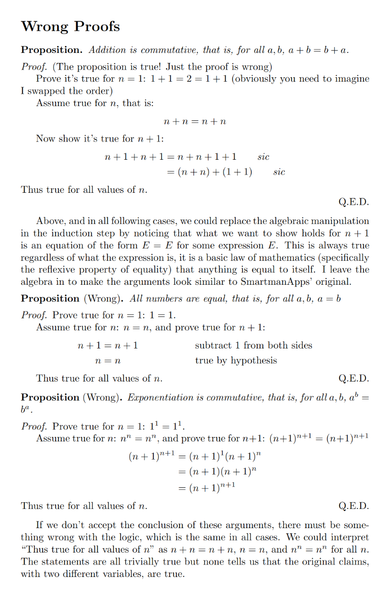
Clearly you really don’t want to answer questions so I’ll leave you with what they were hinting at: some β€œproofs” using the exact same logic as yours but which are obviously wrong. Plus a correct proof of commutativity, should be enough about proofs.
I wonder if you need to take a step back and look at this on your own, or with a trustworthy colleague, either way I leave you with something to think about sans moi.
Thanks for your time.

@cardinal_reinhardt
"don’t want to answer questions" - says person who didn't answer MY questions. I refuse to be deflected by your irrelevant rubbish you mean πŸ˜‚

"different variables" - so put in different variables! πŸ˜‚
Assume true for n+(n+1)=(n+1)+n
Show true for n+1
(n+1)+(n+1+1)
=n+1+n+1+1
=((n+1)+n)+(1+1)
thus true for all n!

You're hilariously bad at this gaslighting thing, still πŸ˜‚

"I leave you with something to think about sans moi" - hooray! Don't let the door hit you on the way out!πŸ˜‚

@cardinal_reinhardt oh boy he still doesn't see it. Yikes.

In a way it's like the mathematicians before algebra who simply didn't have the language to write a proof in full generality - he gives an example and expects you to apply it to your particular case, without ever thinking that there might be a way to prove it for all cases.

But his proof is still wrong because his algebraic manipulation doesn't end up with (n+1+1)+(n+1)!

Also, what bloody questions does he think you left unanswered? "You know that's not an assumption, right?" hardly qualifies...

@FishFace
I'm sure it qualifies in their mind...