In 1865, the guns of the Civil War fell silent. Many Northerners believed the nation had been remade. Good over evil. Right over wrong. But they underestimated the determination of those who had lost. The Civil War ended 161 years ago. Yet Americans are still arguing over the same questions: who counts as a citizen, who can vote, and whose America this is.

1/14

Image: Two Black American Union soldiers, Gladstone Collection of African American Photographs, ca 1860s. Universal History Archive.
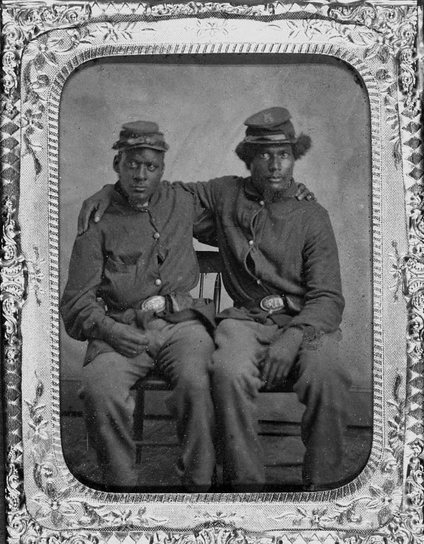
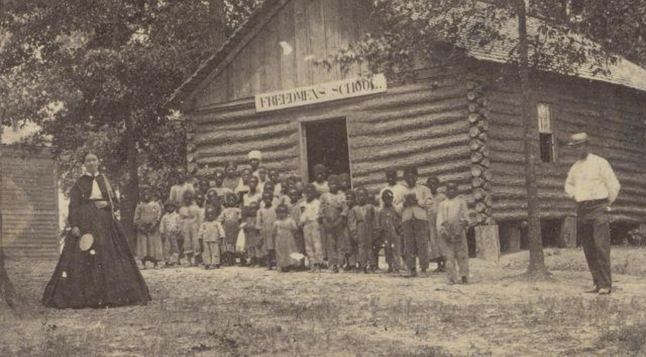
Four million formerly enslaved people answered that question for themselves. They built schools, churches, political organizations, newspapers, and voting blocs. Congress rewrote the Constitution. Black men entered public office across the South.

For a brief moment, American democracy expanded as never before.

2/14

Image: The Freedmen's Schoolhouse in Smithfield is the last-of-its-kind in North Carolina. Collection of the Smithsonian’s National Museum of African American History and Culture.

The backlash was immediate.
Terrorists rode at night. Teachers were beaten. Voters were threatened and murdered. Elections were overturned. A new story had to be told: that democracy itself had become a threat, that Black citizenship meant corruption, and that freedom had gone too far.

3/14

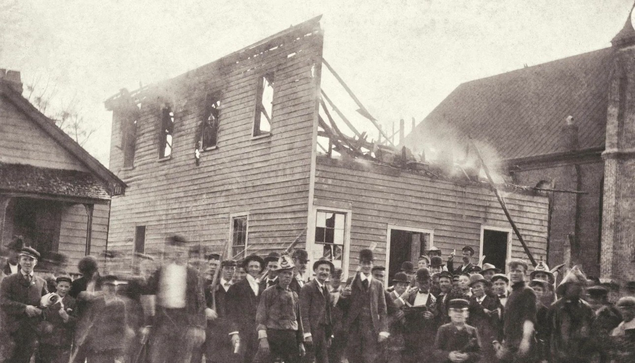
Image 1: White crowd gathered before the burned offices of the Daily Record, Wilmington, NC, November 10, 1898. Photograph. North Carolina Room, New Hanover County Public Library, Wilmington, NC.

By 1900, much of what Reconstruction had built lay in ruins. Voting rights vanished. Segregation hardened. White supremacy became law.

The South did not overturn Reconstruction by defeating the Union Army.

It overturned Reconstruction by winning the argument about what freedom, citizenship, and democracy were supposed to mean.

4/14

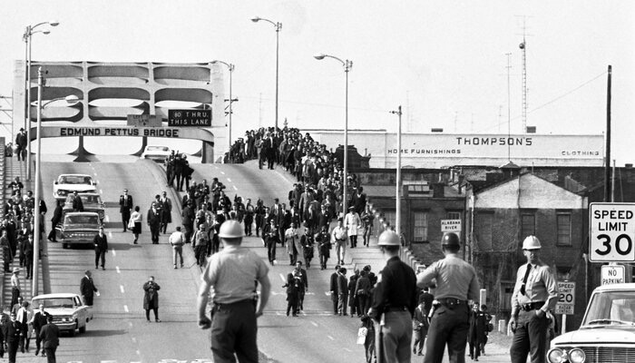
Image:,State troopers watch as marchers cross the Edmund Pettus Bridge in Selma, Alabama as part of a civil rights march on March 9, 1965. Bettmann Archive.

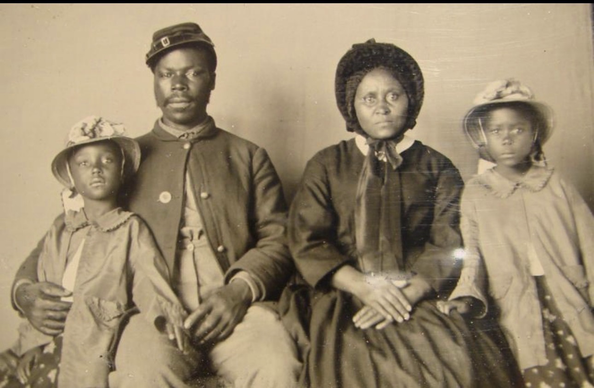
Image: African American soldier in Union uniform with his wife and two daughters, 1863-1865. Liljenquist Collection. http://hdl.loc.gov/loc.pnp/ppss.00400

Intellectual Map

Primary Sources

Congressional Globe. 39th Cong., 1st sess. Washington, DC: Government Printing Office, 1866.
https://digital.library.unt.edu/ark:/67531/metadc30867/

Douglass, Frederick. The Life and Writings of Frederick Douglass. Reconstruction and After. Edited by Philip S. Foner. Vol IV. New York: International Publishers, 1950–1975.
https://archive.org/details/lifewritingsoffr0000unse/page/n5/mode/1up

5/14

@Deglassco
Are their names known. I love genealogy.
@Scotter No, identity unknown.