 PugJesus
"I can't believe the poors would support a horrific creature like you just because they're reduced to slaves in their own homeland!"
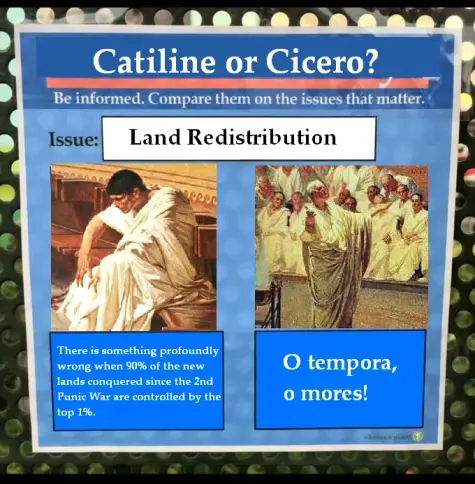
Explanation: Catiline was a Roman politician of the Late Republic who was initially aligned with the Optimates (conservatives). However, as his own fortunes became imperiled, he swung towards the Populares (reformists) who supported land reform and the poor. Catiline championed debt relief in particular (as he owed enormous debts, lmao), and obtained support from a wide base of the lower aristocracy as well as dispossessed farmers.
While Catiline was legitimately an opportunist piece of shit, the fact is that the Late Republic was not well-functioning, and the poor were immensely suffering under a republican system whose only major reforms had been to make it less democratic since the crisis began.
The Optimates had no intention of letting anything so radical as debt relief pass, especially since they were generally the ones doing the lending. So Catiline formed a conspiracy to overthrow the Republic and implement a dictator to reform the Roman constitution - not unlike the coup of the ultraconservative Sulla just two decades before, whose memory was still celebrated by many Optimates. The conspiracy was discovered, and while Catiline denied it, the moderate Optimate Cicero absolutely dissected him in a series of brutal oratories that are still read today for their objective rhetorical value.
Catiline would then leave the city of Rome and roll the dice on his attempted coup, raising his army of debtors in the countryside, while his co-conspirators who didn’t leave Rome in time were captured. Cicero (and the rest of the Optimates) claimed that they needed to be killed immediately, without a formal trial (which would take time and whose outcome would be uncertain), to prevent them from assisting their co-conspirators or reviving the conspiracy.
Julius Caesar (of later conqueror and dictator fame), a lifelong (if moderate) Populare, suggested that the greatest punishment the Senate could lawfully directly levy (as Roman citizens could only be executed after a trial, and only for very specific acts) would be imprisonment, and even proposed a system by which the conspirators would be separated, preventing them from communicating or re-conspiring. While the debate was close, ultimately, Cicero’s call for killing the co-conspirators won out, and they were all strangled by his direct authority.
The coup would fail, and Cicero would count ‘defeating’ it as his crowning achievement. As to why why Catiline could garner such support for such a radical cause, Cicero would go on to do absolutely no reflection on this crisis, as was his custom, and blithely continue engaging in civility politics as a ‘moderate’ conservative who was willing to support relief for the poor, a little, I guess, if the political situation was dire; but not support it enough to ever meaningfully go against his ultraconservative colleagues who refused all attempts at relief for the poor. And not because Cicero was powerless or lacked influence - Cicero’s voice (both literally, in his rhetoric, and metaphorically, in his political leadership) was very powerful in the politics of the Late Republic.
Oh, the times! Oh, the morals!
 BrickEater