I use such proper English on this platform that many probably don't realize that when I speak to Malaysians, I dont use the same type of English. What I use is Manglish (close to Singlish - the Singaporean version - but more confusing lmao). This is an English-based creole language of Malaysia - a fancy way to put it.

It sounds like this:

β€œHey! You really bojio me ah? Told you to wait you say yes but you belah instead. Lucky you my friend or I already beat you kau kau. Tell the aneh there to tapau me some roti bakar then we go and see uncle. He already marah me so I want you to kena also. You are really so chai.”

There are literally five languages here. Malay, English, Cantonese, Hokkien and Tamil.

That's how Malaysians speak to each other but this is more typical Manglish from a Malaysian Chinese πŸ˜†

When we speak to foreigners most of us context switch to neutral accented English so you can understand. (And, uh, try to stick to one language). If I spoke heavy Manglish, I dont think you can understand me!

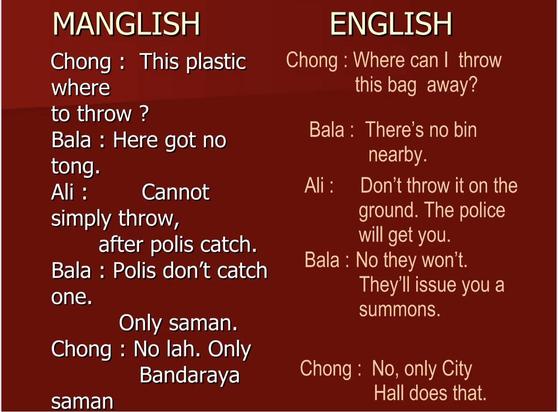
Also, Manglish: πŸ‘‡

(Me: Where got polis so hardworking saman people throw rubbish one. πŸ˜†)

#Languages #Southeastasia #Malaysia

@liztai Hah, it's close enough to Singlish that it felt very familiar.
@loke to throw the Singaporeans off we just add more Malay πŸ˜†

@liztai

Wow. A melting pot of languages.

@CelloMomOnCars

Sort of like the English language, eh?.
That's why it's confusing.

@liztai

@TrueNorthSpice @liztai

At least with English the foreign influences came in waves over a thousand years or so (Brittany, Denmark and Norway, the Low Lands, France again). Some of it happened so long ago, for some words you have to squint a little to see where they came from.

Singlish looks like a pretty fresh mix like a salad where you can clearly see the different constituents, no squinting required.

@liztai
Creole languages are fun
😁

Wanna try Lingwa de Planeta?
Maybe you could like learning it
πŸ˜„

http://lingwadeplaneta.info
@liztai Tried to decipher with a dictionary
Hey! You really bojio (isolated) me ah (question marker)? Told you to wait you say yes but you belah (departed) instead. Lucky you my friend or I already beat you kau kau (?). Tell the aneh (strange?) there to tapau (pack) me some roti (bread) bakar (baked) then we go and see uncle. He already marah (angry) me so I want you to kena (meet) also. You are really so chai (?).

@matling here it is:

Hey! You really bojio (didn't call/invite - Hokkien) me ah (just an empty word we use to express something)? Told you to wait you say yes but you belah (departed - βœ…) instead. Lucky you my friend or I already beat you kau kau (thoroughly). Tell the aneh (Tamil for brother) there to tapau (pack (Hokkien)βœ…) me some roti (bread βœ…) bakar (toasted) then we go and see uncle. He already marah (angry/scolded) me so I want you to kena (get the same treatment) also. You are really so chai (an idiot, Cantonese)

@liztai
I love the rhythm of different dialects! Interesting that "tong" is also a rubbish bin in Korean, but their language also borrows heavily from Chinese.
@EllenInEdmonton yes I was surprised to find out tho I really shouldn't be surprised haha
@liztai
Because I attempted to learn Vietnamese when I lived there, I find it interesting how many Chinese loanwords are in both languages, with only the slightest variations. Blessedly, Korean has NO tones, super challenging for me to hear and use correctly.

@liztai I love the rhythm.

If I had endless time I'd like to study linguistics. As I understand it a lot of Aboriginal languages in Australia put question words and negating words at the end of a sentence, opposite to what we do in English. And I notice that a lot of Singlish (I'm more familiar with it than Manglish) does it too.

Like, "This one, vegetarian can?" (An important travel sentence for me, lop).

Is that the case in Malay? Or is it a borrowed structure to make it clearer?

@keira_reckons yes Malay does do it to, like sometimes we add "lah" to soften something or "kan?" To emphasize something.

For eg: "He's so annoying."
"kan??"

It's not a question, but more like a strong agreement, "isn't he, totally??"

@liztai cool.

Officially English doesn't do that, but unofficially we absolutely do.

"Bad day, huh?
"That's so annoying, hey!"
"That's just the way it is, eh"

@liztai I'm reminded of a Singlish Cinderella story I heard as a kid. I had enough proximity to Singaporeans to get the general concept, but wasn't close enough to fully get all the phrasing.

It did feel extremely Singaporean though 🀣