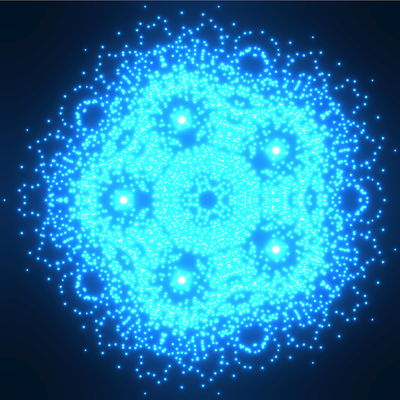
 𝓙. 𝓜.
𝓙. 𝓜.I felt like having some fish today...
\[\begin{align*}x&=2\cos t-\sqrt{2}\sin^2 t\\y&=\sin 2t\end{align*}\]

I felt like having some fish today...
\[\begin{align*}x&=2\cos t-\sqrt{2}\sin^2 t\\y&=\sin 2t\end{align*}\]
@tpfto what a great concise paper! I first encountered figures like these under the name “mystery curve”in a post by @walkingrandomly (Mike Croucher):
https://walkingrandomly.com/?p=5677
It inspired me to write my own example with my interactive JavaScript library:
https://paulmasson.github.io/mathcell/docs/examples/mystery-curve.html
Should probably do an update to include amplitudes as part of the input. And for people without access to paywalled gardens here’s an open link:
https://sci-hub.cat/storage/zero/7577/5076a423ccedaeb29f566c5c39609ba7/farris1996.pdf
@paulmasson I hadn't known before that @johndcook also looked at this (as cited by @walkingrandomly) but I'm not surprised. There are a surprising variety of curves that turn out to be Fourier series when you look at their equations in the Argand plane.
As for the Mathematica implementation that I used, it was originally a function written by Stan Wagon, which I made slightly more flexible for my own uses.
 Paul Masson