The long-awaited "Leiden Declaration" on Artificial Intelligence and Mathematics is now live and seeking signatories: https://leidendeclaration.ai/

This declaration stemmed from a workshop in Leiden University last September on "Mechanization and Mathematical Research", where it became clear how important it was in the age of AI to make explicit the goals and values of the mathematical community. Many of these goals have long been left implicit, being disseminated informally from advisor to student, or through mechanisms such as the peer review process. So long as the community was largely driven by internal decisions, this implicit system sufficed, and we only needed to share a few explicit goals with the broader public, such as working on unsolved problems, discovering new mathematical phenomena, or applying mathematics to the sciences or other real-world situations.

But in an era where increasingly powerful AI can be set to optimize (or over-optimize) many of the goals that are explicitly presented to them, such an informal state of affairs becomes inadequate, and so the Leiden working group gathered extensive input from the mathematical community to find consensus on what we truly value in mathematics, and how we recommend individual mathematicians, mathematical institutions and external organizations to act. I myself contributed some feedback to an early version of the declaration, but was not part of the working group. (1/2)
Leiden Declaration on Artificial Intelligence and Mathematics

This declaration calls for action to address the challenges posed by the use of artificial intelligence within mathematics research.

Leiden Declaration on Artificial Intelligence and Mathematics

I am very impressed by the final product, which has been refined extensively over the last few months, and endorse it wholeheartedly. Many of the points made in the declaration have also been made elsewhere -- my own writings and talks often touch on some subset of these, for instance -- but having them all assembled coherently in one document adds significant additional value. I urge everyone in the field to read the declaration, and consider signing it (I myself have already signed).

All the recommendations in the declaration are excellent, but I will highlight "Participate in public discourse". Perhaps notoriously, practicing mathematicians have a tendency to focus more on technical mathematical tasks, such as solving open problems, than on communicating the purposes of such technical work to the broader public. So long as we had a near-monopoly on the ability to accomplish these tasks, we could have this luxury of only discussing "safe" technical topics in public; but in the new era of "proof abundance", it is increasingly important that we also debate the "soft" aspects of our field, such as our goals and values.

See also the previous announcement https://arxiv.org/abs/2603.24914 by Commelin et al. of the Leiden declaration from March of this year. (2/2)

EDIT: See also the New York Times article https://www.nytimes.com/2026/06/02/science/ai-mathematics-leiden-declaration.html

Shaping the Future of Mathematics in the Age of AI

Artificial intelligence is transforming mathematics at a speed and scale that demand active engagement from the mathematical community. We examine five areas where this transformation is particularly pressing: values, practice, teaching, technology, and ethics. We offer recommendations on safeguarding our intellectual autonomy, rethinking our practice, broadening curricula, building academically oriented infrastructure, and developing shared ethical principles - with the aim of ensuring that the future of mathematics is shaped by the community itself.

arXiv.org
@tao I have a PhD in Pure Maths, but haven't been involved in research for 35 years now. Is there value in me signing this?
@ColinTheMathmo I don't believe there is any requirement to be a practising research mathematician to sign the declaration; if you consider yourself a stakeholder, I think that is sufficient justification to consider signing.

@tao This is the kind of thing that gives me a lot of hope for the future! It is very difficult for people like myself, who have few explicit connections, to see the intentions of prominent mathematicians who are currently shaping our future. I think this lack of insight contributes to a lot of anxiety from the public. Even before the AI boom, this has been a huge problem. I am elated to see an explicit call for transparency and open discussion of values (this is something I know you have promoted for most of your career, and I have always been extremely grateful for this). I am certain that this declaration will ease a lot of the anxiety students such as myself are feeling!

That said, one of my remaining worries for the future is the vagueness of 'understanding, clarity, and judgment' (mentioned in the declaration). This seems like a hole that can be co-opted by various interests. It seems to me that there is a large amount of variance on this topic even among mathematicians on classical topics.

With such huge incentives currently present to get AI to demonstrate true 'understanding', I am very worried our definition of 'understanding' will get co-opted by commercial interests, or else that we will continuously be accused of 'moving the goalpost' as AI continues to progress. To be honest, I think this should be a top priority. I think this topic is necessarily philosophical to an extent, and thus 'softer' than what most mathematicians think about in the 21st century, but is absolutely essential in order for true meaningful action to take place. I also do not think it is as intractable as it might at first appear.

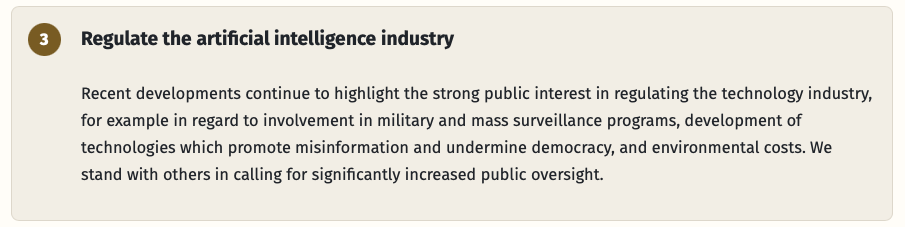
@tao Yes yes yes, except that in the current US environment that regulation would probably protect the interests of commercial AI companies from citizens rather than the other way around. :/
@tao prior to financial deregulation in the UK in the 1980s ("Big Bang"), lore (implicit knowledge?) has it that the governor of the Bank of England regulated banks over a monthly breakfast. Having all been to the same schools, they knew what that raising of his eyebrows meant. After Big Bang, though, Deutsche Bank, Nomura... didn't know how to read his eyebrows, so explicit banking regulation was needed.