just came across this 60 Minutes Australia interview with James Cameron on the OceanGate sub disaster.

Probably one of the best and most engaging interviews about engineering, safety, culture, science, hubris, incompetence... that you'll ever find.

Cameron is so incredibly intelligent, but also extremely good and simplifying complex ideas and doing it in an honourable way.

And oh ya, he also makes movies.

https://www.youtube.com/watch?v=EwSaZfwBrz8
#OceanGate #Titanic

FULL INTERVIEW: James Cameron on the OceanGate sub disaster | 60 Minutes Australia

YouTube

@chris I haven't finished listening to this particular interview, but he lost a lot of credibility early on when he started to blast not just the sub, but composites generally without understanding them.

Steel or titanium are known materials that have predictable behaviour, and for each variant, they have data on its strenght, and how thick it needs to be to widthstand certain forces. (same for sub windows)

1/

@chris

The material properties of carbon fibre are unpredictable because they vary based on shape of object, how the composite was layed, type of resin, and the process of injecting the resin into the "fabric" that has been layed to create object. So each object is unique. So for each object. you need to create a sample that you test to destruction ( or 1.5 times expected stress as do airline manufacturers).

2/

@chris

The process is also extremely important because you need to ensure no imperfections (air bubbles) exist between layers of composite material and no area where ratio of carbon fibre vs resin is different.

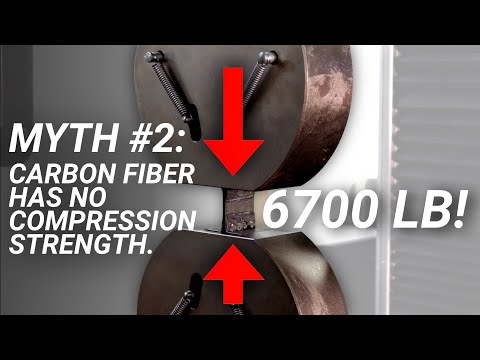
Here is a video from guys building a composite aircrtaft that they made in a subtle counter of Cameron's statements that carbon fibre is unsuitable and cannot be used for compressive loads.

https://youtu.be/8b2EgTu9_GU

3/

The Truth About Carbon Fiber: Myths vs. Reality

YouTube

@chris Had Cameron focused his criticisems only on Ocean Gate not having its "new material" properly tested, I would have had no beef with him. But he started to blast all composite materials as unsuitatable for subs clearly not understanding composites.

Ocean Gate knowingly created a design/process that left imperfections. They saw the wrinkles and just sanded them instead of reviewing the process that create them.

4/

@chris Designing a sub with known materials is far easier to design and have certified because if you use the recommended thickness for a materia such as steel with known strenght, it is very easy to have sub certified via paperwork.

But with composite, because it is an unknwo material, you need to go through the whole ophysical testing regime for this particulr sub.

5/

@chris The carbon fibre sub concept had a HUGE advantage in that the sub was positively bouyant, so dropping weights meant your sub rose and would float once at surface. Steel subs sink so if something goes wrong, you need to be able to inflate balloons/push water out of ballast tanks to create positive bouyancy, so if that fails, you can't go back up.

6/

@chris Another example which shows that with the same material, how you lay it up will give different properties:

https://youtu.be/3uhR4jdFiS4?t=177

Note: Ocean Gate did not use fabric, they used a "tape" of unidirectional fibres (about 2cm wide) and rolled it around the cylinder always in the same orientation, and apparently use 1 layer of fabric every X layers of tape that were added. The tape rolled around in one direction gave no strenght along lenght of cylinder.

How to Make Carbon Fibre Sheet - 3 Alternative Methods

YouTube
@jfmezei positive buoyance doesn't matter if you are crushed into oblivion ;)

@chris Ocean Gate uses a similar process to that developped by Boeing with a tape laying machine placing tape around a rotating drum.

Problems is Ocean Gate didn't place tape at various angles around drum to make it strong (interleaving tape very important) AND didn't realise that this layup process didn't scale well to very thick surfaces. (hence wrinkles, and separately cured layers.

couple of short examples: https://youtu.be/Vwlo-l12en4

https://youtu.be/NltxOxnZAuQ
https://youtu.be/_GDqxnahwbk

layering carbon fiber tape machine that builds the aftbody sections of the Boeing 787 fuselage

YouTube
@chris The wrinkle problem caused then to have to stop laying tape after every inch of thickness, cure that inch, sand it to remove wrinkles and then lay another inch above and cure that one.
However separately curing layers means this was a dum made of 5 1" thick cylinders instead of 1 5" thick cylinder. And that has huge differences because each 1" layer can technically move against the other. (and likely what had caused the big bangs after the dive prior to last one).
@jfmezei exactly. And carbon fiber has never been tested to that level and thus never proven to be able to be used for it. Theory and practice. It
may be one day, but OceanGate will be the example of how to prove it has not yet been used successfully for deep
sea.

@chris Carbon fiber has been used to those depths, but for unmanned crafts, and much smaller.

When Boeing got a huge subsidy from NASA to study concept of all composite fuselage, this had never been done at that scale before, but someone went ahead and did their homework and tested it up the wazoo and then built launched the 787.

Just because nobody went through trouble of building a *proper* composite sub before doesn't mean it can't be done.

@jfmezei totally agree. I hope some of what OceanGate did advances the engineering but It is a real shame that OceanGate didn’t do the job right the first time and instead put a whole bunch of people at risk and eventually killed 5 people out of pure hubris.
@chris OceanGate did not advance the engineering. This simplified Boeing's design and just made it so think it failed. At the point where they knew they had to cure inch by inch, they should have known their design was flawed, at the point they saw wrinkles after first inch had been layed, they should have known the design was flawed.
@jfmezei Cameron specifically says it is excellent for many applications including aircraft. For deep sea it is simply not and that is why it has never been certified for that domain.

@chris That is where Cameron ia wrong. It *can* be excellent for subs, but needs to be designed AND built properly and then tested properly, so it is more expensive than getting "off the shelf" materials like steel.

Just because steel/titanium are easier to work with and ensure resulting sub complies with strenght requirements does not mean that carbon fibre can't achieve the goal. Just because Ocean Gate failed due to incompetence doesn't invalidate carbon fibre.

@jfmezei true. But just because it might be able to be certified one day doesn't mean it will be soon.

I don't think Cameron was negating the possibility of engineers finding a way to use CF, he was just making it clear that at this point there is no pathway and OceanGate when they approached him, made it clear they were not interested in following the rules to find that pathway.

@chris Cameron initially blasted composites instead of blasting ocean gate. He has mellowed à but since. It his initial réaction showed he was speaking about composites without understanding then. Just because ocean gate’s design and were flawed doesn’t mean composites can’t do the job. Had je stated that each composite sub required testing because there are no published specs on material strength and ocean gate refused, I would have had no beef.

@chris No , Initially, Cameron was stating categorically that carbon was unfit to be used for subs because unable to deal with compression, stating carbon was only good for tension. This is very wrong.

Butyou design a part for compression differently than you do for tension. Ocean Gate didn't.