#lisp #commonLisp I would say the lisp #wikipedia page has been vandalised to not mention ANSI standardisation until the last paragraph of the history subheading. #ANSI

Then, halfway through there is a one-line section:
Standardized dialects [edit]
Lisp has officially standardized dialects: R6RS Scheme, R7RS Scheme, IEEE Scheme,[60] ANSI Common Lisp and ISO ISLISP.

This is a significant departure from the former page. Also, calling it now sloppy sloppy sloppy slop

@screwlisp That seems like the right order to me!
(IEEE Scheme is a slightly broken R4RS, prob shouldn't be used, but it's the official spec).

@mdhughes I would say anyone encountering that article would come away with incorrect beliefs about #lisp and the entire history of #computing. The introduction should say something like:

In the beginning, John McCarthy, the father of AI, created lisp in contrast to Fortran. Lisp's centrality to computing led to an explosion of incompatible variations. One was the lambda papers, which defined scheme. The lisp community resolved their differences via an ANSI standard process, ANSI common lisp.

@screwlisp @mdhughes

"In the beginning, there was Caveman Lisp. We didn't understand function calling, so where your free variables got looked up was random. Steele and Sussman fixed this problem, but no one understood what they had done."

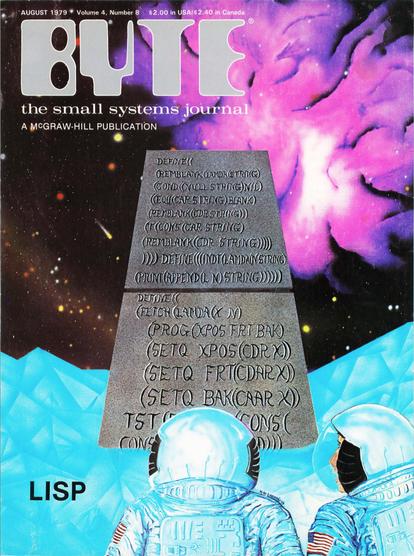
@djl @screwlisp Caveman Lisp was hard because you had to chisel it into stone monoliths.
#lisp

@screwlisp @mdhughes

After that, the Lisp community discovered OOP. The C++ community was going completely OOP insane, but at least they had one standard. Sure, it was insane. But there was only one. No one needs a new type of object that acts like a number, but C++ made that a religious requirement.

In the Lisp community, everyone had their own idea OOP, and that was the main driver of Lisp dialect divergence; in addition to the different Lisp machine dialects, of course.

@screwlisp @mdhughes

Hilariously, the C++ community understood what Steel and Sussman had done, and added it into into C++. Correctly and thoroughly. Good work, guys!. But. With the ugliest, most obscure, most unreadable syntax possible. Did I mention that C++ is insane? Yes, I did. And it is.

But there's only one standard.

@djl
I have been trying to find someone at Canterbury university who remembers seeing Mashey in the 90s in my attempt to get him on the show to talk about 90s microcomputer benchmark standardising efforts (since he didn't like my original small-is-beautiful-but-fifty-years-later-and-lisp-this-time idea ..). Now I am wondering if your backhanded praise of [his] work on C++ in the 80s would help my cause.
@mdhughes
@djl
It was interesting reading your notes in light of, I think, the common complaint that too many varieties of numbers got cooked into common lisp [citation needed]
@mdhughes

@screwlisp @mdhughes

I'm not aware of who did the lambda stuff in C++, I just read about it and played with it a bit after it was standardized and implemented in Mickey$oft C++.

After my two years at AT&T I threw a few stink bombs at the C++ standardization folks. There was some noise from Japan arguing for some sort of subset standard, both for microcontrollers and for users who didn't want to learn the whole thing. I liked that idea but it got flamed royally. (This was early 1990s.)

@djl
Well see you would be interesting to juxtapose though possibly separated in time. Do you happen to be available to remember things about the 90s on Sunday-morning-in-europe (Sunday dinnertime in Japan) some week soon?

We were planning to re/read Perceptrons first - which is one of my tasks in support of my draft-a-book-on-deep-learning-in-June plan but I have not done it yet - but there is a lot to talk about regardless.

@mdhughes

@screwlisp @mdhughes

My memories of the 90s are pretty minimal. After my disaster at AT&T's Tokyo office I looked for another company job, but tried freelance translating (tech stuff, Japanese to English), and that just worked, so I spent the next 30 years hiding under a rock and translating.

I did some programming. A life program in a DOS emulator that spat bits at the video controller. An Othello program, since I had never implemented Alpha-Beta. Currently some corpus stuff for Japanese.

@djl
As I recall you mentioned you are an AI person and closely connected to Steele, which I guess is more of an earlier subject than a later. But did you know any of the e.g. Kyoto Common Lisp people as it happens? I am obviously just guessing for talking points.
@mdhughes

@screwlisp @mdhughes

Nope. Didn't know people doing Lisp things here (Japan). The two years I was using Common Lisp here, we were pure, unadulterated by implemenation concerns, users.

I thought I was being completely useless to them (developers doing 5th gen stuff in an NEC research lab). To kill time, I implemented the pattern matcher described in Carl Hewitt's PhD thesis. It turned out they liked it and actually used it. Go figure.

@screwlisp @mdhughes

I couldn't find my copy of Perceptrons so I grabbed the latest copy with the late 80s, early 1990s additions. Their main point was that it's necessary to prove that your model can actually do X if you think/claim that it can do X. It seems to be mostly down-in-the-weeds details of those proofs.

I'm currently reading Jerry Fodor, whom I think largely has the right ideas wrt. AI, theory of mind, and the like. But that's not much help for a deep learning boook...

@djl
Ah, yeah, I guess Doug Merritt cautioned me that Perceptrons was quite dry and mathematical. I will throw Fodor into my reading list this month anyway.
@mdhughes

@screwlisp that particular edit to the Wikipedia article you mentioned was written on 2019-09-27 according to the revision history by an editor called Ranier Joswig. Here is a link to his homepage that he has in his Wikipedia editor’s profile. So it isn’t slop, it is English written by a native German language speaker.

Honestly, it seems legit. And he is technically correct about those being official standards. The R5RS standard is also still in common use, although it is superseded by R7RS, so I guess that is why he didn’t think R5 should have been mentioned in that section. And the R6 standard is still in common use and is generally seen to be a departure from R5RS in a way that R7RS is not, so it makes sense that he would mention both R6 and R7 as separate official standards, this reflects the common sentiment in the Scheme community.

@djl @mdhughes

Lisp (programming language): Difference between revisions - Wikipedia

@ramin_hal9001
Eh, I had that thought myself and also that I probably should not attempt to lock horns with Joswig per se. However, I think the introduction should be completely different to accurately provide an encyclopedic note on lisp.
@mdhughes @djl