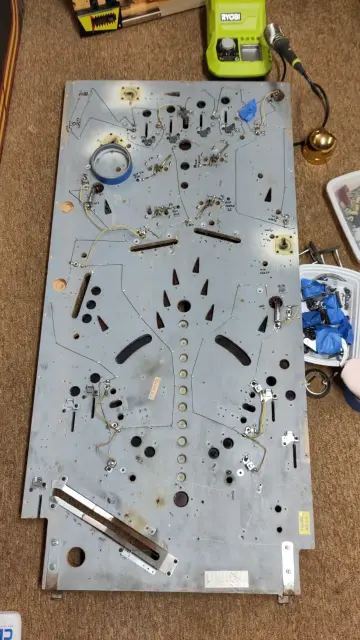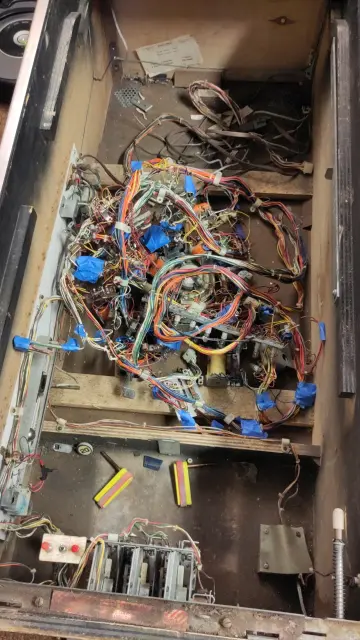
I need to find the thread where I bought this thing but I think it might've been two servers ago. Very long story made very short: I got a Firepower for $250
* Although the backglass survived, its head was destroyed so thoroughly that I ended up fabricating a new one from scratch
* The boards have gnarly battery damage
* The playfield art was roached beyond even the most optimistic hope of repair (and I've restored playfields with a LOOOOOOT of mouse piss soaked in) so I got a still-fucked-but-less playfield and restored that instead

Anyway I started the underside today. All that stuff has to come off and get put on the new playfield
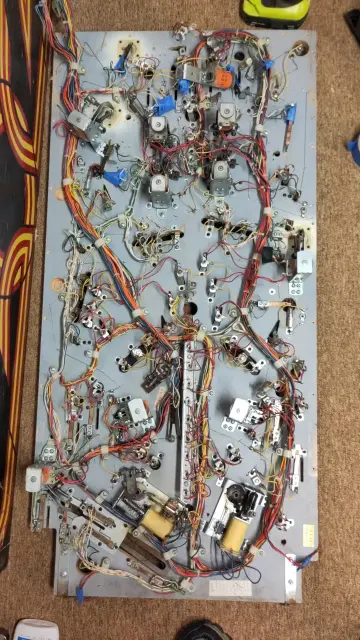
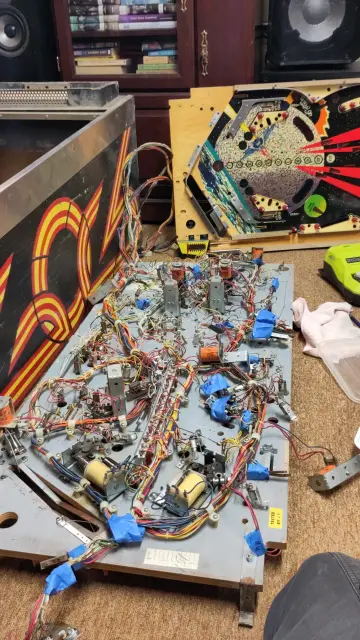
The sheer Volume of wire in this thing

Fun fact: if you took all the wire out of an 80's-era pinball machine and laid each piece end to end in one straight line, I'd be really mad at you

Alright, it is done, all the stuff is off the playfield leaving only the GI braid behind
If the new playfield already had its GI braid in position we could just schwuff all that stuff over to the new playfield and start screwing/soldering it down, but I gotta transfer the braid too. So for now everything's in a big pile inside the cabinet
GI stands for General Illumination, meaning the bulbs that stay lit all the time so you can see what you're doing as opposed to the bulbs that flash to tell you what you've done and what you should be doing next. But Gastro-Intestinal is funnier. Anyway tomorrow I'll swap out its GI tract

Pinball machines are designed to be very very easy to fix and swap parts out etc but Williams absolutely did not expect anyone to swap out The Actual Bit Of Plywood In The Middle Of The Electronics Sandwich

Like it's reasonable to have feelings like, oh, why oh why did they staple the GI braid in like that, but honestly they figured this thing would get hammered hard enough that you'd replace every bulb and rubber a few times, rebuild the flippers, do some board work maybe and then this'd end up in a skip having earned its weight in quarters, they absolutely did not expect Some Guy to be tearing it down this deep *checks watch* forty six years after they'd made the damn thing

Lots and lots of wire.

See Williams used a matrix for the lamps as well as the switches. So you have eight transistors on one end to let the electricity in and eight more on the other end to let it out again, to turn on one lamp you go "Turn on the transistors on row 2 and column 3" and you could control 64 lamps with 16 transistors. Bally just had one transistor per lamp

@ifixcoinops

Do modern ones just stick a small computer in there and do it all in software or do some still do it the fun way?

@gbargoud do what all in software

@ifixcoinops

Pick which lights and stuff to activate at which times

@gbargoud As @ifixcoinops said, since the solid state era games did already (almost) all interaction between in software just like modern games.

What has changed is that modern games use message busses serial message busses to replace the mess of wires with a central CPU board and several satellite boards interconnected by data connections. Stern for instance uses Ethernet cables (but afaik a different protocol underneath).

@gbargoud @ifixcoinops What‘s curious to me is that for how long wiring harnesses survived in new games.

My 1993 Jurassic Park still has them and all electronics are way less integrated than you would imagine from mid 90s technology. I got curious myself and did some research and just learnt that Stern transitioned to messaging busses only in 2015.

https://www.designworldonline.com/advanced-networks-make-pinball-games-pop/

Advanced networks make pinball games pop!

by Paul Mandeltort, Director, Parts and Accessories, Stern Pinball, Inc. Traditional pinball machines are using industrial sensor buses to bring body

Design World
@boink @gbargoud the inside of a pinball machine body is a pretty harsh environment for electronics, full of conductive dust and big big coils and vibration and suchlike, it's kinda a challenging engineering task to design a messaging bus system that can live in the body rather than in the head. I bet Stern were a bit nervous about the early Spike games given that Jersey Jack had tried the whole daisy-chained-RGBLED thing just before then and it had massive reliability problems, though to give them credit I haven't seen NEARLY as many node board failures as I'd expected tbqh

@ifixcoinops @gbargoud It still puzzles me how long it took. We’re putting similar stuff in satellites (g-forces, radiation) and cars (vibrations, dirt) for a while now so I assumed that hardened electronics were no biggie at the time.

Eventually it comes down to price per unit, but assembly of the wiring harnesses can’t be cheap either… or was this a typical outsourcing task?

Good point anyway :-)