 Raghav Agrawal
How fat is actually lost, not the spot-reduction "burn it off your thighs" version, but the real molecular chain, built from zero.
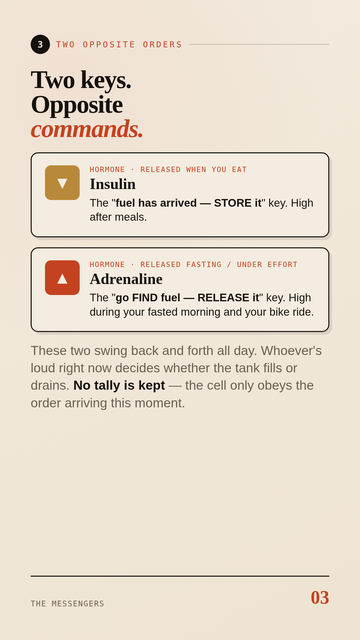
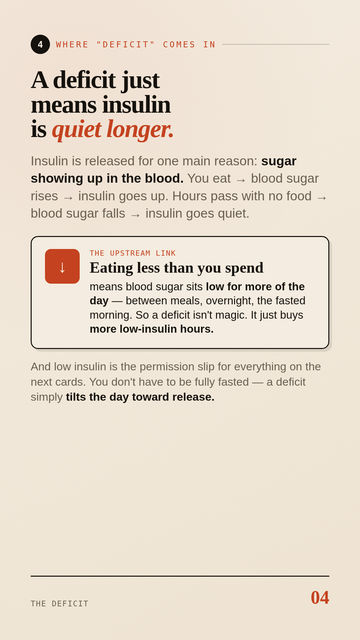
WHY does a deficit help? Insulin rises with blood sugar.
Eat less than you burn → blood sugar sits low more of the day → insulin is quiet more of the day. That's it.
"Deficit" isn't a switch the body detects, it's just more hours with the storage-signal off.
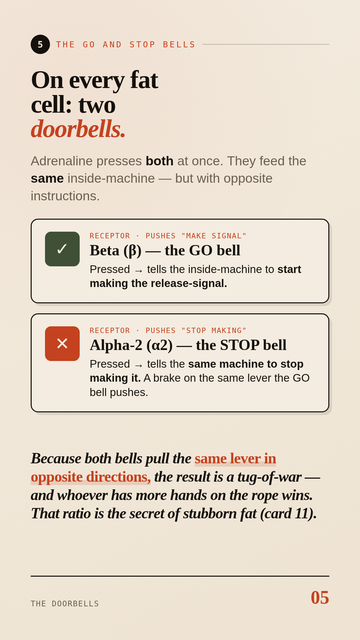
The twist: adrenaline presses TWO doorbells on each fat cell.
β = GO. α2 = STOP. And they fight over the same lever, one pushes it, one pulls it back.
So the outcome isn't about how much adrenaline you have; it's about which bell (alpha vs beta adrenergic receptors) the cell has more of.
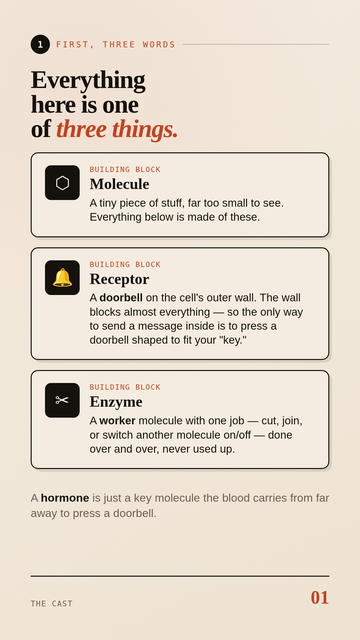
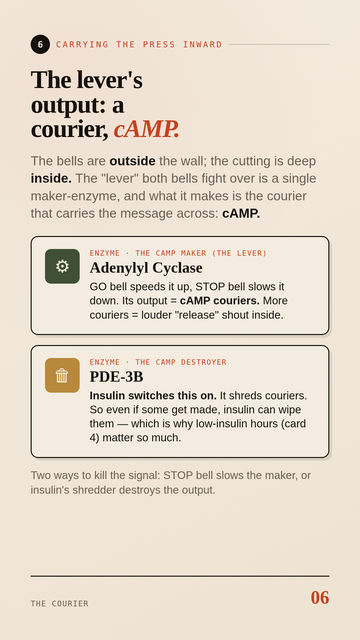
How does a doorbell on the outside reach machinery on the inside? A courier molecule: cAMP.
The GO bell speeds up its maker; more couriers = louder "release."
But insulin runs a shredder (PDE-3B) that destroys couriers.
So eating doesn't just go quiet, it actively erases the signal. Two off-switches, one go-switch
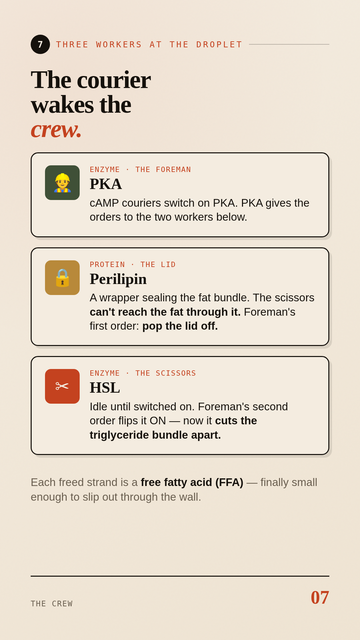
The courier wakes a three-person crew.
PKA (foreman) gives orders.
Perilipin (a lid sealing the fat) gets popped off : people forget the fat is wrapped; you can't cut what you can't reach.
Then HSL (scissors) cuts the bundle into free fatty acids, small enough to leave.
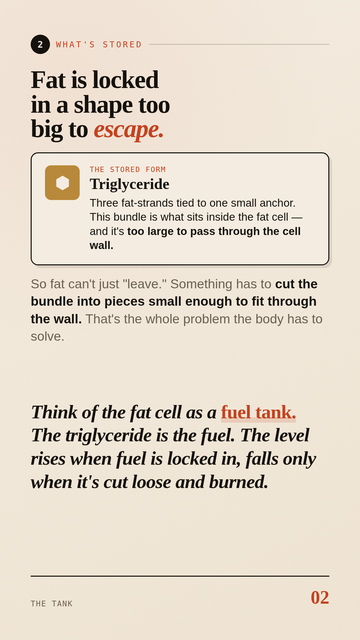
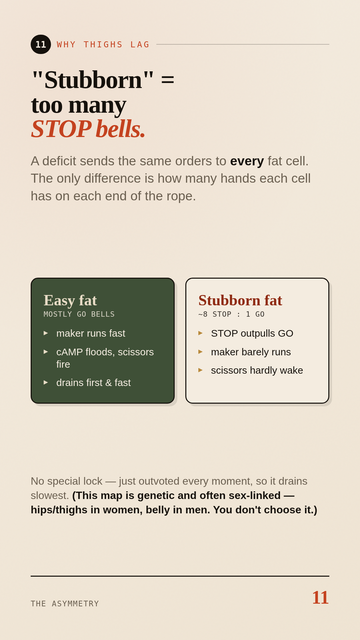
Now fat is finally out of the cell
Now the whole chain in one breath:
effort → GO bell → courier flood (insulin's low, so nothing shreds them) → foreman pops the lid + fires the scissors → bundle cut → fat exits.
Every link was a defined character two cards ago.
But exiting the cell is only halftime, the fat still has to get somewhere and actually burn.
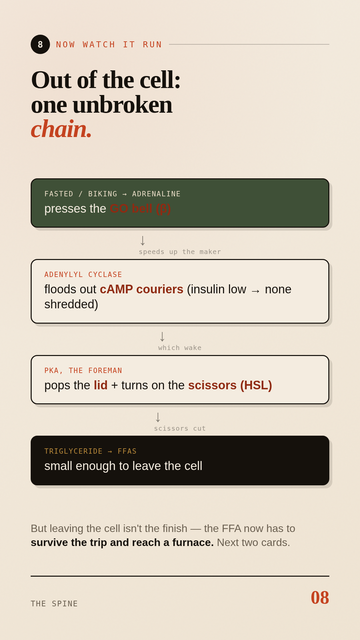
Freed fat hits a problem: it's oil, blood is water, oil doesn't dissolve. So it rides a taxi — albumin, a blood protein.
No taxi nearby (low blood flow)? The fat drifts back in and gets re-stored. The cut was wasted.
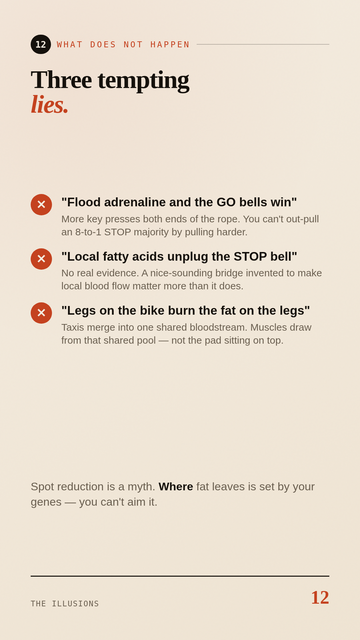
This is the ONE place blood flow truly matters, but the taxis pool together, so no, biking doesn't burn thigh fat specifically
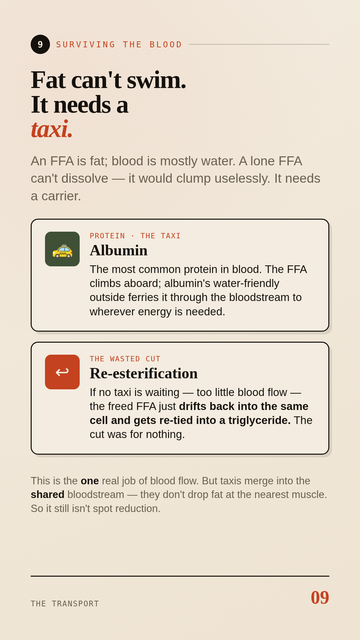
Final leg. "Burn" = broken down in the mitochondria (the furnace).
But there's a guarded door: CPT-1 and here's the elegant part, eat a big carb meal and the cell jams that door shut (there's sugar to burn, why bother with fat).
Low on carbs? Door opens. Then carbon leaves as CO₂ in your breath. You exhale fat.
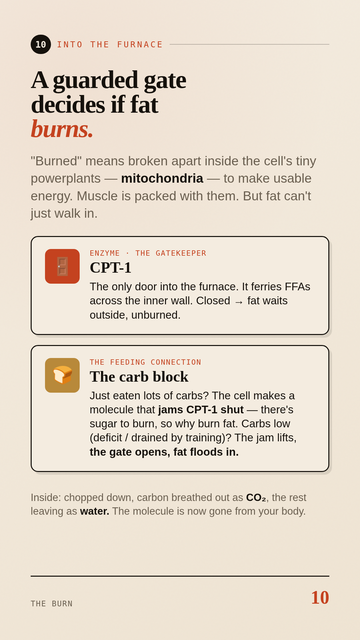
So why are thighs/belly "stubborn"? Those cells carry ~8 STOP bells for every 1 GO bell.
Same adrenaline, same deficit but the STOP side just out-pulls the rope, so they drain last and slowest.
There's no special lock to "unlock."
It's a ratio, it's genetic, it's often sex-linked. You can't pick where fat leaves first.
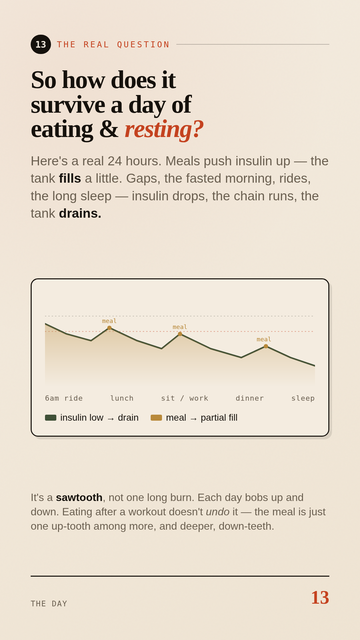
This was the question I actually started with: if I eat and sit and sleep between workouts, how does fat loss "stick"?
Answer : it's a sawtooth, not a switch. Meals nudge the tank up; gaps, cardio and sleep pull it down.
The body isn't holding a streak. Each moment just responds to what's in the blood.
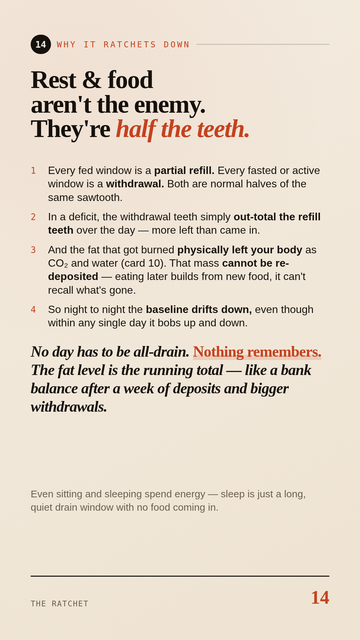
So why does it net out downward Because the burned fat physically leaves your body : exhaled, peed out and can't be re-deposited.
Eating later builds from new food; it can't recall what's gone. The day bobs up and down, but the floor steps down each night. It's a bank balance, not a memory. Rest isn't cheating
References
When somebody loses weight, where does the fat go?
https://www.researchgate.net/publication/269772876_When_somebody_loses_weight_where_does_the_fat_go
Molecular mechanisms regulating hormone-sensitive lipase and lipolysis
https://pubmed.ncbi.nlm.nih.gov/14641008/
Mechanisms underlying regional differences in lipolysis in human adipose tissue
https://pubmed.ncbi.nlm.nih.gov/2503539/
Regional and gender variations in adipose tissue lipolysis in response to weight loss https://www.jlr.org/article/S0022-2275(20)33402-7/fulltext
Carnitine transport and fatty acid oxidation https://pubmed.ncbi.nlm.nih.gov/26828774/
(1/2)
@impactology I'm not sure the facts you've assembled point exactly to your conclusion. My understanding is that it's sugars specifically, not carbs in general, that raise insulin, stopping the fat-cutting process as you describe, and turning on fat-making. In the absence of free sugar, the body is at least as likely to break fats to burn as fuel, as break carbs into free sugars to then burn as fuel, triggering an insulin response as above.
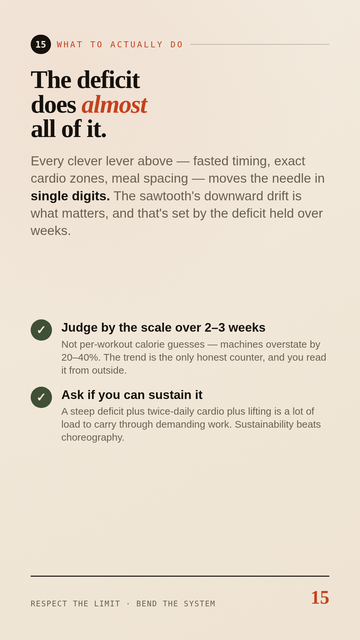
A caloric deficit simply means that across a 24-hour cycle, you have lengthened the periods where insulin remains below the threshold required to activate PDE-3B. This buys more total hours for the lipolytic pathway to run.
As more hours pass without food, insulin falls, allowing baseline catecholamines to engage beta-receptors unimpeded, initiating steady fat mobilization.
Phase 1: Signaling & Breakdown
Fasted State -> Low Insulin -> Zero PDE-3B Shredding -> Adrenaline Surge -> cAMP Flood -> PKA Foreman -> Perilipin Lid Popped -> HSL Scissors Activated -> Triglycerides Split into FFAs
Phase 2: Transport & Burning
Albumin Taxi Transit -> Low Malonyl-CoA (No Carb Block) -> CPT-1 Gate Open -> Mitochondrial Furnace -> Mass Exhaled as CO2
@impactology
> As more hours pass without food, insulin falls
Are you sure? Not that it's a great idea, but imagine you ate 200 grams of butter every hour, and nothing else. After 5 hours you've eaten a kg of food, but your insulin would fall just as fast as if you ate nothing. Wouldn't it?
I can't see why the same wouldn't be true if you did the same with a kg of plant matter than contained no free sugars (short-chain carbs). Same if you ate a mix of both lipids and sugar-free veges, right?
It really depends on how fast the body can get into the low insulin state after digesting the butter right?
@impactology
> It really depends on how fast the body can get into the low insulin state after digesting the butter right?
This seems to assume that eating butter would raise insulin. Does it really? How?
Also here;
https://mastodon.social/@impactology/116652148589350462
It says "when carbohydrate intake is high", but doesn't distinguish between sugars and starches, which have very different impacts on the metabolism when they arrive in the body, no? Starches can only trigger insulin after being broken into sugars, right?
@cy
> There are two kinds of (digestible) sugar, glucose and fructose
There are dozens. What distinguishes them from each other, and from starches, are the numbers of carbohydrates in the chain. Sugars are short-chain. Starches are long chain.
> depriving the body of glucose to burn fat
... is literally the only way you can reduce body fat. If getting your energy from fat instead of carbs was as unhealthy as you (and the sugar industry) claim, then losing weight would be bad for your health.
@cy
> Starches are glucose chains
All carbohydrates are glucose chains. You can swap in 'glucose' for 'carbohydrate' in what I said above and its equally true. Fructose is a chain of glucose, just like every other sugar and starch.
> Pretty sure the body will burn fat even if it has glucose, just not as uncompromisingly as cutting out carbs
Pretty sure it won't. See above, and the rest of the thread about the role of insulin, triggered by blood glucose, opening and closing fat cells.
(1/?)
My app isn't showing those images. Are they on the web somewhere (eg Wikipedia)?
@cy
> Fructose is not a chain of glucose
I'm basing my use of terminology on vague memories of explanations given in school science and health classes. Apologies if I'm using the wrong word.
Point is, all carbs - sugar or starch - are made of the same basic units, in different configurations. Human bodies can break them all down into glucose for energy (carbohydrate metabolism);
https://www.healthline.com/nutrition/sucrose-glucose-fructose#what-are-they
(2/?)
But it takes longer to break starches into glucose (monosaccharides) than sugars, and sugars with more complex molecular structures take longer to turn into glucose than simpler ones.
Glucose in the blood triggers insulin release, this is basic biology;
"The insulin tells cells throughout your body to take in glucose from your bloodstream."
https://www.healthline.com/health/diabetes/insulin-and-glucagon#working-together
*Including* fat cells.
(3/?)
So there's no possible way to burn body fat while eating sugar. No matter how much energy you burn. Conversely, there's no way you can gain body fat if you're *not* eating sugar, even if you're eating more calories in a day than you use. Because there's never going to be enough glucose in your bloodstream to trigger the level of insulin necessary to open fat cells.
I've had the science of this explained to me in detail by general practice doctors who have studied it.
(4/4)
I've been almost entirely sugar-free since 2019. I've got a friend who's gone through long periods of following a ketogenic diet (high fat, moderate protein, low carbs). Neither of us make any attempt to restrict calories, or make sure we use more of them than we eat each day. The only time either of us gain an ounce of body fat is when we lose discipline and eat sugar.
Don't believe the sugar industry hype. Most health problems blamed on saturated fat are caused by sugar consumption.
 Strypey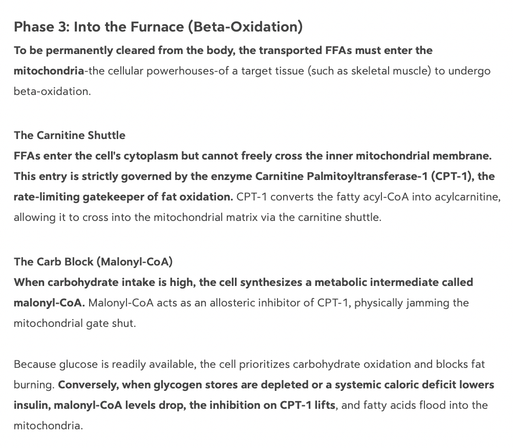
 Cy
Cy
 Uriel Fanelli