 Slow Mover
God’s Living Experiment: A Church Guided by Word and Spirit
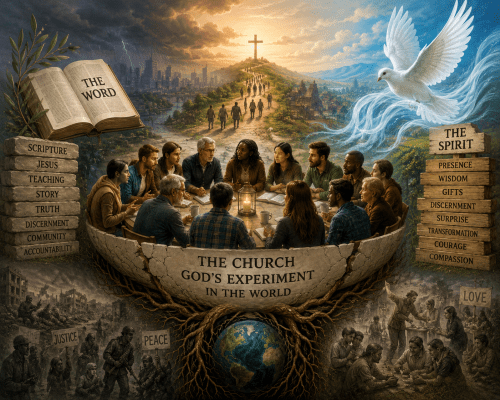
The church may be understood as God’s experiment in the world, not in the sense that God is uncertain about the outcome, but in the sense that the church is a living demonstration of what human community can become under the reign of God. It is not a controlled experiment carried out under ideal conditions. The church is formed from real people, with differences, wounds, gifts, failures, cultures, histories, and conflicting understandings. There are no perfectly controlled variables. Its life unfolds amid the pressures and uncertainties of the world it is called to serve.
Yet the church is not an unguided experiment. It is not simply left to discover its identity by trial and error or by adapting itself to whatever seems successful. The church is guided by both the Word and the Spirit. A Word-centered church continually returns to Scripture, especially to the life and teachings of Jesus, in order to remember who it is called to be. The Word provides the story, direction, and standards by which the church evaluates its life: love of God and neighbor, reconciliation, justice, mutual care, humility, truthfulness, and enemy-love. In moments of confusion, the church asks whether its decisions are consistent with the character of Christ revealed in Scripture.
At the same time, the church is also Spirit-centered. The Spirit is not limited to repeating past answers but continues to lead the church into faithful response in new and changing situations. A Spirit-centered church listens prayerfully, attends to the gifts and voices of its members, remains open to correction, notices where life, healing, reconciliation, and transformation are emerging, and has the courage to respond when God seems to be doing something unexpected. The Spirit enables the church not merely to preserve the memory of Jesus, but to embody the living presence of Jesus in its own time and place.
A healthy church embodies both Word and Spirit. A church too Word-centered may become rigid, legalistic, and fearful, preserving past interpretations while failing to recognize where God is moving in the present. A church too Spirit-centered may become ungrounded and impulsive, mistaking personal preference or emotion for the Spirit without testing it against Scripture and the way of Jesus.
The book of Acts offers a strong example of this relationship between Word and Spirit. The early church did not have a detailed blueprint for every situation it faced. When Gentiles began receiving the Holy Spirit, the church had to discern what this meant for its inherited understanding of God’s people. Peter’s encounter with Cornelius and the later discernment of the Jerusalem Council show a church that is not operating under controlled conditions, yet is not without guidance. The community listens to testimony about what the Spirit is doing, considers this experience in light of Scripture, and reaches a communal decision about how to move faithfully forward.
In this sense, the church is neither rigidly controlled nor directionless. It is a community formed by the Word, animated by the Spirit, and called to discern faithfully within the unfinished, unpredictable conditions of the world. The Word keeps the church rooted in the story and way of Jesus; the Spirit keeps the church responsive to the living activity of God. Together, they guide the church as it becomes a visible experiment in reconciliation, peace, belonging, and new creation.
#AnabaptistFaith #ChristianCommunity #Church #CongregationalDiscernment #ecclesiology #faithfulWitness #GodSExperiment #HolySpirit #LivingChurch #MissionalDiscernment #newCreation #Reconciliation #Scripture #WayOfJesus #WordAndSpirit