Open Web Advocacy joins 17 businesses, industry bodies, public figures and civil society organisations calling for more ambitious and urgent enforcement of the Digital Markets, Competition and Consumers Act (DMCCA) 🚨

🧵👇️ (1/28)

📖Read more:
https://open-web-advocacy.org/blog/open-letter--why-the-cma-must-enforce-the-dmcca/
Open Letter: Why the CMA Must Enforce the DMCCA - Open Web Advocacy

Open Web Advocacy

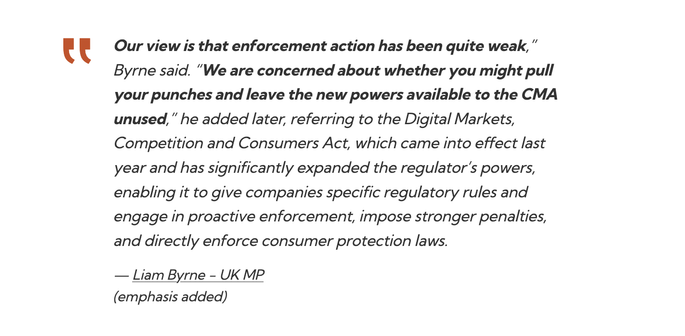
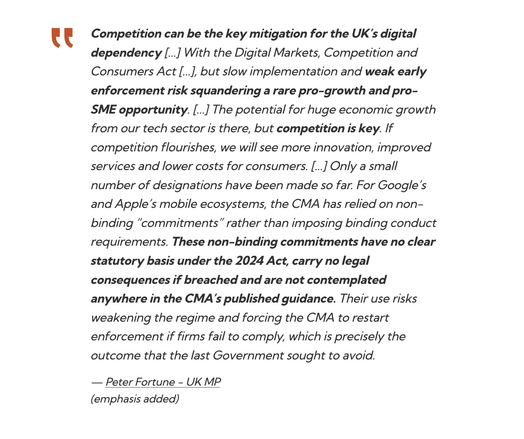
We are concerned at the pace and strength of the CMA's enforcement of the DMCCA:
🧵(2/28)

📖Read more:
https://open-web-advocacy.org/blog/our-submission-to-the-cma-on-apples-ios-interoperability-commitments/

Our Submission to the CMA on Apple’s iOS Interoperability Commitments - Open Web Advocacy

Open Web Advocacy
🧵(3/28)
🧵(4/28)
🧵(5/28)
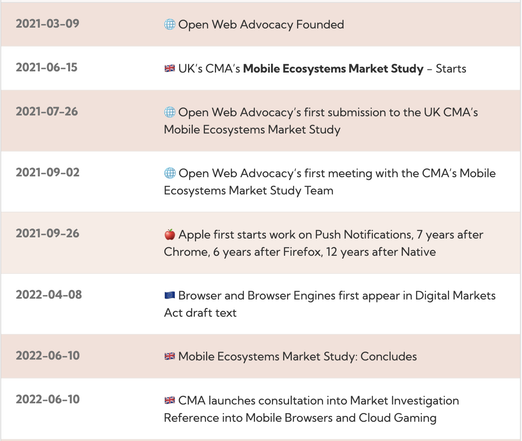
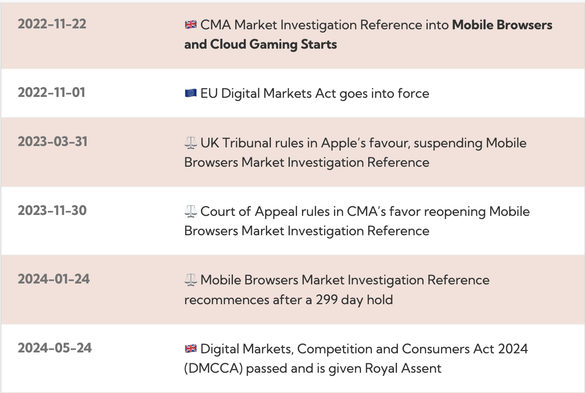
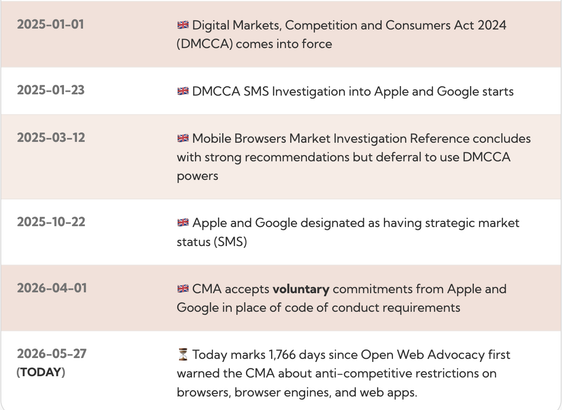
Effective enforcement is vital to ensuring that browsers, browser engines and web apps can compete on fair terms. The CMA has been investigating Apple’s restrictions on browsers and web apps for five years.
🧵(6/28)
🧵(7/28)
🧵(8/28)
🧵(9/28)
On the 22nd of November 2022, the CMA announced it had decided to launch a Market Investigation Reference into Mobile Browsers and Cloud Gaming.
🧵(10/28)
Market Investigation References (MIRs) are only started when the CMA has “reasonable grounds for suspecting that a feature or combination of features of a market or markets in the UK prevents, restricts, or distorts competition”.
🧵(11/28)
They are a significant and expensive undertaking. Once an adverse effect on competition has been confirmed, MIRs are intended to fix the issue.

🧵(12/28)
The Browsers and Cloud Gaming MIR had a long list of findings including:

We conclude that the WebKit restriction means that there is no competition between browser engines on iOS.
- Browsers and Cloud Gaming MIR

🧵(13/28)
We also conclude that the WebKit restriction harms competition in the market for mobile browsers on iOS.
- Browsers and Cloud Gaming MIR
🧵(14/28)
We conclude that Apple’s WebKit restriction limits the ability of rival browser vendors to improve the performance of their mobile browsers on iOS.
- Browsers and Cloud Gaming MIR
🧵(15/28)
We conclude that Apple’s WebKit restriction limits the ability of rival browser vendors to innovate and improve their mobile browsers on iOS.
- Browsers and Cloud Gaming MIR
🧵(16/28)
We conclude that Apple’s WebKit restriction increases costs of rival browser vendors as it requires them to develop and maintain an additional version of their mobile browser, based on WebKit, to serve iOS users.
- Browsers and Cloud Gaming MIR
🧵(17/28)
We conclude that this reduces the features available to consumers and web developers, and limits effective competition between browser vendors on iOS on security, privacy, and performance.
- Browsers and Cloud Gaming MIR
🧵(18/28)
We conclude that the WebKit restriction does not give rise to rivalry-enhancing efficiencies in mobile browsers on iOS that would offset the negative effects on competition associated with the WebKit restriction we have identified.
- Browsers and Cloud Gaming MIR
🧵(19/28)
We conclude that the WebKit restriction therefore limits the features available to users and decreases competition between mobile browsers on privacy features on iOS.
- Browsers and Cloud Gaming MIR
🧵(20/28)
Apple’s WebKit restriction limits the ability of rival browser vendors to compete on iOS. We have seen evidence of limitations impacting security, privacy, and performance improvements, and support for other features, notably those important for web apps and PWAs.
- Browsers and Cloud Gaming MIR
🧵(21/28)
We consider that limited competition in the markets for browser engines and mobile browsers on iOS has led to worse outcomes for web developers than we would expect in a well-functioning market.
- Browsers and Cloud Gaming MIR