 Cory W
They’re roasting my ass on transit bus bluesky and so I’m gonna have a crash out where obviously the only solution is diesel forever. /j but also this is a little annoying because this one of those “you aren’t wrong but technology changed and this should probably be a gradual thing” situations
UnFORCHunately this is a nuanced and multifaceted problem and so “BEB need electrical upgrade haha” is an easy potshot it’s not necessarily a negative (or even true), just something about the drivetrain to be aware of.
 AndThisIsMrsPeacock 🏳🌈
@coryw In Boston the T just ripped out the last vestiges of the 1970s era trolleybus wiring and replaced it with a vague promise of battery-electric buses, maybe, someday. I hate this timeline.
@andthisismrspeacock that’s the inciting event actually. Everything I learn about the MBTA ETB network leads me to believe ETBs were literally never the right tool for the job, they just happened to come along for free with the nearby electric rail transit.
Of course they’ve *also* managed to completely fuck up the transition and it would’ve been better to buy a few new XT series or ask NFI for rebuilds on a few units as part of continuing operation while spinning up a BEB program
@coryw Maybe, that would certainly be better than what's happening. But also for my entire life the T has looked at wires as an expense to be eliminated as quickly as possible instead of a useful power system. This was behind the loss of the A, F, and G trolleys as well as the end of electric buses and the pigheaded refusal to electrify any of the suburban lines.
And now they're gonna do one generation of BEB and declare they wear out too fast and ditch it 🙄
@coryw And you know what, it might make sense if you look at it like "we can get feddybucks for battery buses and battery locomotives but not to maintain real electrification" but that is not a long term strategy that makes any sense.
@coryw It turns out it's a lot cheaper to hire some dudes to maintain your wires than to buy 1100 buses and 110 locomotives all with multiple-ton lithium batteries that need to be replaced every X years...
@andthisismrspeacock the battery replacement thing is mostly wholly unique to the Nissan Leaf because its pack wasn’t liquid temp managed. If a bus maker is repeating that mistake: hahaha that’s gotta be willful ignorance.
Given BEB pack sizes are >10x personal cars I could see “cooled but not enough” but tbh there’s barely any chargers that can get a ~680kwh pack above 1C of charge rate. (Vs 3C max for ioniq5 say)
@andthisismrspeacock Manufacturing defects is the other big thing, that’s what >99% of the replaced Bolt and Ioniq5 packs are from say.
@coryw Oh I'm not saying batteries aren't useful, they are, but IMO they're good for carrying an EV across gaps in the electrification or beyond where wires make financial sense. And the T has TONS of routes where wires DO make sense. Ripping that out just looks like trading a maintenance problem for a vehicle lifespan problem. And hey, maybe capex vs opex is a compelling argument but...
@coryw ...you also get into a jet fuel problem: now you're using the better performance of an EV to accelerate driving around a giant hunk of metal, which on some level doesn't really need to be on board, like how ~30% of jetliner fuel burn is used hauling hundreds of tons of jet fuel into the stratosphere instead of useful payload.
@andthisismrspeacock Sorry for the delay, I would love to see an efficiency measurement for BEBs and ETBs. IME with consumer-sized BEVs is that they're incredibly efficient, and the battery weight has almost no actual bearing on the efficiency of the vehicle. (This includes loading a BEV down with cargo/people not making a huge difference)
so if you have a CNG & a BEB w/ same aero profile I imagine the BEB will do better?
ETBs should be able to get away w/ "better" aero (brick 1ft shorter)
@andthisismrspeacock (cross-fuel disclaimer that "better" largely means per joule of energy and CNG might be better than normal gas/diesel)
Huge tangent away from transit vehicles but PHEV powertrains end up being pretty inefficient and so even when they weigh less the BEV version of a given car is gonna be the most efficient extant one.
(but i might need to go spend itme on fueleconomy dot gov to make some like:like comparisons, e.g. gas/PHEV/BEV Kona/Niro vs comparing Bolts to Pacificas)
@andthisismrspeacock for my own curiosity:
Composite EPA rating on the Niro...
BEV: 113MPGe
PHEV: 108MPGe
Gas Hybrid: 50MPG
in pure electric mode(s) the BEV is 29kWh/100mi and the PHEV is 31kWh/100mi which is less extreme than I was thinking but that's my fault for literally comparing Bolts to Pacificas before.
 bhtooefr
@coryw @andthisismrspeacock on the PHEV efficiency tangent: this is basically a "the hybrid system was badly done" problem, and is usually a purely parallel hybrid thing (although some purely parallel hybrids - notably, the Kia/Hyundai ones - avoid this somehow)
Niro is 49 MPG (unless it's the FE trim, which is 53 MPG)
Niro Electric is 113 MPGe
Niro PHEV is 108 MPGe charge depleting, 48 MPG charge sustaining
the big thing is that purely parallel PHEVs tend to take a huge hit with drivetrain losses that the various types of serial+parallel hybrid system don't take, and undersized electric motors on purely parallel systems mean the ICE needs to run more. Hyundai/Kia use DCTs, but a DCT isn't a guarantee of beating this problem either - all of these are basically the same ICE:
2016 Jetta 1.4T auto: 29 MPG (on regular)
2016 Jetta 1.4T hybrid: 44 MPG (on premium)
2016 Audi A3 e-tron ultra 1.4T PHEV: 86 MPGe CD, 39 MPG CS (on premium)
2016 e-Golf: 116 MPGe
(the A3 and e-Golf will have had slightly worse inherent aero, but similar to each other because the A3 hatch is basically "what if Audi Golf")
for a multi-pathway vehicle with a HEV, PHEV, and BEV variant and a parallel-serial system... I think I have to pull out the Honda Accord/Clarity for the US market?
2019 Accord 1.5T low-trim CVT: 33 MPG
2019 Accord 2.0 hybrid: 48 MPG
2019 Clarity 1.5 PHEV: 110 MPGe CD, 42 MPG
2019 Clarity BEV: 114 MPGe
Niro is 49 MPG (unless it's the FE trim, which is 53 MPG)
Niro Electric is 113 MPGe
Niro PHEV is 108 MPGe charge depleting, 48 MPG charge sustaining
the big thing is that purely parallel PHEVs tend to take a huge hit with drivetrain losses that the various types of serial+parallel hybrid system don't take, and undersized electric motors on purely parallel systems mean the ICE needs to run more. Hyundai/Kia use DCTs, but a DCT isn't a guarantee of beating this problem either - all of these are basically the same ICE:
2016 Jetta 1.4T auto: 29 MPG (on regular)
2016 Jetta 1.4T hybrid: 44 MPG (on premium)
2016 Audi A3 e-tron ultra 1.4T PHEV: 86 MPGe CD, 39 MPG CS (on premium)
2016 e-Golf: 116 MPGe
(the A3 and e-Golf will have had slightly worse inherent aero, but similar to each other because the A3 hatch is basically "what if Audi Golf")
for a multi-pathway vehicle with a HEV, PHEV, and BEV variant and a parallel-serial system... I think I have to pull out the Honda Accord/Clarity for the US market?
2019 Accord 1.5T low-trim CVT: 33 MPG
2019 Accord 2.0 hybrid: 48 MPG
2019 Clarity 1.5 PHEV: 110 MPGe CD, 42 MPG
2019 Clarity BEV: 114 MPGe
@coryw @andthisismrspeacock oh, and one last comparison that's a *bit* of a stretch (the EV is bad because it's the pre-refresh one, not the drastically better 2026 refresh, the ICE has worse aero AFAIK), but *is* one of the better parallel-serial hybrid systems:
2025 RAV4 AWD with stop-start: 29 MPG
2025 RAV4 Hybrid AWD: 39 MPG
2025 RAV4 PHEV AWD: 94 MPGe CD, 38 MPG CS
2025 bZ4X AWD 18" wheels: 104 MPGe
that one's a bigger difference than I expected between PHEV and BEV tbh
2025 RAV4 AWD with stop-start: 29 MPG
2025 RAV4 Hybrid AWD: 39 MPG
2025 RAV4 PHEV AWD: 94 MPGe CD, 38 MPG CS
2025 bZ4X AWD 18" wheels: 104 MPGe
that one's a bigger difference than I expected between PHEV and BEV tbh
@andthisismrspeacock @coryw a final comparison using the updated powertrains, because I checked Toyota’s website this time, fueleconomy.gov didn’t have the 2026 RAV4 PHEV, but Toyota’s own site did - most efficient AWD trim of each:
2026 RAV4 LE/SE Hybrid AWD: 42 MPG CS
2026 RAV4 SE PHEV AWD: 101 MPGe CD, 40 MPG CS
2026 bZ XLE AWD: 120 MPGe

@coryw @andthisismrspeacock my thought on BEBs is… regular depth of discharge is also a significant consideration for cycle life
if average daily driving is from 80 to 70 or 60%, that’s basically doing no wear at all
if average daily driving is from 90 to 20% (and maybe even more than one cycle of it), that’s doing a lot more wear
but also, one huge way to mitigate this is LFP batteries, which basically entirely solve the cycle life issue… except they make the cold weather issues worse because they really need to be heated to perform well, and charging below freezing will wreck the cells. oddly, I think this has been a huge problem in the BEBs that have gone LFP, but has not really been a problem in personally owned EVs especially after the first year or so of LFP being adopted by non-Chinese automakers. (LFP does have Chinese content issues, as well, for BEBs in the US, though…)
@andthisismrspeacock the wear point was what I got in trouble for on bsky. I don’t think that, once teething troubles with the format are sorted by a good integrator, battery wear will be a big deal. I would go as far as to say we could see batteries live to be cascaded into new bodies.
But “replace (viable)wires with batteries” isn’t a good strategy and MBTAs problem is ETBs make most sense on “so frequent you wonder if this shouldn’t be a train” routes especially if they’re shared paths
@andthisismrspeacock (such as Market Street in SF)
@andthisismrspeacock with the sole exception of MBTA which should probably not have been ETBs to begin with I would say BEBs are a decent replacement for diesel if operators can figure out how to make the new powertrain work
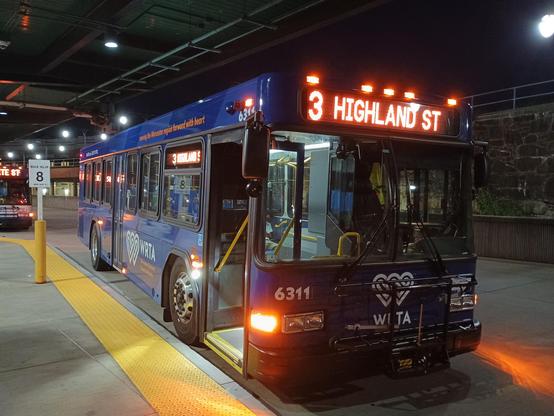
@coryw Meanwhile, out in the hinterlands, the #WRTA is looking especially handsome tonight. #Worcester #Transit #ILoveNewEngland