 PugJesus
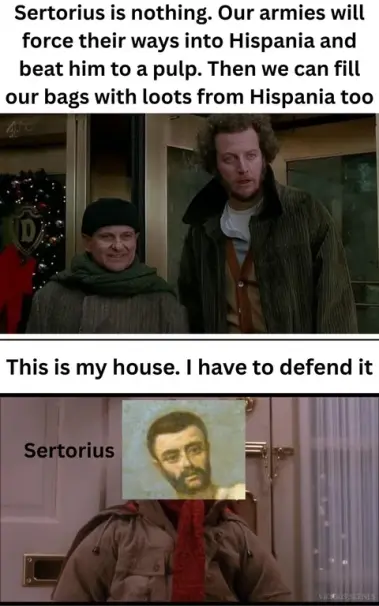
SERTORIUS AIN'T GIVING UP
https://piefed.social/c/historymemes/p/2076251/sertorius-ain-t-giving-up
SERTORIUS AIN'T GIVING UP
https://piefed.social/c/historymemes/p/2076251/sertorius-ain-t-giving-up
Explanation: Quintus Sertorius was a principled member of the populares (reformist) faction in the Late Roman Republic, a man noted for his military skill and his closeness with the common people. After the optimate (conservative) dictator Sulla returned to Rome at the head of an army to coup the populare government, Sertorius ended up taking command of populare forces in Roman Hispania (Spain and Portugal).
As the populares had been largely scattered and butchered by Sulla’s forces, it was considered that the expeditions to Hispania would be little more than a mopping-up operation.
They couldn’t have been more wrong.
Sertorius was not only a fierce and cunning military man, he was also a consummate and idealistic politician. The latter may seem like a disadvantage - and it certainly can be - but idealism can lend sincerity, and thus appeal, to one’s words and actions. Sertorius gained the attention of the provincials of Hispania by his rhetorical skill, and their loyalty by his principled dedication to republican norms. He invited the provincials into a Rome-away-from-Rome - a Republic in Spain with a Senate, assemblies, etc, operating as a government-in-exile for the optimate-couped Roman Republic.
This may seem small, but at the time, extension of political participation to the provinces was a deeply controversial position, even amongst the populares. Yet few things inspire loyalty like acknowledging the share people have in how they are governed - this is one major factor, for example, in the incredible endurance of mid-republic era Rome. If people feel that they are a part of the government, not just subject to it, they will associate its own success with their own, and fight the prospect of its failure as hard as they would fight against their own.
Armed with the loyalty of Hispania and a brilliant military mind, Sertorius held off for almost a decade after the rest of the populare government (many of the prominent figures at the time, mind, who were nowhere near as talented or as principled as Sertorius) in the Roman Republic had fallen or fled. Sertorius was a master of stratagems and used the talent of the tribes he allied with for ambushes and irregular warfare to great effect against the optimate Roman legions sent to reclaim Spain.
Unfortunately, he was still only in command of one province against a sprawling Mediterranean superpower, and that decade holed up in a province while the optimate hold on Rome failed to slacken would wear on many of the Romans under his command. Sertorius would eventually be assassinated by his most trusted lieutenant, who was convinced that he could do a better job of leading the Roman exiles in Spain.
Said lieutenant would be killed by the optimate government not even a year later.
 LegitimateEngineer