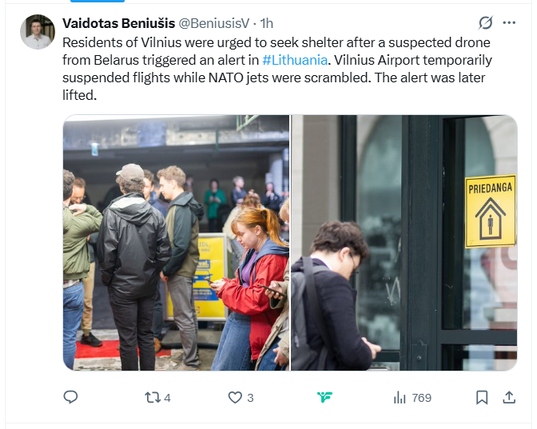
๐Ÿ‡ง๐Ÿ‡พ๐Ÿ‡ท๐Ÿ‡บ ๐—ฉ๐—ถ๐—น๐—ป๐—ถ๐˜‚๐˜€ ๐—จ๐—ป๐—บ๐—ฎ๐—ป๐—ป๐—ฒ๐—ฑ ๐——๐—ฎ๐—ป๐—ด๐—ฒ๐—ฟ ๐—”๐—น๐—ฒ๐—ฟ๐˜ | ๐Ÿฎ๐Ÿฌ ๐— ๐—ฎ๐˜† ๐Ÿฎ๐Ÿฌ๐Ÿฎ๐Ÿฒ

Lithuania activated its "unmanned danger" protocol this morning after radar detected a UAV-signature track originating from Belarusian airspace moving toward Vilnius.

Airspace was closed, flights diverted, and residents, schools, government offices and parliament sheltered in place or relocated to designated shelters.


The alert lasted almost an hour and officials did not announce the identity of the UAV.

The stray Ukrainian drone explanation that circulates by default after every Baltic incident doesn't hold here.

Ukrainian long-range strike packages route east and northeast toward Russian territory.

A Ukrainian UAV reaching Vilnius via Belarus requires a flight path with no operational logic.

An entry from Latvia could make geographic sense but not from Belarus.

Russia and Belarus launched joint nuclear forces exercises on 19 May, one day prior which included more than 64,000 personnel, 200-plus missile launch systems, 140 aircraft, and 13 submarines including 8 strategic nuclear boats.

The drills run through 21 May and explicitly include practice for the joint preparation and use of nuclear weapons deployed on Belarusian territory.

Belarus launched its own parallel exercise on 18 May focused on tactical nuclear combat use and delivery from unplanned sites.

A UAV track originating from Belarus on day two of those exercises is not an obvious candidate for a wayward Ukrainian drone.

#OSINT #Ukraine