 PugJesus
GOD WILL PROVIDE THE CRUSADE'S LOGISTICS
https://piefed.social/c/historymemes/p/2053026/god-will-provide-the-crusade-s-logistics
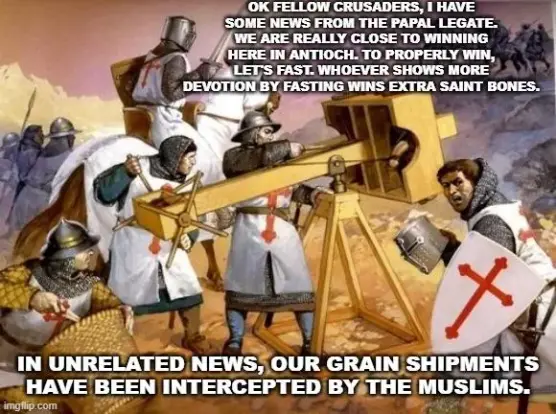
GOD WILL PROVIDE THE CRUSADE'S LOGISTICS
https://piefed.social/c/historymemes/p/2053026/god-will-provide-the-crusade-s-logistics
Explanation: Medieval European logistics were… primitive. And the logistics of the international and ad-hoc undertaking of the Catholic Crusades was doubly so. When called to arms, feudal polities generally did not have an actual system for feeding and supplying their troops - they just made arrangements as they went. Who paid for what was often a matter for argument, depending on the feudal contract, and part of why medieval European polities struggled to raise large armies or endure long campaigns.
In-line with this total lack of logistical organization, or organization in general, there are accounts during the Crusades of poor troops stealing food out of hunger during periods of garrison (not crisis) and being hanged for it - because their lords either could not or would not pay for their supplies, and there was no centralized system to ensure distribution of food - or even its availability. Even if most men in the army could afford food, even if the supply was not short in the local market, if you didn’t have money or connections, you were shit out of luck.
In the Crusades, matters were doubly borked since the primary recruiting method was not “We need X amount of armed recruits from Y region, and your duty as His Majesty’s vassal is to see it done, or else pay a fine”; but rather, “If you are willing, GOD NEEDS YOU TO RETAKE THE HOLY LAND!” Even for those who had a clear overlord who was crusading, and requested their presence, the logistical preparations were “You should take along about two years’ worth of money to buy supplies” rather than any organization of supply lines or depots who would be expecting to receive a sudden influx of mouths in a time of near-subsistence survival.
Not only did this mean that responsibility for many of the ‘soldiers’ coming along was unclear, but also that their usefulness in military operations was doubtful to begin with. Notably, a force of some 20,000-60,000 ‘Crusaders’, the People’s Crusade, was entirely obliterated by ~5,000 Muslim troops during the First Crusade.
… the Muslim polities they fought with were generally more organized. Surely the failure of 8 out of 9 Crusades is unrelated to this fact.
>Medieval European logistics were… primitive. No they were not. [https://books.google.com/books?id=BXQ3EAAAQBAJ&pg=PT206] This notion should look ridiculous on its face. If mediaeval European logistics were ‘primitive’ then it should immediately raise questions as to how the Crusaders managed to hold al-Quds/Jerusalem for decades and why the Mongols failed to conquer all of Europe. Unsurprisingly, BulldogMuhammad lacks the curiosity to raise these obvious questions. >When called to arms, feudal polities generally did not have an actual system for feeding and supplying their troops - they just made arrangements as they went. Tosh. Let’s take a break from the cartoons and consult a history book, shall we? Quoting Bernard S. Bachrach’s & David S. Bachrach’s Warfare in Medieval Europe, c.400–c.1453, pages 202–4 [https://books.google.com/books?id=BXQ3EAAAQBAJ&pg=PT251]: >[T]he crusades were no ordinary wars, and the provision of supply to western troops, who travelled many hundreds or even thousands of miles from home, required the organization of new logistical systems. Certainly, princes and kings were able to manage the logistics for their own military households in a manner consistent with ordinary warfare, while still in their home territories. > >Similarly, individual armed pilgrims could carry food with them as they marched to join larger crusader groups, much as they would have done if called up to perform expeditionary military duty in a war being conducted by their legitimate ruler. However, once these crusaders, whether as individuals, small groups, or entire military households, departed their home territories and began to run low on supplies that they could carry in packs, on animals, or even in vehicles, they required access to new sources of food, fodder, and potentially various types of equipment, as well. > >Moreover, these armed pilgrims faced the need to replenish their supplies without having any legal access to pre-existing or institutionalized systems of distribution. The logistical difficulties facing the crusaders were exacerbated by the vast number of people involved. Although scholars disagree about the overall number of pilgrims participating in all phases of the First Crusade (including the so-called People’s Crusade), the minimum figure presented by historians is in the range of 100,000, and some scholars argue for as many as 150,000 armed participants, which does not include many thousands more camp followers. > >In order to deal with the logistical needs of their men, all of the major magnates involved in the First Crusade made preparations long in advance of their scheduled departures in July 1096. The first step was to make agreements with the rulers of the territories through which they intended to travel. For Duke Robert of Normandy, Count Robert of Flanders, and Count Stephen of Blois, this meant making arrangements with the king of France; with a series of city-states along the Mediterranean coast of the Italian peninsula, including Genoa and Pisa; with the papacy; and with the Norman rulers of southern Italy and Sicily either to provide supplies or establish markets where supplies could be purchased. > >In the case of Duke Godfrey of Lotharingia (1087–1100), matters were complicated by the ongoing civil war in the German kingdom between King Henry IV, who was trapped in northern Italy, and the latter’s son Conrad, who had allied with various rebel factions in Germany, including Duke Welf of Bavaria. As a consequence, Godfrey, who also was hostile to Henry IV, made arrangements with Welf and also with King Colomon of Hungary (1095–1116) to establish markets to supply the Lotharingian duke’s troops. > >Once they arrived in the territory of the Byzantine Empire, supplies were provided by prearrangement by the government of Emperor Alexios Komnenos (1081–1118) until the fracture of the alliance between the crusaders and the Byzantines in the summer of 1098. Even Bohemond of Taranto, who had waged a war of conquest against the Byzantine Empire from 1080–1085, made arrangements with his erstwhile antagonist Emperor Alexios I Komnenos to provide supplies for his troops. > >The efforts of the crusader leaders to seek sources of supply along their routes, and particularly to ask for the establishment of markets, were quite successful. This is made clear by the rather small number of complaints in contemporary chronicles about violent foraging by the crusader armies led by western princes, or failures of supply leading to the collapse of the various crusader groups. > >As powerful princes, men such as Duke Robert of Normandy and Duke Godfrey of Lotharingia, had political and diplomatic connections that gave them the opportunity to write to other European rulers to explain their needs and ask for appropriate supply to be made available. This was not the case for individual pilgrims, or even groups of pilgrims, drawn from the minor nobility or especially the land-owning peasantry. > >It is therefore not surprising that from the beginning of the First Crusade, the great majority of the men from the lower social and economic ranks in society who actually survived the first leg of the journey to Constantinople did so by attaching themselves to the army of one or another of the princes. In effect, they became members of extended military households for the duration of the campaign, because this was the only way to survive. (Emphasis added.) The so-called People’s Crusade is the only phenomenon really consistent with the memester’s misconceptions, and I am guessing that the memester got said misconceptions from either outdated ‘classic’ history books or Monty Python and the Holy Grail—assuming that BulldogMuhammad can tell the difference between the two, which is a generous assumption. Otherwise, this meme is nonsense, and so is the accompanying explanation.
Holy shit, this guy is incredibly stupid, even by the low standards of tankies.
This notion should look ridiculous on its face. If mediaeval European logistics were ‘primitive’ then it should immediately raise questions as to how the Crusaders managed to hold al-Quds/Jerusalem for decades and why the Mongols failed to conquer all of Europe.
Does he not know what logistics are in a military sense? Does he not know what ‘primitive’ means in this context despite me immediately outlining what I meant by it? Does he not realize that ad-hoc logistics does not mean that starvation immediately sets in?
Me:
When called to arms, feudal polities generally did not have an actual system for feeding and supplying their troops - they just made arrangements as they went.
This far-right bootlicking chud, quoting an actual source which disproves me by… saying the exact same fucking thing I did:
[T]he crusades were no ordinary wars, and the provision of supply to western troops, who travelled many hundreds or even thousands of miles from home, required the organization of new logistical systems. Certainly, princes and kings were able to manage the logistics for their own military households in a manner consistent with ordinary warfare, while still in their home territories.
Similarly, individual armed pilgrims could carry food with them as they marched to join larger crusader groups, much as they would have done if called up to perform expeditionary military duty in a war being conducted by their legitimate ruler.
Moreover, these armed pilgrims faced the need to replenish their supplies without having any legal access to pre-existing or institutionalized systems of distribution.
The first step was to make agreements with the rulers of the territories through which they intended to travel. For Duke Robert of Normandy, Count Robert of Flanders, and Count Stephen of Blois, this meant making arrangements with the king of France; with a series of city-states along the Mediterranean coast of the Italian peninsula, including Genoa and Pisa; with the papacy; and with the Norman rulers of southern Italy and Sicily either to provide supplies or establish markets where supplies could be purchased.
Fascists are the same in any shade, it would seem. Morons, to the last.
LOL
btw did you already see this comment of hers? idk if its concern trolling or butthurt or what but I think somebody might be a little obsessed with you (among other things).
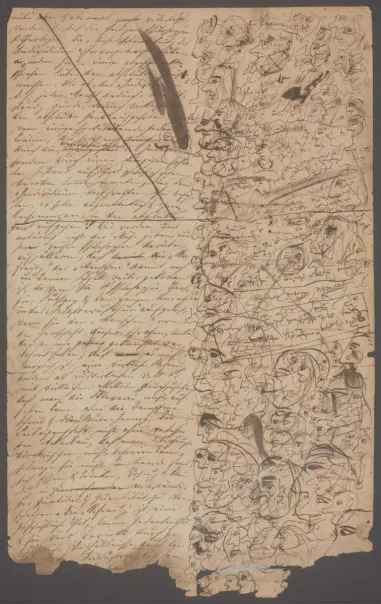
Thumbnail is Marx’s manuscript for The German Ideology. Summary below is a compilation of my notes I wrote when reading Materialism and the Dialectical Method [https://comlib.encryptionin.space/epubs/cornforth1953/] by Maurice Cornforth, along with general knowledge from reading various Marxist authors. Often times, Marxists use the term “material conditions,” and “dialectics.” What does this mean? Why do Marxists care so much about material conditions? The answer is that Marxists seek materialist explanations for observed processes as opposed to idealist, and do so dialectically, as opposed to metaphysically. In other words, Marxists apply dialectical analysis to find materialist explanations for phenomena. Dialectical materialism is the world outlook of the proletariat as a class, and serves as the most vital ideological tool for overthrowing capitalism. In order to understand dialectical materialism, we need to understand its component parts, materialism and dialectics, and their historical predecessors, idealism and metaphysics. *** # Idealism [https://lemmy.ml/pictrs/image/eb4a0933-3129-468e-869d-2ba598c044a7.jpeg] Idealism is, in short, to put ideas prior to matter. Idealism has been used by feudal lords to justify their position above the serfs, forming the ideological basis for feudalism. The 3 major assertions of idealism are as follows: 1. Idealism asserts that the material world is dependent on the spiritual 2. Idealism asserts that spirit, or mind, or idea, can and does exist in separation from matter. (The most extreme form of this assertion is subjective idealism, which asserts that matter does not exist at all but is pure illusion.) 3. Idealism asserts that there exists a realm of the mysterious and unknowable, “above,” or “beyond,” or “behind” what can be ascertained and known by perception, experience, and science. *** # Early Materialism [https://lemmy.ml/pictrs/image/c93a1859-cebb-435f-9df5-fd729757d4db.jpeg] Common idealist arguments are appealing to a supernatural “human nature,” or “good vs. evil” explanations for processes. Materialism arose over time, as people grew to understand the world more deeply, and especially as a tool to overthrow the feudal aristocracy that justified its existence via the church. In other words, materialism rose to help the bourgeoisie. The 3 basic teachings of materialism as counterposed to idealism are: 1. Materialism teaches that the world is by its very nature material, that everything which exists comes into being on the basis of material causes, arises and develops in accordance with the laws of motion of matter. 2. Materialism teaches that matter is objective reality existing outside and independent of the mind; and that far from the mental existing in separation from the material, everything mental or spiritual is a product of material processes. 3. Materialism teaches that the world and its laws are fully knowable, and that while much may not be known there is nothing which is by nature unknowable. *** # Shortcomings of Metaphysical Materialism [https://lemmy.ml/pictrs/image/19bfd580-ef8f-4dce-afe5-73e9c5f851b6.jpeg] The type of materialism that overthrew the feudal lords was still underdeveloped, and metaphysical. The bourgeoisie needed an explanation for why the feudal lords were illegitimate, but still needed to support their own static, permanent rule. This was called mechanistic materialism, for the bourgeois scientists saw the world as a grand machine repeating simple motions forever. Mechanistic materialism, therefore, makes certain dogmatic assumptions: 1. That the world consists of permanent and stable things or particles, with definite, fixed properties; 2. That the particles of matter are by nature inert and no change ever happens except by the action of some external cause; 3. That all motion, all change can be reduced to the mechanical interaction of the separate particles of matter; 4. That each particle has its own fixed nature independent of everything else, and that the relationships between separate things are merely external relationships. *** # Moving from Metaphysics to Dialectics [https://lemmy.ml/pictrs/image/8d77a74c-5859-4014-aebb-d5052c609c33.avif] This, of course, has proven false. History did not end with the dissolution of the USSR, despite what modern mechanistic materialists claim. Mechanistic materialism relies on metaphysics, seeing everything as a static abstraction, devoid of its context. It has no explanation for how new qualities emerge, and ultimately fell to idealism to explain the “first mover,” ie “God.” Dialectical materialism holds instead: 1. The world is not a complex of things but of processes; 2. That matter is inseperable from motion; 3. That the motion of matter comprehends an infinite diversity of forms which arise one from another and pass into one another; 4. That things exist not as separate individual units but in essential relation and interconnection. *** # Dialectical Materialism [https://lemmy.ml/pictrs/image/e5a79e07-790f-4079-9af7-93bf7bbdc6b7.jpeg] This became remarkable for the proletariat, as it sees nothing as static, and therefore marks the eventual downfall of the bourgeoisie. Putting it all together, we get the following: 1. Dialectical materialism understands the world, not as a complex of ready-made things, but as a complex of processes, in which all things go through an uninterrupted change of coming into being and passing away. In other words, when analyzing events and contextualizing them, we must always viee them as a struggle between the rising and the falling, the old and the new, for example the concentration of capital in markets and the rise in socialize labor. [https://lemmy.ml/pictrs/image/2b66a4af-3afe-4f75-b3bf-0f90a9c60eda.jpeg] 2. Dialectical materialism considers that matter is always in motion, that motion is the mode of existence of matter, so that there can no more be matter without motion than motion without matter. Motion does not have to be impressed upon matter by some outside force, but above all it is necessary to look for the inner impulses of development, the self-motion, inherent in all processes. In other words, all movement is a result of contradiction. Your foot presses on the Earth, and the Earth presses back on you. [https://lemmy.ml/pictrs/image/3656ac40-ca7f-4972-bdcd-6bfc3ed5d967.jpeg] 3. Dialectical materialism understands the motion of matter as comprehending all changes and processes in the universe, from mere changes of place right to thinking. It recognizes, therefore, the infinite diversity of the forms of motion of matter from the simple to the complex, from the lower to the higher. In other words, dialectical materialism recognizes that development exists as a change of quantity into quality. Addition or subtraction gives way to qualitative change. A balloon is filled with air, until at a given point it pops due to pressure buildup. Water goes from liquid to gas at its boiling point, and back into liquid when cooling down to said point. [https://lemmy.ml/pictrs/image/d16de8cd-d1a4-41f8-9354-3bc72a4a1da6.jpeg] 4. Dialectical materialism considers that, in the manifold processes taking place in the universe, things come into being, change and pass out of being, not as separate individual units, but in essential relation and interconnection, so that they cannot be understood each separately and by itself but only in their relation and interconnection. In other words, everything is connected, and must be analyzed in context to truly understand it. A worker isn’t just an individual, but instead part of a social class of many workers. Wages are not something invented brand new every time, but instead are set by societal standards, controlled by the ruling capitalist class. [https://lemmy.ml/pictrs/image/7f34b316-53d0-40fa-8720-0ec0786be269.webp] *** # Conclusion Karl Marx created dialectical materialism by turning Hegel’s idealist dialectic into a materialist one. Then, he applied it to the progression of society, creating historical materialism. By analyzing social structures and progress as a dialectical process based in materialism, we can learn from history and analyze where it’s going. This is scientific socialism in progress. Human thought is shaped by our social experience, forming class consciousness and ideology. How we produce and distribute determines our ways of thinking. Socialism and communism also have their own contradictions as well, and just because we progress on to socialism does not mean we cannot fall back to capitalism. The dialectical materialist world outlook understands that nothing is static, and there is always new contradiction and new movement from that. If you keep these in mind, you can do your own dialectical materialist analysis. Always seek explanations based on the material, not the ideal, and always do so by contextualizing the processes, analyzing their contradictions, the unity and struggle of opposing tendencies. Quantitative changes lead to qualitative development, and progresses as a result of the conflict or struggle of opposite tendencies. There’s much more to dialectical materialism, but this should help serve as a simple overview!
 Rodolfo Graziani