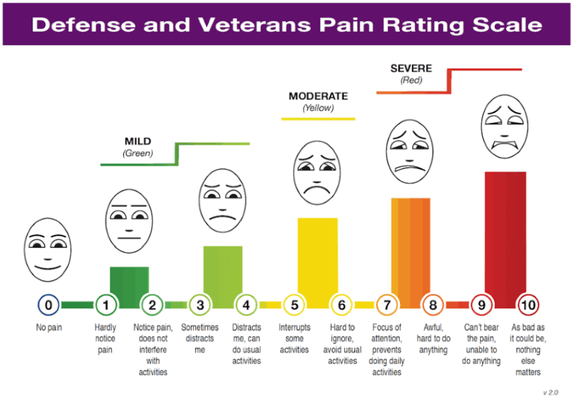
Periodic reminder that “rate your pain on a scale from 1 to 10" is bullshit without reference points. People with chronic pain, tough guys, people with intense periods, and people who struggle with interoception all struggle when the endpoints are nebulous.

Let me introduce you to the DVPRS: https://www.va.gov/WHOLEHEALTHLIBRARY/docs/Defense-and-Veterans-Pain-Rating-Scale.pdf

It even works if you substitute pain for general impact. If you're asked to rate a symptom on a scale from 1 to 10, this works too.

0 = No pain
1 = Hardly notice pain
2 = Notice pain, does not interfere with activities
3 = Sometimes distracts me
4 = Distracts me, can do usual activities
5 = Interrupts some activities
6 = Hardto ignore, avoid usual activities
7 = Focus of attention, prevents doing daily activities
8 = Awful, hard to do anything
9 = Can’t bear the pain, unable to do anything
10 = As bad as it could be, nothing else matters

10 is still pretty subjective there, but "nothing else matters" is clear enough, and really 9 or 10 isn't really a big difference in how much it matters clinically. (It tells the clinician if an intervention helps though)

@aredridel The DVPRS and similar versions of the pain scale which focus on the effects the pain is having have been a tremendous boon to communicating more effectively both in healthcare settings and in conversation with friends and family.

This page talks about the DVPRS, how it was created, how it's meant to be used, and so on:
https://www.disabled-world.com/health/pain/dvprs-2.php
At the end of the article, it also includes the supplemental DVPRS questions page which asks about impact on: activity, sleep, mood and stress.

DVPRS 2.0 Pain Scale Chart: Military & Veteran Pain Tool

Defense and Veterans Pain Rating Scale with functional descriptors and supplemental questions for pain impact, includes downloadable DVPRS 2.0 pdf chart.

Disabled World

@Texan_Reverend @aredridel Holy shit I always add +1 to my number because I know I minimize & am used to chronic but this makes me seem like I should’ve been adding +3-4 😭

10 is always described as worst pain imaginable to me and I’m like well I haven’t done and hopefully will never do birth or awake amputation so I would’ve put “nothing else matters” as my 7 but apparently not 🙃

@moss @Texan_Reverend @aredridel I have a chart with VERY UPSET frowny faces that basically distills this down into simple terms, and I always reference it if I'm asked that question. as someone who's operated a motor vehicle at a 10 I am not the best judge of this in a vacuum
@ldottxt @Texan_Reverend @aredridel Having it as a reference is so smart!! I need to put this into my planner so I can reference it too because lolsame twin
@moss @ldottxt I keep the various scale images in a specific gallery folder on my phone just for them. That way I can always find them easily when needed.

@moss @ldottxt @Texan_Reverend @aredridel In the planner! That's such a good idea, I'm doing it right now.

I have had this set of pain references for awhile and I find it so helpful (my whole fam gets migraines and our expectations around pain are out of whack). Love to see it going around

@moss Yeah, the two biggest purposes of the pain scales are to determine wherher you're in acute need of treatment and whether interventions have had a positive effect on lowering your pain.

The DVPRS and similar help patients do a much better job of communicating what clinicians actually need to know while also giving them a more powerful tool for self-advocacy, clarity of clinician expectations, and understanding of their own conditions.

@Texan_Reverend The interesting challenge here for the latter of if interventions are working is if I should continue my migraine calendar at my previous scale to not impact results or raise the numbers for accuracy 😂

Maybe I ask my Very Precise Neurologist who will balk at a question on subjectivity.

@moss If you're up for it, you might try including both numbers. One for the consistency of how you would normally rate it, and one with the updated number based on how it actually affected you that day.

This could also help you better understand how your longer-held internal scale relates to the impact scale.
(And maybe help you give yourself a little extra grace when you realize where those shake out and what they mean.)

@moss @Texan_Reverend Welcome to the start of taking your pain seriously. Time to take it to your doctor, say “I discovered I may have been under-reporting my pain” and go from there.