Yeah, he has gone pretty far around the bend.
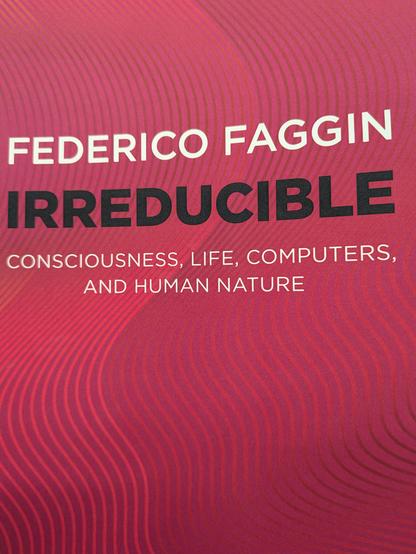
So, this is Federico Faggin's Irreducible: Consciousness, Life, Computers and Human Nature. I wouldn't call it a #HateRead, but maybe an #OhThatsNotRightRead. I'll put some comments here when I can, though I won't read it straight through.
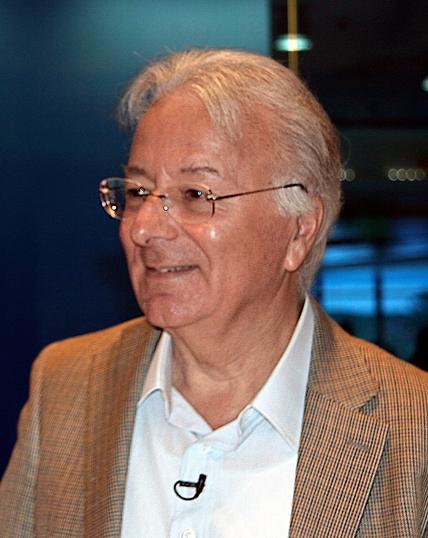
If you don't know Faggin, he should be a household name in the tech biz. One of the creators of MOS, the metal-oxide-semiconductor process, then of the microprocessor itself (though that has other contributors as well), then CEO of Synaptics, which pretty much controlled the track pad biz.
Also founded Zilog, of the Z80, my first microprocessor, along the way. A number of my friends went to work for Synaptics over the years. en.wikipedia.org/wiki/Federic...

Federico Faggin - Wikipedia

In 1990, according to the book, he had a spiritual experience in the middle of the night in a house at Lake Tahoe that convinced him that "everything is 'made of' love" (inner quotation marks are his).
"Quantum physics is already telling us that the universe is holistic and creative," um, no, I don't think it's telling us that. But yes, with his talk of The One, we are solidly in #panpsychism territory here. #OhThatsNotRight.
"[T]he universe itself is alive and conscious" is, in my limited understanding, one of the core tenets of #panpsychism. Faggin seems to jump from "I don't understand how consciousness arises in biological systems" to "therefore the universe is aware of itself" pretty quickly.

The latter strikes me as a much bigger claim, albeit one that is going to be a LOT harder to prove, even setting aside that we talk to each other and are willing to accept, at least provisionally, that others are conscious, whereas the universe doesn't exhibit any volition that I can detect.
Faggin's description of the history of physics, including 19th century physics and the working out of quantum mechanics, is serviceable but not what I would call sparkling. It sort of skips around rather than being either chronological or thematic.
It's pretty standard to say that the Michelson-Morley experiment and the ultraviolet catastrophe were two of the critical open problems at the turn of the 20th century, though I'm not sure everyone would say the photoelectric effect was also at the top of the list.
I do think his list of the key assumptions about the laws of the universe is retrofitted much later; I don't think the 19th century scientists understood it that way at the time.
Moreover, despite "the only thing left to do is measure more precisely" attitude, there was still quite a lot of unfinished physics at the time, including an explanation for the periodic table (developed in the 1860s), not understood until Bohr, Pauli and others in the 1910s and 20s.
But as a let's-get-this-over-with speed run through history, it's maybe not egregious. Others who are better scholars than I am might disagree, of course.
In Chapter 2, The Nature of Quantum Reality, we get a little foreshadowing of things to come, with explanations of entanglement and nonlocality that are unlikely to be understandable by those not already well versed in the concepts.
Mostly, it's not wrong, just not enlightening. But when he describes the hydrogen atom as something that arises out of entanglement between an electron and a proton, the collective heads of many physicists will hit their collective desks. #OhThatsNotRight
I think p. 45 in my edition, under something about monism, is the first time he uses the term "panpsychism".
The second half of Chapter 2 (remember, titled "The Nature of Quantum Reality") really goes off the rails, several pages of stuff on how we perceive reality and we understand it but a computer doesn't because it isn't conscious, cogito ergo sum. Not a quantum in sight, either.
Ch. 3, on digital computers, is rightfully Faggin's forte and so it's fine until he compares computers and living cells at the end.
Bedtime here, more some other time. Might have to skip forward a bit to get to the wilder stuff.
Ch. 4 starts out with Shannon's information theory, then winds up with just the bald assertion that humans "understand" what a symbol means, whereas a computer just transforms it into another symbol. No theory yet of what it means for a human to understand. Maybe in Ch. 5? #OhThatsNotRight
Ch. 4 gave us the one equation I_S = -log_2 p_x, information is the number of bits it would take to express the probability of the event, though he neglects to mention that the units are bits. From there, it's *straight* to humans have qualia and computers don't.
"Qualia refer to what it *feels like* in our inner experience", he says, though I have seen enough descriptions that I definitely don't fully understand how pros rigorously define it.
(Although, to be solipsistic about it, he has never proven to me that he has qualia, only that he can describe it, but I'm willing to give him the benefit of the doubt.)
He knows he's using two different definitions of information here, the technical number of bits involved in a message versus the human use of data placed in context to allow decision making, but he occasionally mixes them anyway.
Okay, Chapter 5, where he introduces "live information", is an absolute train wreck. I'm sure no living (!) biologist could get through it without serious damage to either their own brain or whatever object is in the book's flight path. #OhThatsNotRight
"matter, energy and information form a unit that I call 'live information'".
I am sacrificing brain cells and precious minutes of my remaining life to bring you this. I hope somebody's getting something out of it. #hateRead #OhThatsNotRight
"Live information [in the cell]...can only be explained with quantum physics." Technically true, but...but...
Still in Ch. 5, in only a few pages we have gone through "live information", the origin of human language, and end with a few paragraphs on #QuantumComputers that are, um, yeah, #OhThatsNotRight.
"Quantum information processing cannot be openly performed in spacetime with classical matter...So where does quantum computation take place? This question has puzzled physicists since the inception of this technology, but there is still no adequate answer." #QuantumComputing #OhThatsNotRight
In Ch. 6, The Nature of Life, which goes through prokaryotic to eukaryotic cells and a speculative (and I would guess not very accurate) outline of the evolution of life, before talking about the "consciousness" and "free will" of individual cells.
By now, his assertions that individual cells and even smaller units have consciousness and make decisions are getting kind of stale. He keeps promising to explain things, but never really does.