Reworked the 24-cell sketch, much easier to understand now.

Every one of the 12 visible #spinors has a button that brings the yellow spinor (the 1 state) to the clicked one because in 3D spinors double as rotations. (both are #quaternions so there exists a quotient between spinors, which is a rotation).

I think what's clear is that thinking in terms of a spinorial/rotational lattice makes things much easier to grasp than in terms of a vectorial/translational lattice
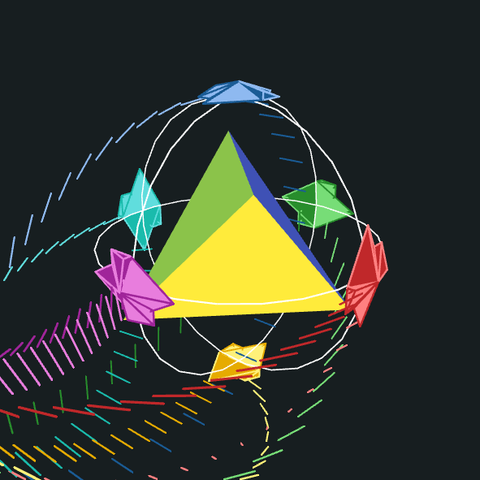

https://editor.p5js.org/aap/sketches/-N-Bnk_jn

Oh damn. i just realized the 3 in "3D space" and the 3 in "triality" are related. You can see the breaking up of the 24 into 3 groups of 8 each, corresponding to the 3 rows of buttons:

* a vector, 8 spinors aligned and anti-aligned with the z axis here, 4-fold phase multiplicity (180° apart)
* a right spinor, same with y axis
* a left spinor, same with x axis

i seriously did not expect it to be this plain. 3d space is truly marvelous

Actually reminds me a bit of the CPT triality of @Garrett, also very spatial or even quaternionic iirc?
Ah, in terms of the tetrahedral group the vector corresponds to the 180° rotations, and the left and right spinors to the clockwise and counterclockwise 120° rotations.
in one case the 4 (8 double covered) is related to the 3 dimensions of space + identity.
in the other cases the 4 is related to the 4 faces/vertices of the tetrahedron.
two different notions of 4 to give us two or even three different flavors of 8s in the 24-cell here. and this is nicely captured by a tetrahedron.
The fact that these three just map to ±xyz directions is totally wild to me as well
@aap Why thanks, it's my favourite space to live in. Feels like home.