 Ruby Jones
Progress on #MiniButt:
We now have slightly meatier thighs and the start of some abs.
Apologies for poor photography, it's so bright outside I couldn't see what I was doing. #WIP #WorkInProgress #art
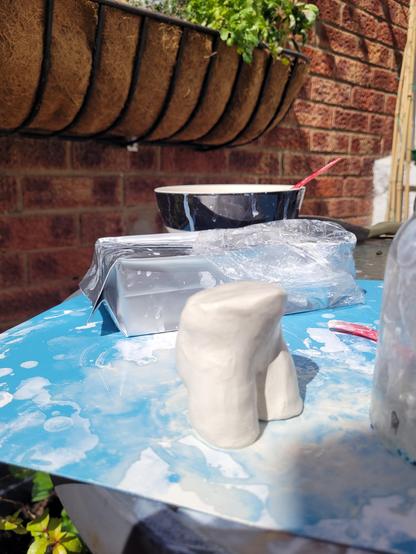
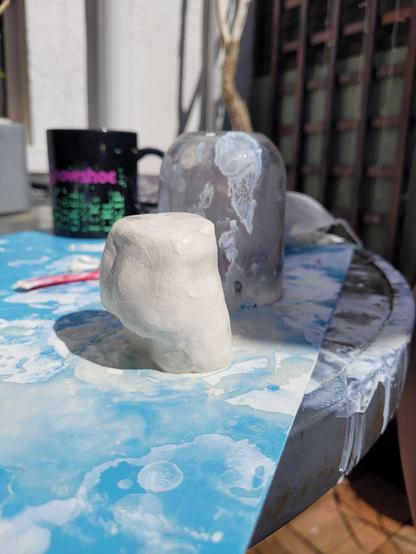
Progress on #MiniButt:
We now have slightly meatier thighs and the start of some abs.
Apologies for poor photography, it's so bright outside I couldn't see what I was doing. #WIP #WorkInProgress #art
So much of art is figuring out how to make the materials do what you want.
It isn't nearly as much about having a beautiful creative vision as people who don't create regularly seem to think.
This is why so-called 'AI art' is so empty. You didn't work out how to do that.
'I put in the right prompt.' So what? That is a tiny amount of effort, and largely uninteresting. All the thought and passion and creativity went into the millions of pieces you're stealing from.>
>'But it still looks beautiful!'
Sometimes! I'm not someone who is going to deny there's any aesthetic appeal to 'AI art'. But there's very little artifice.
I was initially intrigued - honestly, as a cognitive scientist I have been excitedly following this technology for years to see where it leads as it *does* mimic some aspects of how we believe thoughts and imagery are formed in the brain. That's really cool! It also hasn't changed much in 20 years.
What changed was wholesale theft.>
>And it's not remotely the same kind of 'learning' I get by viewing lots of art. To be frank: the human brain is massively more efficient. Just STAGGERINGLY more efficient than any LLM. Just think of the energy consumption alone!
And that's part of why it's so effective. Using and reusing neural pathways, exploiting feedback loops, constantly adapting - this is part of how we're able to make much more sophisticated connections, and ultimately the self-reflection that marks self-consciousness>
> I am gonna restrain myself from going down a philosophy of mind rabbit hole. Forcibly. I do not have the spoons to spend on that right now. But the main thing I was getting to with the efficiency is how *few* other works of art I have needed to view or study in order to make art myself.
And I have spent countless hours doing so. Visiting art museums. Drawing still lifes. Doodling.
But I was able to do that without stealing because I don't need the vast libraries required for machine learning
>Of course, I am constantly observing the world and getting three-dimensional sensory feedback about it. This is part of why I need fewer extent works of art to study. But it's also giving me something that the current state of 'AI' cannot achieve: the multi-modular, sensory, high-level analysis that gives rise to understanding.
That sees one butt and another butt and understands in what ways they are similar even if they look quite different.
A machine-learning model can learn to>
>sort and replicate shapes and tag some similar ones with the label 'butts' - you can train it to do that.
But it can never *recognise* (re-cognise) a butt. It cannot get to know butts. And it certainly can't be attracted to butts.
Which is why you get these (to a human) obvious gaffs where limbs start merging with the scenery, or there are too many of them. Because the machine doesn't have a concept of butts. It has millions upon millions of example images that it can deliver approximately>
>similar result too. But its success is judged on the likelihood that an arrangement or pixels will be accepted by a user as containing 'butts', not on any idea of what a butt is.
It crafts nothing. It imagines nothing. It creates nothing. It just automates shifting pixels around.
And the prompter applies a very tiny amount of craft composing their prompt. But even when they select a 'successful' one, that success is owed to the millions of mastercrafts people who have not been compensated.