> Mark Carney talks a big game about 🇨🇦's “climate leadership,” but he’s pouring public $ into new “nation-building” pipelines rammed through Indigenous lands.

Where Carney steps back, Indigenous communities are trying to step up, w/ > 2,000 renewable energy projects now owned/operated by Indigenous nations in 🇨🇦

Serena Mendizabal and Farron Rickerby-Nishi of Sacred Earth write that real climate leadership must mean federal investments in Indigenous-led renewable energy. https://breachmedia.ca/pick-a-path-there-is-no-energy-transition-without-indigenous-nations/
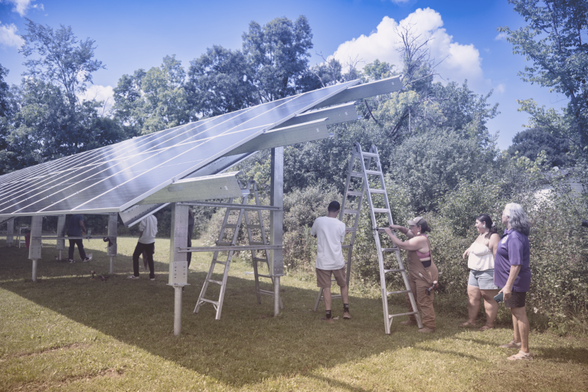

Pick a path: There is no energy transition without Indigenous nations ⋆ The Breach

Indigenous communities are not waiting for permission to start a green transition—they’re forging ahead. Will Canada follow, or stand in their way?

The Breach

If the 🇨🇦 federal government is serious about building anything resembling a just & durable energy future, it must confront the relationships at the core of this country. A true transition is not simply about changing fuel sources; it is about transforming power—political, economic, & territorial. That means centering nation-to-nation relationships with Indigenous peoples, not treating them as stakeholders in projects that are already predetermined.

#CanadianColonialism #EnergyPolicy #EarthDay

There are more than 200 medium- to large-scale renewable energy projects and over 2,000 small-scale initiatives that are owned or operated by Indigenous nations. These projects are not just about reducing emissions; they are about community control, local economic development, and long-term stewardship. They reflect values grounded in responsibility to land, water, and future generations.

This is what a real transition looks like: decentralized, community-driven, and rooted in sovereignty.

Yet federal policy continues to treat Indigenous participation in energy projects as a box to check rather than a foundation to build upon. Programs are underfunded, access to capital remains limited, and capacity-building investments fall far short of what is needed—especially for the fastest-growing population in the country.

If Canada is serious about its energy transition, it should commit at least $5 billion over five years to Indigenous-led renewable energy and capacity building, backed by accessible loan guarantees and coordinated federal-provincial strategies. Not as charity, but as a recognition of jurisdiction, rights, and opportunity.

Carney cannot claim to support reconciliation while advancing energy projects that violate Indigenous rights.

From LNG expansion in British Columbia to nuclear development in Ontario, his current approach continues to override Indigenous sovereignty. Across the country, communities are being pressured to accept projects—pipelines, mines, waste sites—that carry devastating, long-term risks to their lands and waters.

The push for nuclear expansion is a clear example. It is not just about the location of reactors; it is about whose lands will bear the consequences of the full lifecycle, from uranium extraction to the long-term storage of toxic waste. As the search for new sites to warehouse that waste continues, Indigenous communities are in an economic hostage situation: compelled to accept the destruction of their homelands in order to fund essential services in their communities.

Similarly, the rush for critical minerals risks replicating the same extractive logic that has defined Canada’s economy for generations. Once again, Indigenous territories are being targeted as resource frontiers. Some amounts of critical minerals are a necessary component of the energy transition, but we must ensure that critical minerals are developed with a clear-eyed prioritization of Indigenous rights and free, prior and informed consent.

Meanwhile, so-called climate solutions like carbon capture and storage risk entrenching the status quo. When industry groups talk about “decarbonized pipelines,” they are not proposing transformation—they are proposing continuity. Public money flows to these projects through subsidies and tax credits, while fossil fuel production expands.

Even as Carney speaks about a “new world order” and the urgency of climate action, funding for climate, environmental protection, and Indigenous programs is being cut or constrained. At the same time, billions continue to flow to fossil fuel subsidies and large-scale industrial projects.

This is not a transition—it is an attempt to tiptoe around oil and mining corporations while preserving existing power structures.

If Canada wants to be an energy superpower, it must answer a simple question: at whose expense?

Right now, the answer too often remains the same as it has always been: Indigenous lands, Indigenous rights, and Indigenous futures.

There is another way forward.

Indigenous-led renewable energy offers the potential for resilient, local systems that prioritize community benefit over corporate profit. It aligns climate action with economic justice. It builds capacity where it is most needed and returns decision-making power to those who have stewarded these lands for generations.

But this path requires choices.

It requires withdrawing subsidies from the fossil fuel industry and redirecting that capital toward Indigenous-led solutions. It requires respecting jurisdiction and building true partnerships based on consent. It requires confronting the harms of ongoing rights violations and taking meaningful steps to address them.

Most of all, it requires recognizing that Indigenous nations are not obstacles to the transition—they are its leaders.

Canada cannot have it both ways. It cannot claim climate leadership while undermining the very communities that are already showing what leadership looks like.

If we are serious about building a future that is sustainable, just, and credible, then the path is clear.

There is no energy transition without Indigenous peoples at the forefront. The solutions exist. The leadership exists. The land, as it has always been, is Indigenous.

The only question left is whether Canada is willing to follow—or continue to stand in the way.

Sacred Earth, an Indigenous women-led organization dedicated to advancing a just transition for Indigenous communities, is in Ottawa this week alongside 15 other organizations to meet with Members of Parliament and Senators, calling on the federal government to immediately invest in an east-west grid powered by renewables. You can learn more here: https://www.sacredearth.solar/resources

Resources — Sacred Earth

Sacred Earth
@adub Once a colonist...