 Hypx
HypxHow to generate hydrogen at home with recycled solar panels
 partial_accumen
This seems like a really inefficient way to make/store energy. It would only be worth doing if you specifically needed hydrogen for an application, but that isn’t the use case the article lays out:
This significantly exceeds the estimated baseline demand for basic household uses such as cooking or heating, which is approximately 120 liters per day.
Cooking and heating can be done simply with the raw electricity coming off the panels without any expense of hydrogen conversion equipment. The article also doesn’t call out that to produce hydrogen with an electrolyzer, you need to consume water too. The linked paper cites energy storage via hydrogen as a benefit, but again with conversion overhead, batteries connected to those panels would be a better solution.
So unless you need the chemistry of hydrogen for a specific process, this is a subpar solution compared to purely electrical solutions.
That’s liters of hydrogen not liters of water.
Yep, I understand that. I’m not referring to the amount of water consumed, but its introducing yet another unneeded complexity for the system. I didn’t even bring up the fact that those electrolyzer catalysts are likely a consumable part that need to be replaced at regular intervals.
The system generates more than enough hydrogen for daily use, so it is an effective use of abandoned solar panels.
Why not simply use the “abandoned solar panels” to generate electricity for immediate use or storage in a battery? That is a far FAR less complex system without all of the conversion losses this hydrogen solution introduces.
I didn’t even bring up the fact that those electrolyzer catalysts are likely a consumable part that need to be replaced at regular intervals.
PEM electrolyzers are not consumable parts and can last for decades.
Why not simply use the “abandoned solar panels” to generate electricity for immediate use or storage in a battery?
The point is that you avoid having to buy the electronic equipment for that. It says in the article:
Unlike conventional systems, which rely on power electronics such as inverters or maximum power point trackers, the approach uses internal reconfiguration of the PV module to match its current-voltage curve to the electrolyzer’s requirements. This removes the need for additional components and reduces system complexity, the scientists explained.
The point is that you avoid having to buy the electronic equipment for that. It says in the article:
So you’re avoiding buying an inverter, but you have to buy a PEM electrolyzer. But you also have to account for storage with either giant multi cubic meter low pressure hydrogen bags/tanks (how safe is that with the high combustion risk?), or you have to buy a compressor then multiple pressure vessels to store the hydrogen, but then you’re having to come of with another source of electricity to run the compressor pump.
It is possible that it will be the cheaper of the two options. A household-sized system is not an industrial system, and will be using much smaller and fewer components. You may even forgo the hydrogen tanks and compressor altogether, and use something like a metal hydride storage system instead.
It is possible that it will be the cheaper of the two options.
Okay here’s a self contained unit with 1KWh of batteries that can accept 500W of the “abandoned solar panels” input for use or charging the batteries.
Here’s an induction hotplate that can use the unit above’s electricity for cooking food at full blast for just under an hour on just stored electricity.
With this solution the only input is sunlight. There are no consumables. This unit is rated for 4000 cycles and is designed for a 10 year lifespan.
So your budget to beat a regular PV solution is $507 USD.
With that you need to provide a hydrogen solution that can:
- take the solar panel input
- store 1KWh of energy
- provide a cooking surface to cook food at high temperatures for about an hour
I’m interested to see what hydrogen solutions exist to do this for less money.
You’re ignoring the need for an invertor and other electronics.
A super scaled down version of a hydrogen electrolyzer plus storage system is not nearly as big as you think. Not impossible that it would fit in a backpack, and cost similar to what you’re proposing.
You’re ignoring the need for an invertor and other electronics.
I’m not. The Ecoflow is an inverter and battery all in one package.
A super scaled down version of a hydrogen electrolyzer plus storage system is not nearly as big as you think. Not impossible that it would fit in a backpack, and cost similar to what you’re proposing.
Your assertion was that the hydrogen solution would be cheaper with no regard to size. I’ve looked in the past and haven’t seen anything close for the performance or low cost. Please list a product(s) for sale showing this competitive price for equal performance.
Well then I retract my previous statement. However, your product is likely not something you would use in a home solar setup. This is more of a camper/RV power system. A real system would be significantly larger and more robust. Adjust costs accordingly.
Your assertion was that the hydrogen solution would be cheaper. I don’t really care about the size right now. I’ve looked in the past and haven’t seen anything close for the performance or low cost. Please list a product(s) for sale showing this competitive price for equal performance.
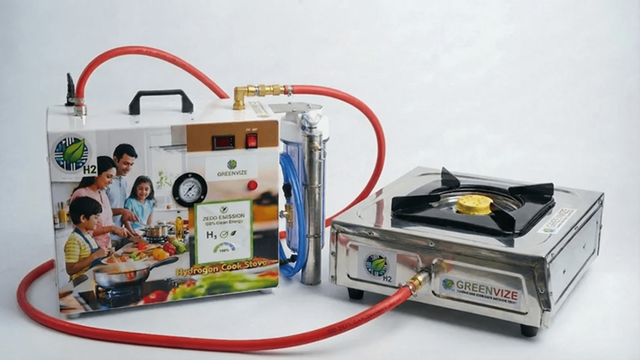
Looking around, it doesn’t seem like there is an equivalent product using hydrogen at the same price. The closest would be a self-contained hydrogen stove system, for around $1,100: https://interestingengineering.com/energy/plug-and-play-hydrogen-stove
I suppose that’s “close for the performance,” depending on your perspective.
Regardless, hydrogen systems are rapidly coming down in price. For instance, PEM electrolyzers are available for a few tens of dollars these days:
So I suspect we will see a hydrogen system for a similar price to what you are showing.
Well then I retract my previous statement.
First, I very much appreciate your honesty. I also appreciate that you showed the information for the parts to compete with my proposed electrical solution.
However, your product is likely not something you would use in a home solar setup. This is more of a camper/RV power system. A real system would be significantly larger and more robust. Adjust costs accordingly.
I agree with you on the scale of the electrical solution I showed. It is a very small setup, and I used that specifically because it was a simple all-in-one turnkey solution. Getting into a system large enough for a home gets more complicated because we have to raise questions about where that home is to design a solution. Different countries have different regulations as far was what equipment is used to comply with local codes and ordinances. The solar panels on my house in the USA and the batteries in my basement along with the support devices and wiring would be different in a country like Australia. The costs would be significantly lower too for an equally performing system in Australia.
I would love for home Hydrogen systems to offer a superior performance or pricepoint to current purely electrical ones, however I see that to be difficult simply with the require conversion losses for consumption. One angle Hydrogen could succeed is in energy storage assuming the technology is developed to do so where the Hydrogen would be used for combustion for home heating. However at this point I don’t know of any technology that would be even close to more efficient, better performing, or less expensive than many other non-Hydrogen solutions on the market right now.
I keep watching the space though and hoping Hydrogen can be a viable energy. I’m just not seeing it yet.
Just so we’re clear, we may eventually see something similar to your cheap all-in-one solution. We simply aren’t there yet technology-wise.
The main point is that hydrogen is totally feasible as a home energy storage system. It will make sense for some people or some situations, but not everyone or every situation.
The main point is that hydrogen is totally feasible as a home energy storage system.
Feasible in the sense that it would function and serve the purpose, I would agree. Feasible in the sense that Hydrogen is the best choice for the application is where I have my doubts.
It will make sense for some people or some situations, but not everyone or every situation.
I’m interested in when we arrive at a situation where its the best solution among all technology offerings. It will take some technological leap before I think that will happen though.