 PugJesus
"BUT WHERE IS THE GLORY WITHOUT THE GUNS AND THE EXPLOSIONS!?"
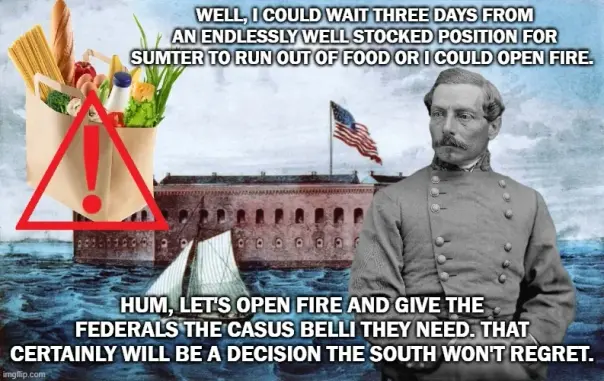
"BUT WHERE IS THE GLORY WITHOUT THE GUNS AND THE EXPLOSIONS!?"
Explanation: In the opening stages of the US Civil War, before the first shots of the war were fired, both the Union and the forming Confederacy were engaged in a cautious ‘battle’ of PR and politicking to appear the more ‘just’ cause in order to strike from a position of strength.
The Confederacy had blockaded Fort Sumter in South Carolina, which was held by pro-Union Federal troops, and already frightened off one supply ship (sent by the worthless pro-Southern president Buchanan in the Lame Duck period of his presidency). Fort Sumter was not really meant for a long-term siege (nor any Federal force truly prepared for a serious war at the time), and would soon run out of supplies.
The new president, Abraham Lincoln, gave orders for a ship to land provisions only, not ammunition or troops. A calculated move - attempting to stop the ship would not only be illegal (as the previous interception was), but also would put the Confederates in the position of a PR disaster, as such would blatantly admit the intention to starve out the Americans in Fort Sumter, not simply prevent the possibility of aggressive action.
In negotiations with the commanding officer of Fort Sumter, Major Anderson, the Federal forces openly admitted that they had only three days of provisions left, and that they would surrender in that time. It was viewed by the fort’s commander that to surrender without being attacked or being bereft of provisions would be in some way ‘dishonorable’ (a common view of the period), but that, at the same time, there was no real hope of holding the fort deep in rebel territory, outnumbered ~50-1.
This schedule was not fast enough for the Confederate rebels, and so they opened fire on Fort Sumter, giving President Lincoln the excuse he needed to openly resort to military force to crush the Confederacy, and Northern states, incensed at the attack on American troops, enthusiastically answered the call.
Both sides would enter thinking it would be a short war.
The US Civil War would last for four years, and result in more combat casualties for the Union than WW1 would some ~50 years later.