 supersquirrel
Mount Etna breaks volcano rules, tapping 80-kilometer-deep magma in a rare fourth category of eruption
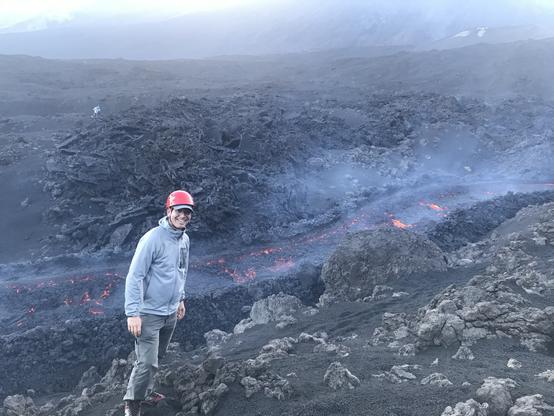
Mount Etna breaks volcano rules, tapping 80-kilometer-deep magma in a rare fourth category of eruption - Sopuli
link to open access paper… https://agupubs.onlinelibrary.wiley.com/doi/10.1029/2025JB032785 [https://agupubs.onlinelibrary.wiley.com/doi/10.1029/2025JB032785] [https://sopuli.xyz/pictrs/image/1ba6ef13-8f27-4476-91d2-565cb9522d97.webp] > Figure 1 >> Geological context and eruption rate for volcanism in East Sicily. (a) Simplified tectonic map of central Mediterranean area. (b) Map reporting the location of the volcanic products erupted during different periods of volcanic activity in East Sicily. These periods (Basal Tholeiitic, Timpe, Valle del Bove, and Stratovolcano) are referred as supersynthem stratigraphic unit in Mount Etna literature (Branca et al., 2011). Geological structures are from Mastrolembo Ventura et al. (2014). © Time averaged eruption rates versus age at Mount Etna. The values reported for the different supersynthem since 220 kyr are from Barreca et al. (2018), while the eruption rates for the basal tholeiitic period and the Hyblean Plateau are illustrative only. [https://sopuli.xyz/pictrs/image/ef34d8ea-1aa0-4585-b898-ae0dbb1bbd33.webp] > Figure 7 >> Evidence for the presence of low melt fraction at the base of the lithosphere and its implication for the origin of magmas erupted at Mount Etna. (a) Map of Central America subduction zone indicating the location of profile shown in panel ©. Modified from Naif et al. (2013). (b) Map of south Italy showing the location of the profile shown in panel (d). © Cross section showing resistivity ratio from inversion of the seafloor magnetotelluric data in front of the Central America subduction zone (Naif et al., 2013). The color scale gives log(ρy/ρx), where ρy and ρx are the electric conductivity measured parallel to the plate motion and parallel to the Nicaragua trench axis, respectively. Black dots indicate the distribution of earthquakes within the subducting Cocos plate. Figure modified from initial Figure 2b from Naif et al. (2013). (d) Cross section of offshore Sicily illustrating the potential importance of low degree melts to explain the formation of magmas erupted on the Hyblean Plateau and at Mount Etna. Dots report the location of Mv > 3 earthquakes reported in the Italian Seismic Instrumental and parametric database (ISIDE; available at http://iside.rm.ingv.it/ [http://iside.rm.ingv.it/]) projected on the profile reported in panel (a). Only earthquakes observed between longitude 14° and 17°E, and latitude between 36° and 40°N are reported. Earthquakes observed below Sicily mainland are reported in gray, while earthquakes associated to the subducting Ionian slab are color coded as a function of depth. The location of the subducting slab below the Tyrrhenian Sea is estimated from the locations of earthquakes as a function of depth. The melting zone at the base of the lithosphere is extrapolated from the zone observed for the Cocos plate subducting below Central America in panel ©. [https://sopuli.xyz/pictrs/image/9d288633-7fe7-4e75-b950-f0b4642a890a.webp] > Figure 10 >> Tectonic model for the magmatic evolution around Sicily and the formation of magmas at Mount Etna. (a, b) Paleogeography at 5 Ma associated with the formation of the Hyblean Plateau basalts. Subduction of the Nubia plate (northern margin of the African plate) beneath the Sicily block corresponding to the southern margin of the Eurasian plate flexures of the subducting plate. This flexure allows pre-existing melts at the top of the asthenosphere to interact with the lithosphere before being extracted to the surface. The controlling mechanism is similar to that observed off-shore Japan, where small volumes of alkaline magmas were released in a region of convex lithospheric flexure (Sato et al., 2018). (c, d) Paleogeography at 0.5 Ma corresponding to the onset of volcanic activity at Mount Etna. The first tholeiitic magmas at Mount Etna between 500 and 300 kyr are associated with the development of the Aeolian-Tindari-Letojanni (ATL) transtensional fault-System and Cefalù-Etna strike slip faults related to the differential subduction between the Hyblean Plateau stuck beneath Sicily, while the Ionian slab continues to rollback. The development of these fault systems promotes extraction of melts from the base of the lithosphere and controls their emission at the surface. The initial tholeiitic composition of Mount Etna lavas is explained by melt–peridotite interaction. (e, f) Current context at Mount Etna. GPS measurements show that ATL transtensional fault system accommodates the differential movement between south-west and north-east parts of Sicily (Mastrolembo Ventura et al., 2014). This extension, and the progressive formation of dunite conduits by focused melt flow allows the rapid extraction of low degree asthenospheric melts accumulated by plate flexure (Naif et al., 2013). This mechanism provides an explanation for the increasing volumes of alkaline magma observed at Etna since 60 kyrs. Tectonic constraints are from Dewey et al. (1989), Argnani (2009), Mastrolembo Ventura et al. (2014), Barreca et al. (2020), and references therein. Arrows in panel (e) show the relative average horizontal velocity of tectonic plates around Sicily with respect to the Eurasian plate (Mastrolembo Ventura et al., 2014).