kiyanwang
The Economics of Software Teams: Why Most Engineering Orgs Are Flying Blind
https://www.viktorcessan.com/the-economics-of-software-teams/
The Economics of Software Teams: Why Most Engineering Orgs Are Flying Blind
https://www.viktorcessan.com/the-economics-of-software-teams/
> The obvious objection is that code produced at that speed becomes unmanageable, a liability in itself. That is a reasonable concern, but it largely applies when agents produce code that humans then maintain. Agentic platforms are being iterated upon quickly, and for established patterns and non-business-critical code, which is the majority of what most engineering organizations actually maintain, detailed human familiarity with the codebase matters less than it once did. A messy codebase is still cheaper to send ten agents through than to staff a team around. And even if the agents need ten days to reason through an unfamiliar system, that is still faster and cheaper than most development teams operating today. The liability argument holds in a human-to-human or agent-to-human world. In an agent-to-agent world, it largely dissolves.
Then I'd wager it's the same for the courses and workshop this guy is selling...an LLM can probably give me at least 75% of the financial insights for not even .1% of what this "agile coach" is asking for his workshops and courses.
Maybe the "agile coach LLM" can explain to the "coding LLM's" why they're too expensive, and then the "coding LLM's" can tell the "agile coach LLM" to take the next standby shift then, if he knows so much about code?
And then we actual humans can have a day off and relax at the pool.
Exactly. I think it's been a while since I've read an LLM hot take which couldnt have been written by an LLM and this one is no exception.
There's a 99% chance that the training materials on sale are equally replaceable with a prompt.
They're buying a defensible (or laudable) justification when the training company's fee appears as a line item in the company budget.
This doesnt mean the training has to be good, useful or original in the slightest but the provider does need to have credentials which arent just "some dev with a hot take" that a fellow executive would recognize.
Ceding the premise that the AGI is gonna eat my job, my job involves reading the spec to be able verify the code and output so the there’s a human to fire and sue. There are five layers of fluffy management and corporate BS before we get to that part, and the AGI is more competent at those fungible skills.
With the annoying process people out of the picture, even reviewing vibeslop full time sounds kinda nice… Feet up, warm coffee, just me and my agents so I can swear whenever I need to. No meetings, no problems.
There’s gonna be one guy in charge of you, and he’s going to expect you to be putting out 20x output while thanking him for the privilege of being employed, assuming all goes the way every management team seems to want
I dont think this will happen because AI has become a straight up cult and things that are going well don’t need so many people performatively telling each other how well things are going.
> my job involves reading the spec to be able verify the code and output so the there’s a human to fire and sue.
So, you're the programmer (verify code) and the QA (verify output) and the project manager (read the spec)?
The PMs and QAs I know would disagree with that assessment.
> What would you trust more - an engineer doing project management too - or a project manager doing the engineering job?
If one of the three, {PM, QA, coder}, was replaced by AI, as a customer I'd prefer to pick the team missing the coder. But for teams replacing two roles with AI, I'd rather keep the coder.
But a deeper problem now is, as a customer, perhaps I can skip the team entirely and do it all myself? That way, no game of telephone from me to the PM to the coder and QA and back to me saying "no" and having another expensive sprint.
When I see someone just throwing a lot of numbers and graphs at me, I see that there are in to win an argument, and not propose an idea.
Of late, I've come across a lot of ideas from Rory Sutherland and my conclusion from listening to his ideas is that there are some people, who're obsessed with numbers, because to them it's a way to find certainty and win arguments. He calls them "Finance People" (him being a Marketing one). Here's an example
"Finance people don’t really want to make the company money over time. They just thrive on certainty and predictability. They try to make the world resemble their fantasy of perfect certainty, perfect quantification, perfect measurement.
Here’s the problem. A cost is really quantifiable and really visible. And if you cut a cost, it delivers predictable gains almost instantaneously."
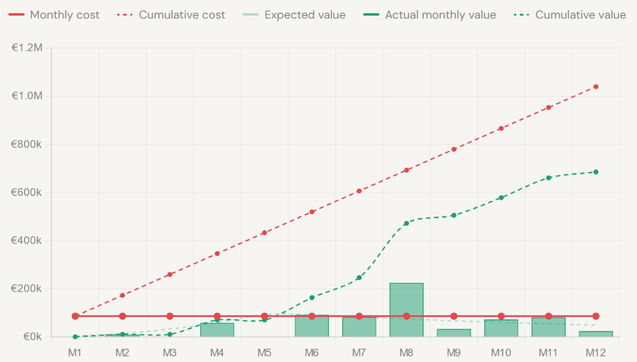
> Choosing to spend three weeks on a feature that serves 2% of users is a €60,000 decision.
I'd really want to hire the Oracle of a PM/ Analyst that can give me that 2% accurately even 75% of the time, and promise nothing non-linear can come from an exercise.
As with most things, isn't the truth somewhere in the middle? True cost/value is very hard to calculate, but we could all benefit by trying a bit harder to get closer to it.
It's all too common to frame the tension as binary: bean counters vs pampered artistes. I've seen it many times and it doesn't lead anywhere useful.
As with any attempt to become more precise (see software estimation, eg. Mythical Man Month), we've long argued that we are doing it for the side effects (like breaking problems down into smaller, incremental steps).
So when you know that you are spending €60k to directly benefit small number of your users, and understand that this potentially increases your maintenance burden with up to 10 customer issues a quarter requiring 1 bug fix a month, you will want to make sure you are extracting at least equal value in specified gains, and a lot more in unspecified gains (eg. the fact that this serves your 2% of customers might mean that you'll open up to a market where this was a critical need and suddenly you grow by 25% with 22% [27/125] of your users making use of it).
You can plan for some of this, but ultimately when measuring, a lot of it will be throwing things at the wall to see what sticks according to some half-defined version of "success".
But really you conquer a market by having a deep understanding of a particular problem space, a grand vision of how to solve it, and then actually executing on both. Usually, it needs to be a problem you feel yourself to address it best!
None of his math really checks out. Building a piece of software is or at least was orders of magnitudes more expensive than maintaining it. But how much money it can make is potentially unbounded (until it gets replaced).
So investing e.g. 10 million this year to build a product that produces maybe 2 million ARR will have armortized after 5 years if you can reduce engineering spend to zero. You can also use the same crew to build another product instead and repeat that process over and over again. That's why an engineering team is an asset.
It's also a gamble, if you invest 10 million this year and the product doesn't produce any revenue you lost the bet. You can decide to either bet again or lay everyone off.
It is incredibly hard or maybe even impossible to predict if a product or feature will be successful in driving revenue. So all his math is kinda pointless.
I think the only thing that matters is whether the people on the team care deeply about the product; whether they care more about the product than their own careers (in the short term). Without that, any metric or way of thinking can and will be gamed.
Unfortunately, even with all the management techniques in the world, there are just some projects that are impossible to care about. There’s simply a significantly lower cap on productivity on these projects.
> A messy codebase is still cheaper to send ten agents through than to staff a team around. And even if the agents need ten days to reason through an unfamiliar system, that is still faster and cheaper than most development teams operating today.
I’ve been on 2 failed projects that have been entirely AI generated and it’s not that agents slow down and you can just send more agents to work on projects for longer, it’s that they becoming completely unable to make any progress whatsoever, and whatever progress they do make is wrong.
Very much like humans when they drown in technical debt. I think the idea that a messy codebase can be magically fixed is laughable.
What I might believe though is that agents might make rewrites a lot more easy.
“Now we know what we were trying to build - let’s do it properly this time!”
Potentially, yes, but as with other software, you need to know AND have (automated) verifications on what it does, exactly.
And of course, make the case that it actually needs a rewrite, instead of maintenance. See also second-system effect.
>And of course, make the case that it actually needs a rewrite, instead of maintenance.
"The AI said so ..."
> Potentially, yes, but as with other software, you need to know AND have (automated) verifications on what it does, exactly.
Yes, but even here one needs some oversight.
My experiments with Codex (on Extra High, even) was that a non-zero percentage of the "tests" involved opening the source code (not running it, opening it) and regexing for a bunch of substrings.
> “Now we know what we were trying to build - let’s do it properly this time!”
I wonder if AI will avoid the inevitable pitfalls their human predecessors make in thinking "if I could just rewrite from scratch I'd make a much better version" (only to make a new set of poorly understood trade offs until the real world highlights them aggressively)
this is the part of the article that I did not sit well with me either. Code is agent generated, agent can debug it but will alway be human owned.
unless anthropic tomorrow comes in and takes ownership all the code claude generates, that is not changing..
Same here. I have now deleted 43k and counting lines of my codebase. There is no point in putting any AI code into production anymore as it almost always uses none or the wrong abstractions.
When you try to throw more agents at the problem or even more verification layer, you just kill your agility even if they would still be able to work
>I’ve been on 2 failed projects that have been entirely AI generated and it’s not that agents slow down and you can just send more agents to work on projects for longer, it’s that they becoming completely unable to make any progress whatsoever, and whatever progress they do make is wrong.
This rhymes a lot with the Mythical Man Month. There's some corollary Mythical Machine Month thing going on with agent developed code at the moment.
I thought it was a good article, till I saw the Slack example.
The copy doesn’t even remotely grasp the scale of what the actual Slack sofware does in terms of scale, relaiability, observability, monitorability, maintability and pretty sure also functionality.
Author only writes about the non-dev work as difference, which seems like he doesn’t know what he’s talking about in all, and what running an application at that scale actually means.
This "clone" doesn’t get you any closer to an actualy Slack copy than a white piece of paper