Even though I am generally interested in science and technology, I have found it impossible to get excited about Artemis II.

I'm not quite sure. Maybe it's because America isn't exactly my favourite country these days because ... well, you know why. Or maybe it's because, contrary to what I'd always assumed, these things are a lot more jingoistic than I thought. It's not "Mankind is going to the moon", it's "America is beating China to the moon".

#Artemis #Artemis2

@davidnjoku

Yup.

Related:
I never see any of the "I'm just excited about space progress and science!" crowd celebrating any of the Chinese space flight accomplishments.

They were silent when China landed a robot on the moon a few years ago. Silent when China landed a rover on Mars. Silent about the Chinese space station that's orbiting the planet. Silent about China's crewed mission to Mars that is on schedule to depart on 2033.

When they talk about space and science and exploration being "humanity's accomplishments," it's pretty clear who they're viewing as humanity. There's an era of cold war nationalism that feels yucky.

@mekkaokereke @davidnjoku

The reality behind the scenes is far, far more complex than this.

@cyberlyra @davidnjoku

Please say more?

@mekkaokereke @davidnjoku

Oh man. Where to start.

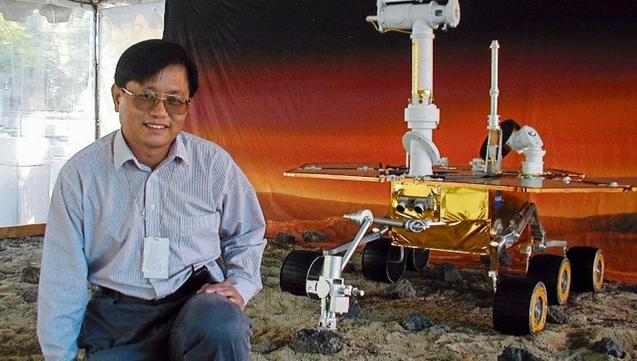
Most conspicuous ITAR, the International Traffic in Armaments Regulations, which covers defense tech as well as all space related technologies and their export. That includes ALL non-Americans. I wasn't allowed to be in many rooms at NASA during my fieldwork because as a Canadian citizen, that would be an export violation. The German team that built an instrument on a Mars Rover wasn't allowed to troubleshoot it when it broke because after delivery it became a NASA asset, so it was off limits. So was the lab printer.

On the scientific side, however, a majority of NASA-funded scientists do believe in a more Star Trek like vision of the future, in which national identities and creeds are put aside for a more egalitarian future for all humanity, even though that sounds corny. They also maintain major international collaboraitons. JPL teams were embedded with the Indian Space Research Agency for a recent massive joint mission, NISAR, and absolutely celebrated Indian achievements in space, as well as Japanese achievements.

Even during the height of the Cold War, NASA scientists maintained collaborations with those behind the Iron Curtain, including joint work with Russian scientists and even a (failed) joint mission to Mars in the early 1990's. The two main crew modules of ISS are built by the Russians and Americans respectively: one has the steering wheel and the other has the gas pedal, effectively, so they must collaborate.

All international collaborations must maintain assiduous dedication to those rules associated with exchange of technical information because the fines are multi-million dollars, and enormous. When NASA collabs with ESA (who built the propulsion unit for the Artemis II capsule) or JAXA or the ISRA, all of which they do continually and successfully (AND cheer for) they have to articulate very clear hand offs between one side and another.

@mekkaokereke @davidnjoku

There are thousands of Chinese students (and other internationals of course) at the American research institutes as graduate, postdoctoral, and undergraduate research assistants. This is also the case on NASA missions I have observed. They are considered part of the team. Like all other international groups, they can't see technical details.

At the same time, there are other issues afoot which trouble ITAR regulations. Ten years ago a major Mars researcher from China living in the US working on the Mars Rover projects disappeared from his post at a US university. A few years later and the Zhurong Rover China landed on Mars looks -- extremely suspiciously very much like the robots this researcher worked on. No country is allowed tech transfer of this kind. Even the ESA rover (under perpetual development) isn't an exact copy.

See: https://www.dispatch.com/story/news/crime/2015/09/08/fbi-investigates-china-ties-ohio/23633350007/

So on the one hand, you have these cases of close scientific collaboration. On the other hand, you have protection on the engineering side against cases of what look like industrial espionage in a highly regulated environment.

That isn't to say the US doesn't tip the scales in their favor. Space Law developed in the 1950s-1970s precluded equatorial countries from claiming the orbital space above their regions, for instance. That allows the US to say "space is for everyone" because it cannot be claimed by any country -- but it also allows for a current wave of commercial claimants who see open territory. I've written about this at https://www.techpolicy.press/in-the-twenty-first-century-space-is-the-new-railroad-for-billionaire-ambitions/

All that is to say, space is very, very complicated as an international domain of both collaboration and competition, and there are a lot of feelings and national regulations on all sides. NASA is not a singular culture or agency, and even as American scientists remain committed to a vision of internationalism in science, they also operate within a legal regime that imposes restrictions.

FBI investigates China ties of Ohio State professor who resigned, disappeared

Professor Rongxing Li was a star at Ohio State University, attracting international attention as he helped NASA rovers explore Mars in the past decade. Then, early last year, Li quit his post as OSU'…

The Columbus Dispatch

@mekkaokereke @davidnjoku I guess one more thing to note is that NASA is both a not-for-profit organization and (still) a civilian space agency. Although it deals in space and is therefore subject to defense regulations, it is not a defense agency or related to military aims, nor can it gain economically from going to space. That means NASA cannot go into space for anything other than peaceful or scientific reasons--unlike thousands of launches per year you never hear about that put up defense related technologies or private communications satellites.

NASA's goals include doing science, expanding space capabilities, and stimulating the American scientific and technical workforce and the US economy through outreach and contracting. Eve contractors don't make much money with NASA partnerships as they usually built one-offs, but see it as a pro-bono opportunity to push the boundaries and limits, think outside the profit-driven model, and have other metrics for success than return-on-investment.

All national space agencies also construct the political orientation of the nation through their scientific and technical goals and means, of course, and NASA is no exception. Going back to the original writings of James Webb as administrator in the 1960's, the challenge of doing civilian spaceflight in the USA is that a centralized authoritarian structure (he was thinking of the USSR at the time) would be more efficient, but less democratic. The challenge at NASA was to build capacity in a decentralized way that stimulated a national economy at the same time. That made "space age management" a challenge with political import, not just a question of getting into space (and back).

Much of this is at threat with the cuts to science at the agency and the massive reorientation toward "new space" entrants that allow for venture investment. The "space economy" is actually on earth - not in space - because of what they hope to stimulate through ROI.

So when they say "for all humanity" they are speaking to this core tension. Must be for science, for a greater mission, not military, not merely industrial, but for inspiration, while accepting that the reality is a complex set of tensions in which they must achieve the impossible

@cyberlyra Sorry for an off topic comment, but as a person with subject matter knowledge how do you rate For All Mankind? They extensively use a plot device between Soviet and American scientist collaborating to further space exploration. Is this something that’s plausibly anchored in reality? Of course if you haven’t seen it or isn’t in your interest please feel free to disregard this

@mojala I only watched the first few episodes, sorry. I did find it a fun counterfactual although there were many things they got wrong about how NASA works or how the science works.

The big collaborations between the US/USSR were in the late 1970's and 1980's, though -- the 60's were still the thick of the Cold War.

Also missing in that account was how the Americans had all those German engineers they poached from Europe working for them at the NASA propulsion centers. That's often ignored as part of the story, which gets glossed as America versus Russia.

One scientist who was a Jewish refugee I researched during this time (60's-70's) was dedicated to international work and collaborated with Russia and Japan in this period, finding it easier to build that international base of science than to work with Von Braun and many of the rocket scientists at NASA facilities.

@cyberlyra @davidnjoku I was wondering along similar lines in response to @mekkaokereke's posting on this topic: Does NASA maybe do a better job of publicizing their accomplishments than other space agencies?

Because NASA is always in queue for budget cuts they really have to make their benefit clear, so have incredible public relations that has been built and polished over decades. Their PR strengths both give politicians cover for voting for the budgeting, while also making voters more likely to support NASA's efforts.

I absolutely recognize that I heard less buzz about China's or India's space accomplishments because I mostly consume US-based media, but I imagine there must be an outreach component to it as well

@edgeworth @davidnjoku @mekkaokereke

NASA *has to* publicize because their funding is allocated annually by Congressional Committee. Public relations are everything for ensuring that their activities are talked about and the word is out about what they are doing and why they need continued funding.

The NASA logo is open source, any one can use it. It's one of the few brand icons in the world that anyone can put on anything to sell.

Another huge part of NASA's portfolio is education - so there has historically been a lot of public outreach in the K-12 and K-8 space in particular.

And because they have a lot of spin-off projects through NASA funding it's important to remind congressional representatives that the money to NASA is being distributed widely and is going into inventing things like velcro that people use every day.

There are also independent organizations like the Planetary Society that help get NASA's achievements out there, lobbying for support for civil spaceflight and science funding from Congress.

Unfortunately the budget cuts in the current administration are eviscerating Education and Public Outreach, a process that has been ongoing for a long time but is really accelerating now. We will see what this means for the future of NASA funding. The less money they have, the less they can tell you about what they are doing with US tax dollars -- which fuels a downward spiral in which we assume the only innovation is happening in places like SpaceX.