 supersquirrel
The Cascadia Subduction Zone isn't shutting down—but it's more complicated than previously thought
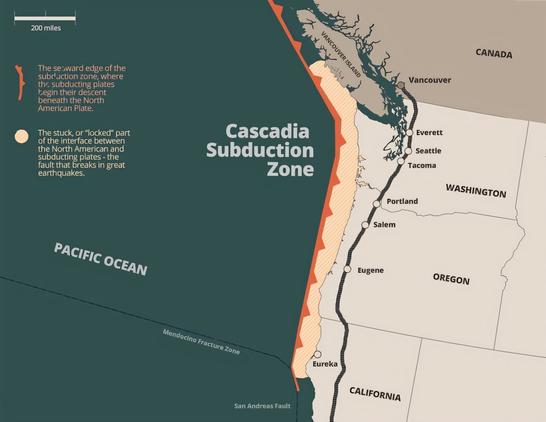
The Cascadia Subduction Zone isn't shutting down—but it's more complicated than previously thought - Sopuli
[https://sopuli.xyz/pictrs/image/4e7ef77b-c475-4baf-a7b8-dd4c71359585.webp] > Fig. 2. Seafloor expression of the NFZ in northern Cascadia. >> Map of seafloor scarps associated with active Nootka Fault Zone (NFZ) deformation. Color shading represents the gradient of seafloor bathymetry calculated from an azimuth of 300° clockwise from north using the Global Multi Resolution Topography version 4 grid (89). The scarps of the Northern Nootka Fault (NNF) and Southern Nootka Fault (SNF) have an average trend of ~N28°E. H, Haggis Mound; M, Maquinna Mound. Note that the NFZ is wider in the SW and narrows toward the deformation front in the NE. [https://sopuli.xyz/pictrs/image/68246ab6-6743-48a5-916a-a05b00fb2a58.webp] > Fig. 9. Slab fragmentation and cessation of subduction enabled by the NFZ. >> Schematic 3D interpretation of the NFZ-Exp-JdF triple junction region in northern Cascadia where subduction termination is imminent. The paleo-NFZ (thin black lines) developed as a broad shear zone in nascent oceanic lithosphere and reactivated inherited abyssal hill faults formed at the ridge. The weakened lithosphere buckled as a trench-parallel slab tear formed at the northern edge of the Exp slab and migrated across the paleo-NFZ wake. Recent strain localization along the modern NFZ at ~1 Ma dissected the migrating slab tear and effectively isolated the Exp microplate, leading to enhanced tearing, decoupling, and a local reduction in the slab pull force. The NFZ thus serves as a trench-normal segmentation boundary enabling piecewise slab fragmentation and subduction termination.