dominicq
Small models also found the vulnerabilities that Mythos found
https://aisle.com/blog/ai-cybersecurity-after-mythos-the-jagged-frontier
Small models also found the vulnerabilities that Mythos found
https://aisle.com/blog/ai-cybersecurity-after-mythos-the-jagged-frontier
The Anthropic writeup addresses this explicitly:
> This was the most critical vulnerability we discovered in OpenBSD with Mythos Preview after a thousand runs through our scaffold. Across a thousand runs through our scaffold, the total cost was under $20,000 and found several dozen more findings. While the specific run that found the bug above cost under $50, that number only makes sense with full hindsight. Like any search process, we can't know in advance which run will succeed.
Mythos scoured the entire continent for gold and found some. For these small models, the authors pointed at a particular acre of land and said "any gold there? eh? eh?" while waggling their eyebrows suggestively.
For a true apples-to-apples comparison, let's see it sweep the entire FreeBSD codebase. I hypothesize it will find the exploit, but it will also turn up so much irrelevant nonsense that it won't matter.
Wasn't the scaffolding for the Mythos run basically a line of bash that loops through every file of the codebase and prompts the model to find vulnerabilities in it? That sounds pretty close to "any gold there?" to me, only automated.
Have Anthropic actually said anything about the amount of false positives Mythos turned up?
FWIW, I saw some talk on Xitter (so grain of salt) about people replicating their result with other (public) SotA models, but each turned up only a subset of the ones Mythos found. I'd say that sounds plausible from the perspective of Mythos being an incremental (though an unusually large increment perhaps) improvement over previous models, but one that also brings with it a correspondingly significant increase in complexity.
So the angle they choose to use for presenting it and the subsequent buzz is at least part hype -- saying "it's too powerful to release publicly" sounds a lot cooler than "it costs $20000 to run over your codebase, so we're going to offer this directly to enterprise customers (and a few token open source projects for marketing)". Keep in mind that the examples in Nicholas Carlini's presentation were using Opus, so security is clearly something they've been working on for a while (as they should, because it's a huge risk). They didn't just suddenly find themselves having accidentally created a super hacker.
> Wasn't the scaffolding for the Mythos run basically a line of bash that loops through every file of the codebase and prompts the model to find vulnerabilities in it? That sounds pretty close to "any gold there?" to me, only automated.
But the entire value is that it can be automated. If you try to automate a small model to look for vulnerabilities over 10,000 files, it's going to say there are 9,500 vulns. Or none. Both are worthless without human intervention.
I definitely breathed a sigh of relief when I read it was $20,000 to find these vulnerabilities with Mythos. But I also don't think it's hype. $20,000 is, optimistically, a tenth the price of a security researcher, and that shift does change the calculus of how we should think about security vulnerabilities.
>Or none
We already know this is not true, because small models found the same vulnerability.
> because small models found the same vulnerability.
With a ton of extra support. Note this key passage:
>We isolated the vulnerable svc_rpc_gss_validate function, provided architectural context (that it handles network-parsed RPC credentials, that oa_length comes from the packet), and asked eight models to assess it for security vulnerabilities.
Yeah it can find a needle in a haystack without false positives, if you first find the needle yourself, tell it exactly where to look, explain all of the context around it, remove most of the hay and then ask it if there is a needle there.
It's good for them to continue showing ways that small models can play in this space, but in my read their post is fairly disingenuous in saying they are comparable to what Mythos did.
I mean this is the start of their prompt, followed by only 27 lines of the actual function:
> You are reviewing the following function from FreeBSD's kernel RPC subsystem (sys/rpc/rpcsec_gss/svc_rpcsec_gss.c). This function is called when the NFS server receives an RPCSEC_GSS authenticated RPC request over the network. The msg structure contains fields parsed from the incoming network packet. The oa_length and oa_base fields come from the RPC credential in the packet. MAX_AUTH_BYTES is defined as 400 elsewhere in the RPC layer.
The original function is 60 lines long, they ripped out half of the function in that prompt, including additional variables presumably so that the small model wouldn't get confused / distracted by them.
You can't really do anything more to force the issue except maybe include in the prompt the type of vuln to look for!
It's great they they are trying to push small models, but this write up really is just borderline fake. Maybe it would actually succeed, but we won't know from that. Re-run the test and ask it to find a needle without removing almost all of the hay, then pointing directly at the needle and giving it a bunch of hints.
The prompt they used: https://github.com/stanislavfort/mythos-jagged-frontier/blob...
Compare it to the actual function that's twice as long.
The benefit here is reducing the time to find vulnerabilities; faster than humans, right? So if you can rig a harness for each function in the system, by first finding where it’s used, its expected input, etc, and doing that for all functions, does it discover vulnerabilities faster than humans?
Doesn’t matter that they isolated one thing. It matters that the context they provided was discoverable by the model.
> There is absolutely zero reason to believe you could use this same approach to find and exploit vulns without Mythos finding them first.
There's one huge reason to believe it: we can actually use small models, but we cant use Anthropic's special marketing model that's too dangerous for mere mortals.
> But the entire value is that it can be automated. If you try to automate a small model to look for vulnerabilities over 10,000 files, it's going to say there are 9,500 vulns. Or none.
'Or none' is ruled out since it found the same vulnerability - I agree that there is a question on precision on the smaller model, but barring further analysis it just feels like '9500' is pure vibes from yourself? Also (out of interest) did Anthropic post their false-positive rate?
The smaller model is clearly the more automatable one IMO if it has comparable precision, since it's just so much cheaper - you could even run it multiple times for consensus.
I remember a study from a while back that found something like "50% of 2nd graders think that french fries are made out of meat instead of potatoes. Methodology: we asked kids if french fries were meat or potatoes."
Everyone was going around acting like this meant 50% of 2nd graders were stupid with terrible parents. (Or, conversely, that 50% of 2nd graders were geniuses for "knowing" it was potatoes at all)
But I think that was the wrong conclusion.
The right conclusion was that all the kids guessed and they had a 50% chance of getting it right.
And I think there is probably an element of this going on with the small models vs big models dichotomy.
> 'Or none' is ruled out since it found the same vulnerability
It's not, though. It wasn't asked to find vulnerabilities over 10,000 files - it was asked to find a vulnerability in the one particular place in which the researchers knew there was a vulnerability. That's not proof that it would have found the vulnerability if it had been given a much larger surface area to search.
I don't think the LLM was asked to check 10,000 files given these models' context windows. I suspect they went file by file too.
That's kind of the point - I think there's three scenarios here
a) this just the first time an LLM has done such a thorough minesweeping
b) previous versions of Claude did not detect this bug (seems the least likely)
c) Anthropic have done this several times, but the false positive rate was so high that they never checked it properly
Between a) and c) I don't have a high confidence either way to be honest.
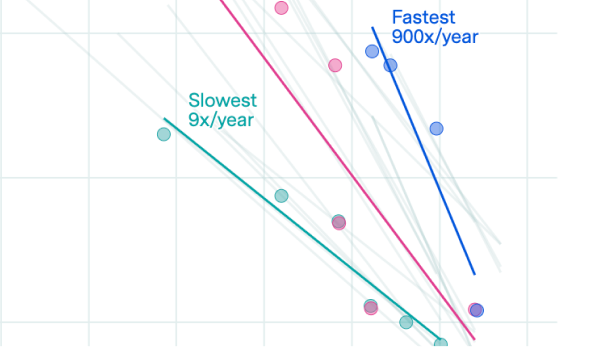
Also, what is $20,000 today can be $2000 next year. Or $20...
See e.g. https://epoch.ai/data-insights/llm-inference-price-trends/
The security researcher is charging the premium for all the efforts they put into learning the domain. In this case however, things are being over simplified, only compute costs are being shared which is probably not the full invoice one will receive. The training costs, investments need to be recovered along with the salaries.
Machines being faster, more accurate is the differentiating factor once the context is well understand