In February 2004, American aircraft landed in Port-au-Prince and, by morning, Haiti’s elected president Jean-Bertrand Aristide was gone. Haiti isn’t an exception. It’s part of a longer history of the U.S. removing democratically elected governments when they conflict with U.S. strategic or economic interests.

#history

1/11

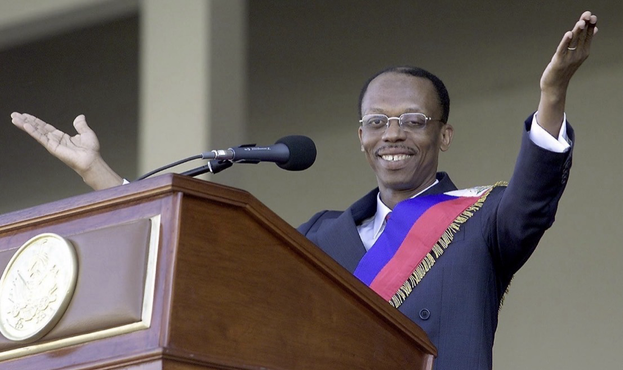
Image: Jean-Bertrand Aristide celebrates inauguration as Haiti’s first democratically elected president in decades, Port-au-Prince, 1991. Photo: Associated Press.
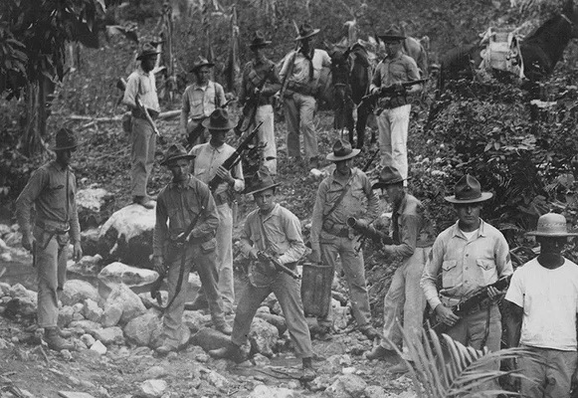
In Haiti, that pattern stretched back decades. U.S. Marines first entered in 1915 and remained for 19 years, rewriting the constitution, taking control of customs and the treasury, and building the military institution that would dominate Haitian politics long after the occupation formally ended.

2/11

Image: U.S. Marines search for Haitian rebels in 1919. U.S. National Archives.

That military repeatedly shaped who could rule. In 1991, only months after Aristide’s first democratic victory, soldiers forced him from office. By 2004, armed rebels—many veterans of earlier coups and paramilitary campaigns—were again moving toward Port-au-Prince as American forces returned.

3/11

Image: Soldiers of C Company, 2nd Battalion 22nd Infantry, 10th Mountain Division securing Port-au-Prince Airport on the first day of Operation Uphold Democracy, Sept. 22 1994, Wikimedia Commons.

Before sunrise, Aristide was escorted onto a waiting plane and flown out of the country he had been elected to lead. By morning he was gone. Haiti was not an exception, but part of a recurring history in which democracy abroad has often been tolerated only when it aligned with American interests.

4/11

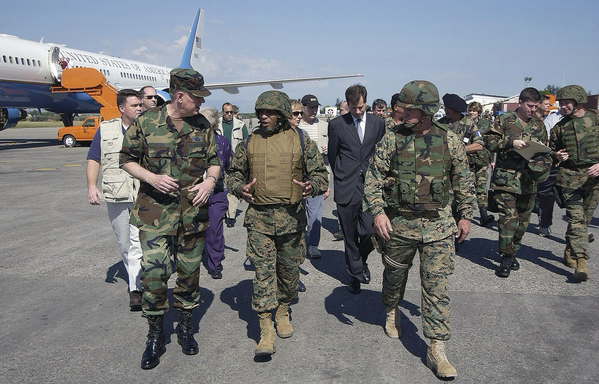
Image: Chairman of the Joint Chiefs of Staff Richard B. Myers talks with Brigadier General Ronald S. Coleman after disembark from Toussaint Louverture IAirport 13 March 2004. Wikimedia Commons.

Intellectual Map

The Haitian Revolution

Blackburn, Robin. The Overthrow of Colonial Slavery, 1776–1848. London: Verso, 1988.

Dubois, Laurent. Avengers of the New World: The Story of the Haitian Revolution. Cambridge, MA: Belknap Press, 2004.

Fick, Carolyn E. The Making of Haiti: The Saint Domingue Revolution from Below. Knoxville: University of Tennessee Press, 1991.

Geggus, David Patrick. Haitian Revolutionary Studies. Bloomington: Indiana University Press, 2002.

5/11

More Sources

James, C. L. R. The Black Jacobins: Toussaint L’Ouverture and the San Domingo Revolution. New York: Vintage Books, 1989. Originally published 1938.

Popkin, Jeremy D. A Concise History of the Haitian Revolution. Malden, MA: Wiley-Blackwell, 2011.

Dubois, Laurent. Haiti: The Aftershocks of History. New York: Metropolitan Books, 2012.

6/11

Still more sources

Girard, Philippe R. Haiti: The Tumultuous History—From Pearl of the Caribbean to Broken Nation. New York: Palgrave St. Martin's Griffin, 2010.

Heinl, Robert Debs Jr., and Nancy Gordon Heinl. Written in Blood: The Story of the Haitian People, 1492–1995. Lanham, MD: University Press of America, 1996.

Trouillot, Michel-Rolph. Haiti: State Against Nation: The Origins and Legacy of Duvalierism. New York: Monthly Review Press, 2000.

7/11

And more

Nicholls, David. From Dessalines to Duvalier: Race, Colour and National Independence in Haiti. Cambridge: Cambridge University Press, 1979.

Renda, Mary A. Taking Haiti: Military Occupation and the Culture of U.S. Imperialism, 1915–1940. Chapel Hill: University of North Carolina Press, 2001.

Schmidt, Hans. The United States Occupation of Haiti, 1915–1934. New Brunswick, NJ: Rutgers University Press, 1971.

8/11

And more than that

Plummer, Brenda Gayle. Haiti and the United States: The Psychological Moment. Athens: University of Georgia Press, 1992.

Dupuy, Alex. Haiti in the World Economy: Class, Race, and Underdevelopment since 1700. Boulder, CO: Westview Press, 1989.

Dupuy, Alex. The Prophet and Power: Jean-Bertrand Aristide, the International Community, and Haiti. Nee York: Rowman & Littlefield Publishers, 2006.

Farmer, Paul. The Uses of Haiti. Monroe, ME: Common Courage Press, 1994.

9/11

Still more after that

Hallward, Peter. Damming the Flood: Haiti, Aristide, and the Politics of Containment. London: Verso, 2010.

Fatton, Robert Jr. Haiti’s Predatory Republic: The Unending Transition to Democracy. Boulder, CO: Lynne Rienner Publishers, 2002.

Reports and Primary Documentation

United Nations Security Council. "Report of the Secretary-General on Haiti." New York: United Nations, 2004
https://digitallibrary.un.org/record/519750?v=pdf

10/11

Additional primary documentation

Organization of American States. "Report on the Situation of Human Rights in Haiti." Washington, DC: Organization of American States, 2002.
https://www.oas.org/en/iachr/reports/pdfs/2023/Informe_Haiti_EN.pdf

Journalistic and Contemporary Accounts

BBC News. “Profile: Jean-Bertrand Aristide.” BBC, March 2011.
https://www.bbc.com/news/world-latin-america-12633115

Pollen, Lydia and Weiner, Tim. "Haiti's President Forced Out; Marines Sent to Keep Order.” The New York Times, February 29, 2004.
https://www.nytimes.com/2004/02/29/international/americas/haitis-president-forced-out-marines-sent-to-keep.html

11/11